[unable to retrieve full-text content]

[unable to retrieve full-text content]
On this backdrop, the Jewish Federations of North America (UJA) held their annual General Assembly meeting in Tel Aviv last month under the title "We Need to Talk." This title says more about the crisis and the need to resolve it than a 1,000 testimonies.

Participants of Taglit-Birthright project (file photo)
"Israel is a holy homeland to all Jews," declared Eric Goldstein, the CEO of the Jewish Federation of New York, in an interview with Ynet. "I think any declaration or policy that erodes this statement hurts the ties between American Jews and Israel."
Jay Sanderson, the president and CEO of the Jewish Federation of Los Angeles, takes a more conciliatory tone. "The ties between Israel and the Diaspora are not based on one case, a specific declaration or a certain decision. It is the mission of all of us to work hard to create the strongest bond between the two," he said.
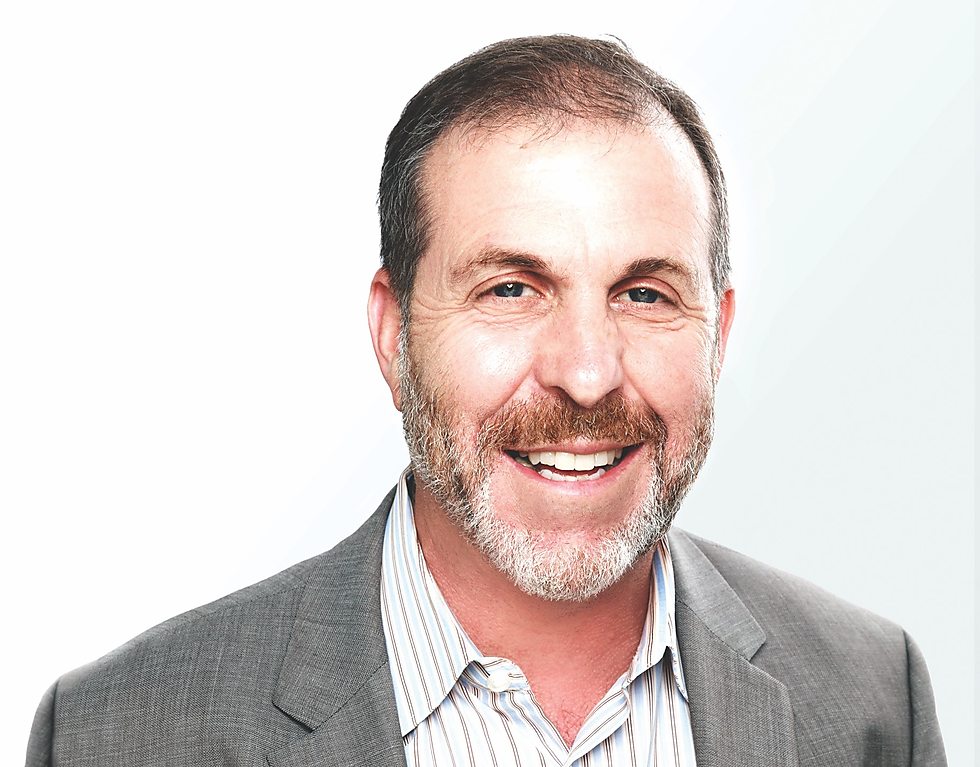
Jay Sanderson, the president and CEO of the Jewish Federation of Los Angeles
Englander cautioned against Israel investing only in its ties with the Orthodox Jewish communities in the Diaspora and not with the Reform or Conservative movements. "Outside Israel, the Orthodox communities make up only 10 percent. So ignoring the other communities means canceling the ties with 90 percent of Diaspora Jews, meaning half of the entire Jewish people," he said.

Shep Englander, the CEO of the Jewish Federation of Cincinnati
Sanderson agreed. "We must not label or judge any Jew, wherever he may be. We need strong and varied communities—both in the US and in Israel," he said.
Naomi Adler, the president and CEO of the Jewish Federation of Philadelphia, said the ramifications of the crisis between the Diaspora and Israel are felt on the ground. "Philadelphia is a very pro-Israeli community, regardless of the political leanings of each of the members. But when a minister in the (Israeli) government or a member of Knesset says something against the way we pray and express our Judaism, it emphasizes the fact they think we're not their equals. It causes pain, confusion and distress for many Jews in our area," she explained. Goldstein asserted that "such statements indicate a lack of understanding about the state of the Jewish communities in the US today, and the importance of other denominations of Judaism. It indicates a need for more meetings and a stronger bond between Israelis and the communities in the US."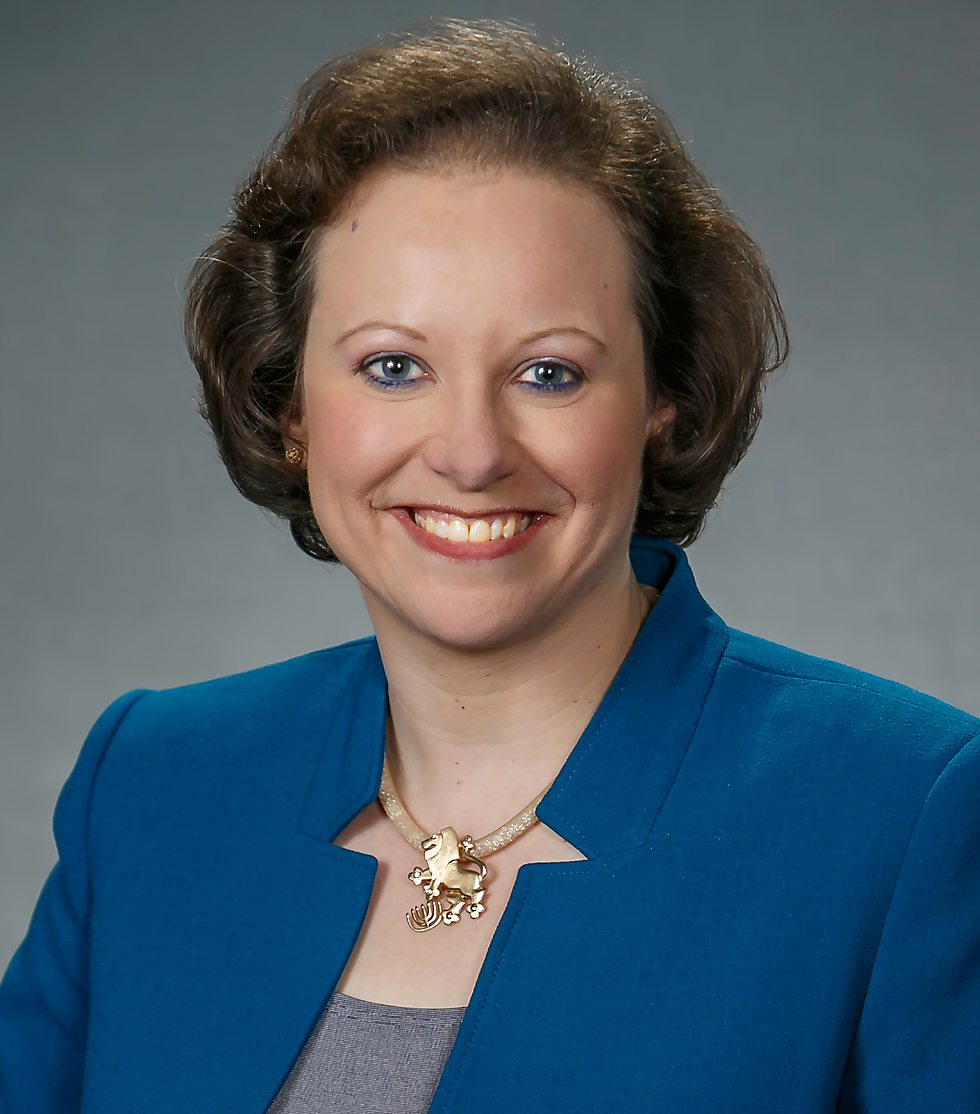
Naomi Adler, the president and CEO of the Jewish Federation of Philadelphia
Most of the heads of the Federations represent the older generation of American Jews, who were raised with the image of Israel as the tiny and fragile country that rose out of the ashes of the Holocaust. One of the real challenges in Israel-Diaspora relations is preserving the ties with the younger generation of American Jews, those who know Israel as a strong and independent nation that perhaps doesn't need as much support from the Diaspora.
Englander claimed the Taglit-Birthright project has brought a record number of young American Jews to visit Israel, but the ones who only learn about the Jewish state via the media or on college campuses are not as inclined to show solidarity with it.

Young Americans receive a warm welcome at the airport
Goldstein, meanwhile, sees an interesting opportunity in the younger generation. "I think young people connect to Israel in other ways, and that is a good thing. The younger generation needs to find its own personal bond to Israel," he said. "The challenge is to find ways to get them involved in the future of the state, even if they don't agree (with the Israeli government) on all issues."
Sanderson says that if Israel is concerned about its connection with the younger generation, the state must be part of the solution: "We need more visits by young Americans in Israel—and also visits by Israelis in the United States. We make sure to send young Americans to Israel through programs like Taglit-Birthright Israel, Masa Israel Journey and others. This is a big part of the solution.
According to Adler, they discovered that "if we present quality interactions with Israel, these young adults show enthusiasm about the journey and feel a strong connection to the country. Some delegations return from Israel full of passion about their journey."
What about maintaining the relationship? At this point everyone is optimistic, but they have a sharp message to deliver: "For years we taught the community in New York about Israel and the Israelis," Goldstein says. "The time has come for Israel to do her part. Israelis must be exposed to the diversity of Judaism and the possibility of establishing, from an early age, meaningful ties with Diaspora Jews."
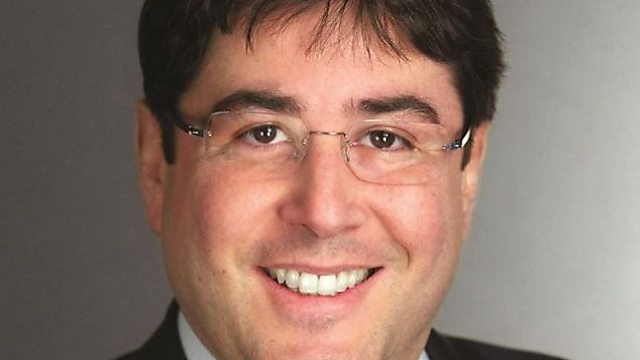
Eric Goldstein, the CEO of the Jewish Federation of New York
Sanderson agrees that this is the answer: "Just as Diaspora Jews come to experience Israel, Israelis need to experience Diaspora Jewry, not just by visiting tourist sites, but by getting to know the customs and experiences of American Jews."
"Visit us, stay with Jewish families and experience as many Judaism types as possible in various communities. We will listen more to each other, we will call and visit," said Englander.
"Just come back with Jewish leaders from around the world, and you'll see how strongly connected they are to Israel," Adler concluded.
American Jews 'love Israel, but feel less welcome' : https://ift.tt/2qzF6LMAfter their last project was stolen, about a month and a half ago, David Roytman and his collegues did not give up and set out to build the world's largest mezuzah. Last weekend their creation was inaugurated in an impressive ceremony in Jerusalem.
The piece is almost two meters tall and roughly 200 kilograms in weight. It was placed in one of the holiest locations in the world—on the rooftop of Yesh A'Torah Yeshiva, near the Western Wall and the Temple Mount.
The world's largest mezuzah, Jerusalem
The mezuzah is a complete pyrotechnical show. It includes a lighting show with dozens of flickering LED screens, and it can even sing "Jerusalem of Gold" (performed by Shuli Natan).
The original mezuzah was stolen from the factory shortly before its launch in September. Roytman filed a police complaint , but says half a year's work and tens of thousands of dollars were lost. Neverthelss, since the plans were already in place, he and his partners worked hard and created a new one.
"The klaf (a piece of parchment inscribed with specific Hebrew verses) will soon be inserted into the mezuza," promised Roytman, a native of Odessa who became religious in Soviet Ukraine. He immigrated to Israel without his parents when he was 11-year-old, as part of the Chernobyl Children's Project. In Israel, the desinger continued his studies in a yeshiva until his enlistment in the IDF.
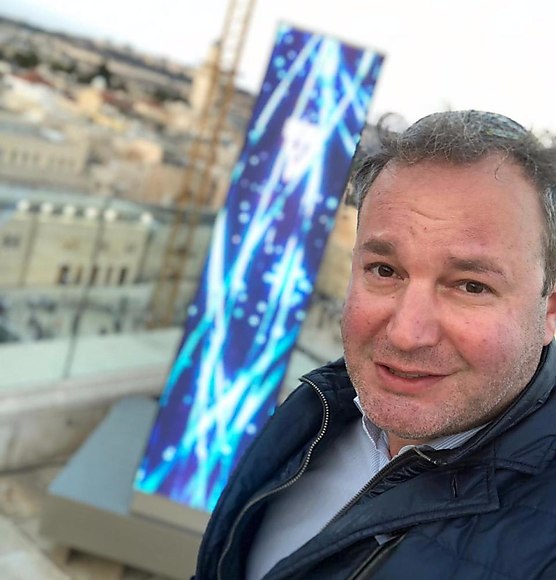
Designer David Roytman
Roytman soon became a famous designer of fine Judaica art. One of his products, for example, a line of expensive leather kippahs, costs thousands of dollars.
The designers behind the project promised to officially apply to the Guinness Book of Records..If the dimensions given by Roytman and his collegues are accurate, it might officially become the largest mezuzah in the world, since other mezuzahs competing for the title are only a 1.5 meters tall.
.
"Yit'gadal v'yit'kadash sh'mei raba," read the front page of the Pittsburgh Post-Gazette—the largest and most popular newspapers in the region —which was devoted entirely to marking the one-week anniversary of the Tree of Life synagogue shooting in Pittsburgh.
The quote, written in Hebrew, is the first line of the Kaddish mourners' prayer, and in English translates to: "May His great name be exalted and sanctified..."
The unusual story inspired other national media outlets. NBC News, for example, finished its Friday news edition with a special gesture—the Kaddish prayer, read in full, and accompanied by pictures of the victims.
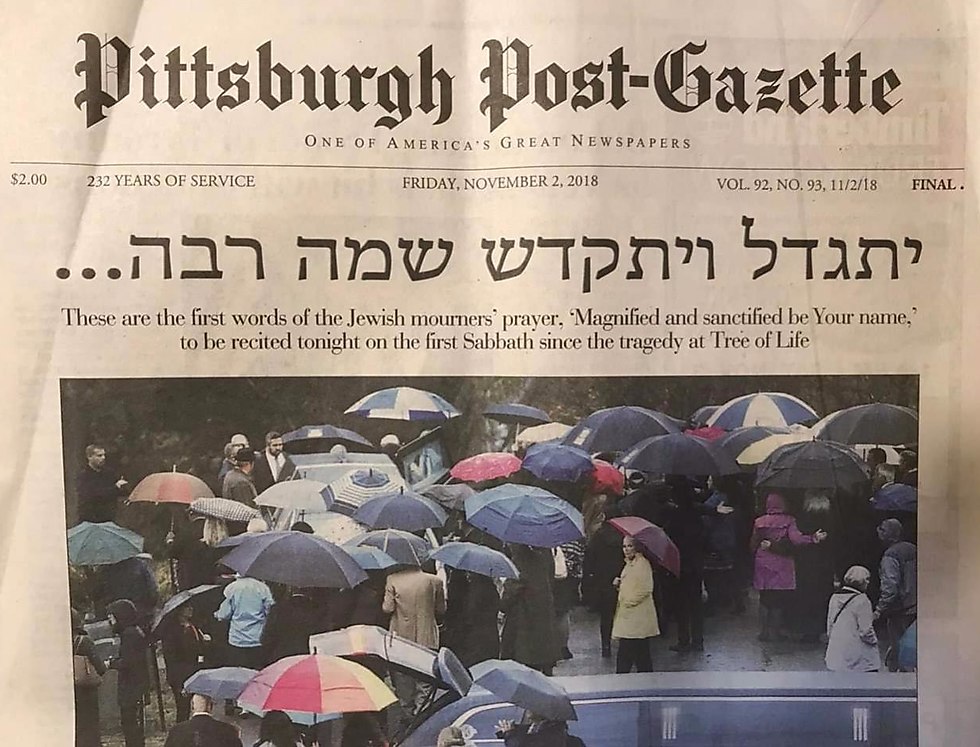
Pittsburgh Post-Gazette front page
"The last part of our broadcast is inspired by the powerful Post-Gazette headline this morning ... On the first Saturday since the attack, we asked cantor Azi Schwartz of Park Avenue Synagogue here in New York, to help us honor (the victims) by reciting the prayer," said the NBC news anchor.
NBC Nightly News 'Remembering the lives lost in the Pittsburgh synagogue shooting'
CNN's digital edition also addressed the Pittsburgh Post-Gazette's gesture, by explaining the prayer's meanings and laws for a public unfamiliar with the Jewish prayer book. "The prayer is in Aramaic, which is similar to Hebrew, and shows up in different versions, including the Burial Kaddish, which is recited during funerals," CNN's site noted.

CNN homepage
"However, the prayer doesn't even mention death. Instead, it celebrates two of the hardest things to remember during times of grief: the existence of God and the power of community," the article read.
Pittsburgh Post Gazette's executive editor and vice-president David M. Shribma devoted his editor's column to explaining the Jewish mourners' prayer.
"When you conclude there are no words to express a community’s feelings, then maybe you are thinking in the wrong language. That’s what prompted me to consider whether an excerpt from a 10th century prayer might be the appropriate gesture—of respect, of condolence—for a 21st century audience mourning its dead, whether family, friend, congregant, neighbor or, simply, Pittsburgher, the executive editor explained.
Liron Nagler-Cohen, Eli Mendelbaum, and Yaniv Pohoryles contributed to this story.
Amar is a rare find in Israel's academia. He is a Mizrahi Jew who wears a black kippah, a Rabbi, but also a professor. For years he has been alone in this mission to find and preserve the cultural treasures of North Africa, while trying to interest various culture institutions in funding his research.

Ancient manuscripts that could be lost forever. (Photo: Tali Farkash)
According to Amar, whereas there is a growing interest in Mizrahi music and cuisine, centuries-old spiritual treasures are being neglected. "Mimouna (a traditional Moroccan end-of-Passover celebration), and Mufleta (a Moroccan pastry - ed.) are nice to enjoy now—but the spiritual legacy will remain forever,” Amar said.
An expert in Medieval Hebrew Paleography, Amar is the chairman of the "Lights of the Jews of the Maghreb," an institution for the preservation of Moroccan Jewry heritage. According to the professor, the problematic relationship between Israeli academia and Sephardic literature and philosophy started back in the 80’
“There was an outrage following the publication of Kalman Katzenelson’s 1964 book entitled 'The Ashkenazi Revolution'”, he explained. According to the book, there are two peoples living in Israel: supreme Ashkenazim and inferior Sephardim, who should learn Yiddish in order to be considered 'cultured.'
“There was a great cry and then the Knesset decided to make a change. The Institute for Integration of Mizrahi Jewry Legacy was founded, and all the universities, who wanted in on the budgets, established research facilities," Amar added.
However, between 2006-2007, things began to change. “Limor Livnat, the education minister at the time, had decided to close the integration institution and the universities were out of incentives. Once a professor retired, his position was cancelled and only several courses were left," he elaborated.
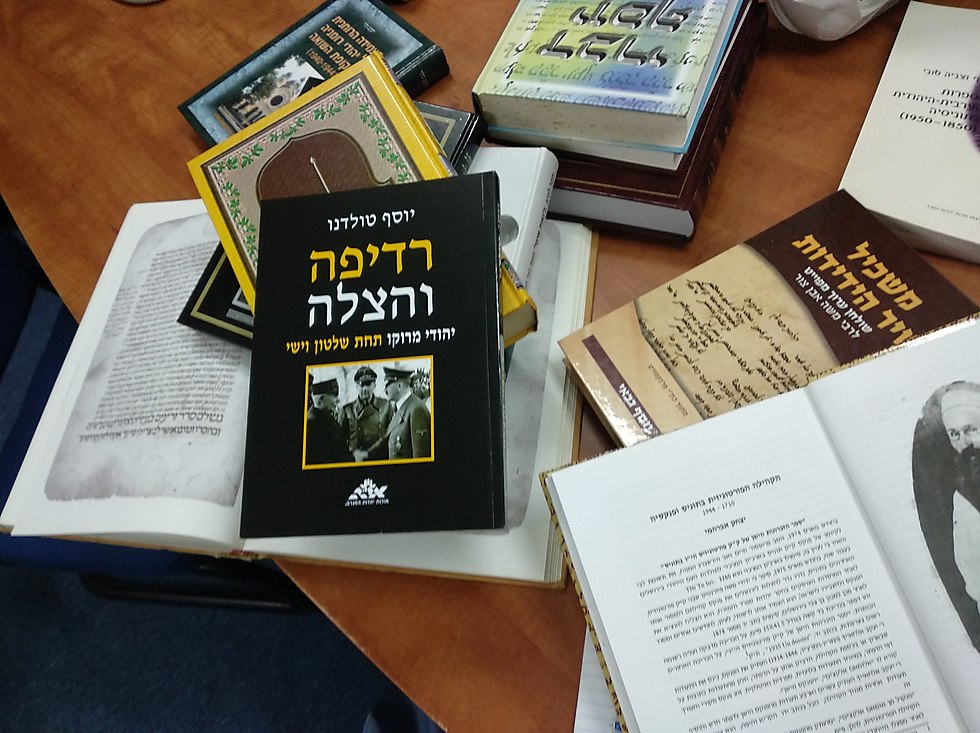
(Photo: Tali Farkash)
There is no shortage of students, however. Amar says the majority of students come to study at the department after consulting with him about other subjects. “It ends there, unfortunately.They have nothing to do with it afterwards, Maghreb Jewry isn’t studied anywhere in universities," Amar lamented.
After the 2016 Biton Committee, which was supposed to encourage Mizrahi legacy in education, one would presume things are about to change. However, according to Amar, Culture and Sports Minister Miri Regev encourages Mizrahi popular culture alone. “We had high hopes of the Biton Committee, but nothing came out of it," he continued.
Professor Amar, one of the leading researchers in his field, is now retired. He travels to Morocco independently in order to find books and manuscripts from different communities—but it’s a one man mission.
He showed me an ancient poetry book, written by a 15th-century Jewish diplomat named Avraham Ben Zimra, only a generation or two after the Alhambra Decree.“I found this by mistake, and intact! His poetry is amazing, and there are a lot of details here about one of the most important periods in history,” Amar exclaimed.
He found it while wandering around antique shops in Morroco. “Antique sellers collected things from abandoned Synagogues or from people who left the country. So I walked in and asked if they have anything that ‘belonged to Jews’. I asked for manuscripts, and the owner said ‘you won’t pay what I want for it’, but closed the shop and showed me the basement.
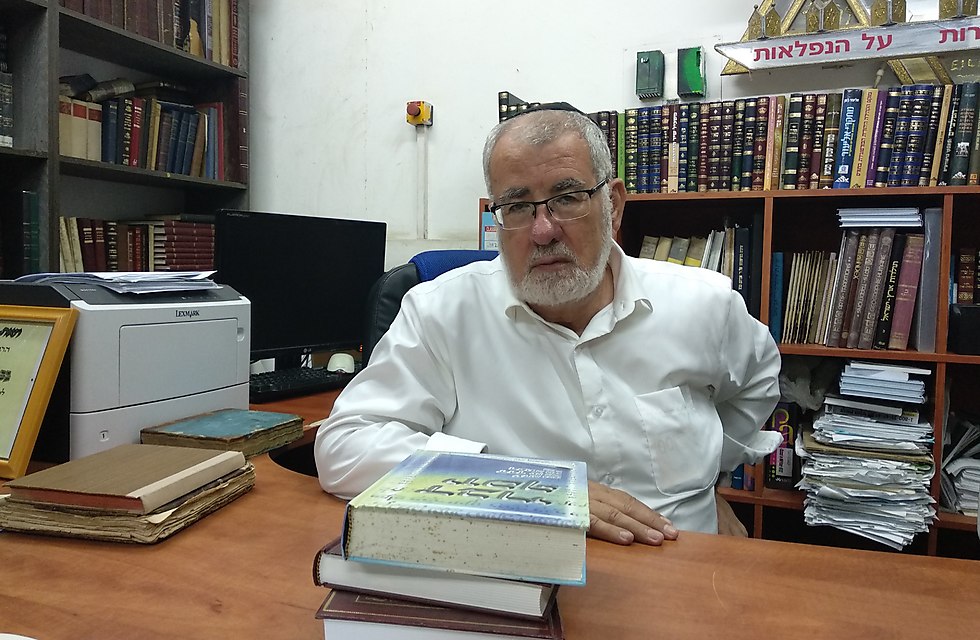
Rabbi and Professor Moshe Amar. (Photo: Tali Farkash)
“In the basement this book was waiting for me, alongside Torah scrolls and inscriptions. Just by the writing I could tell it's very old, and I told him I’ll take it. He asked for $1000, an imaginary sum for Morocco in the 90’s. He said if I don’t take it, an American will come by and pay double the amount. What could I have done?" he went on to say.
Among the texts Amar keeps in his archives are protocols from local Rabbinical Courts that tell the story of entire communities—stories of plagues, pogroms, hardship, philosophy and much more.
Amar’s life story is exceptional in itself. “In 1963 I arrived in Israel, and was studying in the famous Sephardic yeshiva Porat Yosef. The financial situation was difficult. I went to one of my teachers for advice, and he suggested I study to become a Rabbi," he elaborated.
Later on, Amar left the yeshiva and joined the IDF, where he served as a teacher. He continued to serve as a community Rabbi for a decade, until a friend introduced him to Professor Haim Ze'ev Hirschberg—the founder of North African Jewry research at Bar-Ilan University.
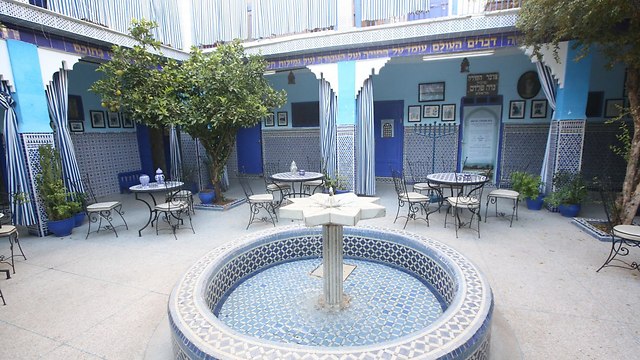
A Synagogue in Marrakesh. (Photo: Oren Aharoni)
“Hirschberg asked, ‘do you have a high school diploma? How will you be accepted into university otherwise?’ I replied that I can read manuscripts of any kind. He pulled out a huge pile of papers from his drawer and asked me to translate them and write a few short texts, so I did," he said.
In 1975, Amar was accepted into university without a highs school diploma. “When I finished my BA I started my PhD immediately, and became a professor a few years after that— I, the yeshiva student, the Orthodox guy who knew nothing about academia.
"My dream is a school that will teach both Rabbis and researchers. We now started a small project in Jerusalem—we only accept Rabbis, and it’s a two-year program. We have two main goals—to teach students how to treat their public, and know the traditions of Sephardic Halachic ruling," Amar added excitedly.
“The young generation knows nothing of Sephardic ruling. They know the Lithuanian tradition,” he bemoaned.
However, Ashkenazi Rabbis also attend the program. “The change I see in how people think is amazing The Sephardic Rabbis knew how to handle problems that today are being dragged for years in the Rabbinate. They knew how to solve problems before they become problems, and how to rule in a way that emphasized Halacha. Today we are far from that kind of ruling,” he concluded.
. A one-man mission to save Sephardic spiritual treasures : https://ift.tt/2CXSuAPIt includes an image of his Democratic opponent, state Rep. Matthew Lesser, with cash in his hands and a maniacal look on his face. Lesser is Jewish.

Ed Charamut’s mailer (Photo: MCT)
“The entire campaign committee, which includes members of the Jewish community, never discussed or considered Mr. Lesser’s ethnicity, race, religion or any other personal characteristic of Mr. Lesser and it was never our intention for the mailer to be anything more than a reflection of Mr. Lesser’s policy record,” the campaign said. “However, it is clear now that the imagery could be interpreted as anti-Semitic, and for that we deeply apologize as hate speech of any kind does not belong in our society and especially not in our politics.”
The statement refers to Charamut in the third person and does not include any personal message from the candidate. It indicates Charamut will remain in the race.
The message was posted on the Charamut campaign Facebook page, which also included a profile picture that was updated on October 28 with a frame from the Campaign Against Antisemitism, which was released after the mass shooting at a Pittsburgh synagogue. The frame has a Star of David made of interlocking arms of different colors and the hashtag “Together Against Antisemitism.”
The Anti-Defamation League says the mailing comes amid a rise in reported anti-Semitic incidents, including Saturday’s shooting that left 11 people dead and six others wounded.
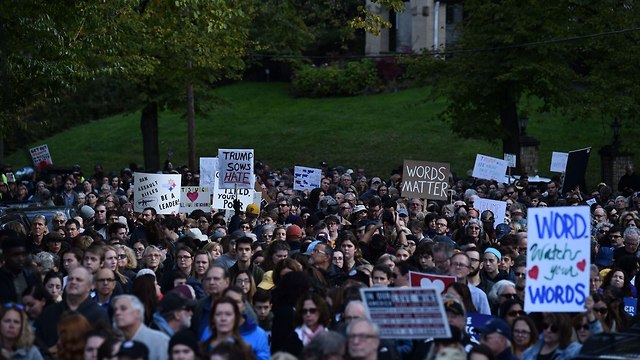
Protest at the scene of Pittsburgh shooting (Photo: AFP)
Lesser said the flyer is overtly anti-Semitic. He said he has not been contacted by Charamut or state Republican leaders since the mailing went out.
“I’m not sure if there is anything he could do to undo the hurt that he has inflicted on my family, but also on a like number of people across the district, across the state and across the nation,” he said.
Charamut had defended the mailer on Tuesday, saying it was only meant to draw a contrast between Lesser and his own fiscal conservatism.
“The mailer makes the point that if elected, Matt Lesser will undoubtedly vote to hike people’s taxes again and again,” Charamut said in a statement. “Those wishing to portray a graphic illustration as something hateful are completely wrong.”
J.R. Romano, the state’s Republican Party chairman, issued a statement condemning the mailer, just hours after defending it and accusing Democrats of having “false outrage.” He said his change of heart came after discussing the imagery with Jewish friends.
“In a race with a Jewish candidate, this image should be recognized as offensive, raising classic anti-Semitic tropes,” he said. “It cannot be justified. I personally would not have approved this mailer, and I am grateful that the party did not approve it. I have requested to sit down with the ADL to broaden my understanding of and sensitivity to anti-Semitism.”
Lesser said it is his understanding that Romano is still supporting Charamut in Tuesday’s election.
He said he’s not sure what effect the mailer might have on the election.
“My belief is that voters are decent people,” he said. “My expectation is that voters will reject this kind of hatred and bigotry and division.”
Republican candidate apologizes for anti-Semitic mailer : https://ift.tt/2yNgQuiA synagogue in California was defaced with anti-Semitic graffiti, police said on Wednesday, in an attack that took place just days after 11 people were gunned down at a Pittsburg synagogue.
Allen Berezovsky, president of the board at Beth Jacob synagogue in Irvine, south of Los Angeles, said staff discovered the vandalism in early morning. He told AFP the words "F*** Jews" and "Jews" were spray-painted on the white facade of the building.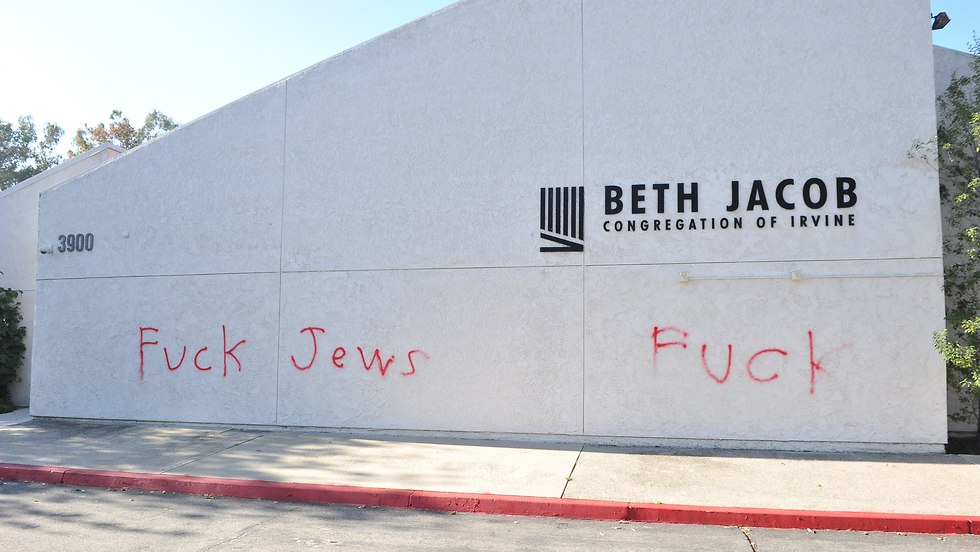
(Photo: AFP)
The majority of the attacks—13 percent—targeted Muslims, followed by Jews at nine percent.
California synagogue defaced with anti-Semitic graffiti : https://ift.tt/2Deb4Wv