It is not clear if the video possibly crosses any lines imposed upon the one-time multi-millionaire who is banned from acting as a broker or investment advisor.
Jordan Belfort on Monday dipped back into his old persona in a video posted to YouTube in which he reenacted a scene from Wolf of Wall Street, which was based on his 2007 memoir.
In the video, which runs nearly three-minutes long, the one-time New York City multi-millionaire stockbroker encouraged (mostly Reddit) stock traders to not be intimidated by hedge funds and short-sellers while also taking shots at the app Robinhood, which limited the buy of GameStop shares last week.
"We are not Fucking Leaving!!! #GME #HoldTheLine,' Belfort tweeted in addition to sharing the video. "Hold the line" has been the slogan of r/WallStreetBets on Reddit where risky stocks are being pushed.
The video is Belfort giving the speech his character gave in The Wolf of Wall Street film when he told his firm's staff he would not be walking away from the business, which was part of his fraud and corruption plea bargain. Played by Leonardo DiCaprio, the scene is one of the more memorable and intense in the 2013 Martin Scorsese film.
The video — parody or not — is a departure from the message Belfort shared last week when he warned that "massive victims" would result in GameStop and AMC stock manipulation.
"The problem is it is sort of this loose collision where one person says 'Let's stick together and stay strong.' And theoretically, that's illegal," Belfort said then. "But I doubt that the [U.S. Securities and Exchange Commission] would try to make a case out of something like that."
Belfort cautioned at that time, "Just remember, every time the market goes up, GameStop goes up, it's going to be harder and harder to make that next move up because the market cap is just not sustainable. So, at a certain point, someone has to be crossing out the people who are selling and moving on to the next one."
Belfort — banned from the securities industry and from acting as a broker or investment advisor, as a result of his conviction — did not specifically say what shareholders should do.
An official with the SEC could not be immediately reached to comment on whether the video crosses any lines, but Financial Industry Regulatory Authority's BrokerCheck system states, "The SEC has barred this individual from acting as a broker or investment adviser or otherwise associating with firms that sell securities or provide investment advice to the public."
GameStop stock skyrocketed to nearly $500 a share last week before plummeting back down to Earth, trading at $225 Monday afternoon. GME$ was trading at $5 a share two months ago.
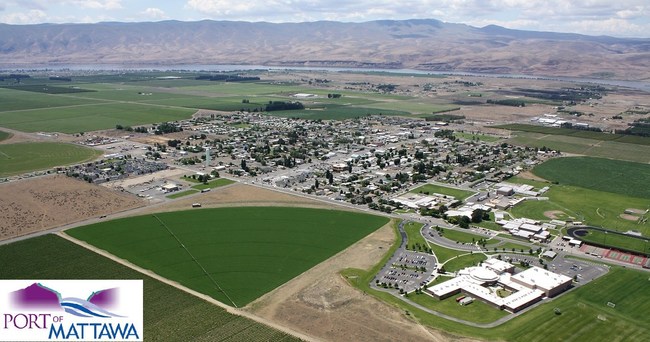
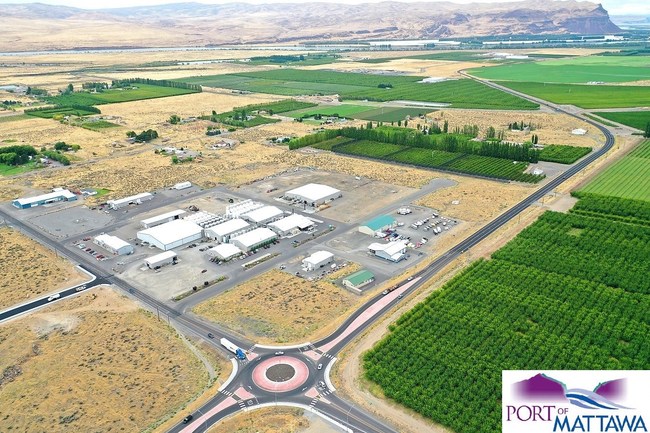
MATTAWA, Wash., Feb. 1, 2021 /PRNewswire/ -- The Port of Mattawa is working to expand and improve the infrastructure of its Wastewater Treatment System to accommodate the increasing growth of the wine grape crushing/bulk wine-making industry in central Washington as well as support other food processing in the Mattawa area, which will help to retain and create jobs and increase economic development in the south Grant County/Mattawa area.
Port of Mattawa Aerial Photo with Logo (PRNewsfoto/Port of Mattawa)
Port of Mattawa Aerial Photo with Logo (PRNewsfoto/Port of Mattawa)
The State of Washington is the nation's second largest wine producer, with over 1,000 wineries and an economic impact of $8.4 billion. Washington State's wine production has more than doubled over the past two decades, and the Port of Mattawa has become a major production area of bulk wine in Washington State, thus increasing the need for wastewater treatment capacity in Mattawa.
As a result, the Port of Mattawa's is requesting capital budget and/or infrastructure funding for Phase 4 of the Port's Wastewater Infrastructure Improvement Project, which would increase the capacity of the Port of Mattawa's industrial wastewater treatment system, especially for wine waste, which is a byproduct of the wine grape crushing process.
The capital budget/infrastructure funding request by the Port of Mattawa is widely supported, with the Port receiving letters of support from over thirty (30) organizations, companies, and entities in Washington State.
The expansion of wastewater treatment capacity of the Port's Industrial Wastewater System will allow the Port of Mattawa to keep up with rapidly growing wine crushing/bulk wine-making industry in central Washington as well as support other food processing in the Mattawa area.
Moreover, the bulk wine that is produced in Mattawa is used by wineries all over Washington State and elsewhere in the Pacific Northwest, which helps to promote and enhance tourism in our region.
Furthermore, the expanded treatment system will allow the Port of Mattawa to better and more safely discharge treated wastewater onto crops while also recycling the wine and food processing waste in an environmentally sustainable manner.
"The Port of Mattawa has become a leading location for wine grape crushing and bulk wine-making in the Pacific Northwest, and the Port is working to continue to improve its wastewater treatment infrastructure to keep up with this very important value-added agriculture-industry," stated Lars Leland, Executive Director of the Port of Mattawa.
In particular, over the past few years, the wine grape crushing industry has created and retained over 200 jobs in the Mattawa area, and it is projected that the Port of Mattawa's Phase 4 wastewater infrastructure expansion project will help to create more jobs and stimulate economic development as it will allow for wine grape crushing companies to continue to grow and hire more people in Mattawa and central Washington.
For more information, please contact Lars Leland of the Port of Mattawa at [email protected] or 509-761-9734.
The Port of Mattawa is located in south Grant County on the Columbia River in Washington State and is the closest inland port in central/eastern Washington State to the Ports of Seattle and Tacoma. Grant County is the top agricultural production county in Washington State, and Mattawa is a major producer of wine grapes, apples, cherries, potatoes and onions and other high-value irrigated crops.
The Port offers ideal sites for wineries, food processors, fresh produce packing companies, cold storage facilities, small manufacturers, and is a prime location for agribusiness companies because of its central location in Washington State near major irrigated agricultural production areas including the Columbia Basin and the Yakima Valley.
The Port of Mattawa is also very close to Interstate 90 and enjoys some of lowest-cost electricity in the United States from Grant County PUD.
The greater Mattawa area (Mattawa, Desert Aire, Beverly, etc.) is one of the faster growing rural communities in Washington State and has a population of nearly 10,000 people. Additionally, Mattawa is only a one-hour drive or less from several major communities in central Washington such as Moses Lake, Othello, Richland, Kennewick, Pasco, Yakima, Sunnyside, and Ellensburg, which have metropolitan statistical areas (MSA's) with a combined population of nearly 1 million people.
"port" - Google News
February 01, 2021 at 09:08PM
https://ift.tt/36ulE8C
Port of Mattawa Works to Expand Wastewater Infrastructure to Accommodate the Increasing Growth of the Wine Grape Crushing & Bulk Wine-Making Industry in Washington State - PRNewswire
"port" - Google News
https://ift.tt/2VXul6u
https://ift.tt/2WmIhpL
The 1980s were good for a few things. Hair metal. Karate. Tom Cruise movies. Acid wash jeans.
Just a few things that leap to mind.
However, they weren’t a great time for the Pittsburgh sports scene. No titles were won in Pittsburgh from 1979 (when the Steelers and Pirates both won championships) until 1991 (when the Penguins won the franchise’s first Stanley Cup).
I’ve heard it said quite a bit recently that we may soon be entering another 1980s downturn for Pittsburgh’s professional sports teams.
I’m here to tell you that it has already started.
In the 1980s, the Steelers missed the playoffs six out of 10 years. And they won just two playoff games the entire decade, beating the Denver Broncos in 1984 and the Houston Oilers in 1989. They got to 10 wins just once (1983) and finished below .500 three times.
The Penguins lost in the first round of the playoffs in 1980-82. They failed to qualify the next six seasons, finishing in last place of the six-team Patrick Division four times and fifth twice.
Their only playoff series victory of the 1980s was a four-game first-round sweep of the New York Rangers in 1989. That was followed by that painful seven-game Patrick Division Final loss to the Philadelphia Flyers.
As for the Pirates, they were about as competitive in the 1980s as the Democratic presidential tickets. Those teams under Chuck Tanner and Jim Leyland finished with an average win percentage of .467. They never qualified for the postseason and finished in last place three times (four if you count the second half of the strike-altered 1981 season).
Here’s why the current editions of our three local sports clubs are trending in the same negative direction.
We may not have a nice, clean turn of a decade like 1980 to start our analogy. But let’s begin with the 2017 NFL season since the Penguins won Pittsburgh’s last championship that previous June.
Since then, the Steelers have missed the playoffs twice (2018, ‘19) and lost embarrassing postseason upset defeats at Heinz Field the other two years (2017, ‘20). Mike Tomlin’s players have yet to bottom out below .500 like Chuck Noll’s clubs of ‘85, ‘86 and ‘88.
However, given the trend of losing five of six to end 2020 and the wave of subtractions expected in 2021, don’t be stunned if next year yields the first NFL losing season in Pittsburgh since 2003.
That’s what I’m expecting anyway.
Then, with a change at quarterback from Ben Roethlisberger and a subsequent rebuild likely to begin in 2022, who knows how long it could be before the Steelers taste postseason success again.
After all, we’ve already gone through a decade similar to the 80s in terms of seasons featuring postseason victories. Much like 1980-89, Tomlin’s Steelers only saw playoff wins in two years (2015, ‘16) between 2011 and 2020.
As for the Penguins, they followed up 2017’s Stanley Cup championship with a first-round playoff elimination of the Flyers in 2018. But then they were knocked out in a hard-fought six-game second-round loss to the Washington Capitals, followed by a first-round defeat to the New York Islanders in 2019 and qualifying-round loss to the Montreal Canadiens in 2020.
Given the reformatted 2021 playoffs, tough Eastern Division depth, shaky goaltending, the resignation of general manager Jim Rutherford and non-stop injuries on defense, a postseason berth for the Penguins this year is no guarantee.
That has seemingly been the case every year since 2007. But don’t count on it moving forward with Sidney Crosby, Evgeni Malkin and Kris Letang continuing to advance through their mid-30s and little help forthcoming from a thin farm system.
Then there’s the Pirates who are … the Pirates. You could argue they are currently even worse off than the 1980s teams. Their ineptitude dates back to 2016, with a 323-383 record (.458) over the past five seasons. They’ve finished last in the NL Central in each of the last two seasons, have been stripped to the bone at the Major League level for 2021 and may challenge the organization’s 1952 record of 112 losses (113 if you want to date back to the Pittsburgh Alleghenys of 1890).
There’s no reason to predict a playoff push over the next four or five years. And such hopes for a significant run from the other two Pittsburgh clubs are flickering, too.
For better or worse a lot of 80s trends and fads have come back again. Prior to the coronavirus pandemic, the hottest selling concert for the summer of 2020 was Motley Crue, Poison, Def Leppard and Joan Jett. A “Top Gun” sequel is planned for July. “Cobra Kai” is one of the biggest shows on Netflix. Damaged denim is a thing again.
Sadly, so is sports frustration in Pittsburgh. And it’s up to franchise management at Heinz Field, PNC Park and PPG Paints Arena to stop our “Crying in the Rain.”*
*Whitesnake. Originally released on the 1982 “Saints and Sinners” album. Track No. 5. Later re-recorded for the self-titled “Whitesnake” album in 1987.
Figured I’d save you the time of looking it up.
Tim Benz is a Tribune-Review staff writer. You can contact Tim at tbenz@triblive.com or via Twitter. All tweets could be reposted. All emails are subject to publication unless specified otherwise.
Categories: Penguins/NHL | Pirates/MLB | Sports | Steelers/NFL | Breakfast With Benz
TribLIVE's Daily and Weekly email newsletters deliver the news you want and information you need, right to your inbox.
STOCKHOLM, Feb. 1, 2021 /PRNewswire/ -- Today, Eco Wave Power (EWPG Holding AB) is pleased to announce the winning of the Smart Port Challenge Competition held by Morocco's National Ports Agency and National Single Window for foreign trade- PORTNET, together with the Global Alliance for Trade Facilitation and Morocco's port community.
The goal of the challenge was to find disruptive solutions that will facilitate transit at Morocco's ports and improve port performance.
The event took place virtually, and Eco Wave Power was represented by Matias Sigal from the Eco Wave Power Business Development Department.
After pitches by seven finalists, and time taken by the judges for deliberation, Eco Wave Power was determined as one of three winners.
The award granted to Eco Wave Power is 100,000 MAD, as well as an opportunity for Morocco to become an Eco Wave Power testing and implementation hub.
One of the Jury members, Dr. Mikael Lind from the Research Institute of Sweden (RISE) congratulated Eco Wave Power for winning the award and said: "I think that Eco Wave Power's solution is very promising for responding to the needs of the port to establish itself as an energy hub and as a contributor to the green conversion of the maritime and the global transport chain."
Inna Braverman, Founder and CEO of Eco Wave Power said: "I am very grateful for such recognition by the Smart Port Challenge in Morocco. We are very interested in the Moroccan energy market, and hope that this will be the beginning of a long-term collaboration"
EWPG Holding AB (publ) ("Eco Wave Power") is a leading onshore wave energy technology company that developed a patented, smart and cost-efficient technology for turning ocean and sea waves into green electricity. Eco Wave Power's mission is to assist in the fight against climate change by enabling commercial power production from sea and ocean waves.
EWP is recognized as a "Pioneering Technology" by the Israel's Ministry of Energy and was labelled as an "Efficient Solution" by the Solar Impulse Foundation. Eco Wave Power's project in Gibraltar has received funding from the European Union Regional Development Fund and from the European Commission's HORIZON2020 framework program. The company is also recognized by the United Nations in receiving the "Climate Action Award".
The Eco Wave Power share (ECOWVE) is traded on Nasdaq First North Growth Market.
FNCA is the company's Certified Advisor (+46 8-528 00 399, [email protected]).
Central Coast fishermen are selling their catch of the day after the Dungeness crab season was delayed for weeks.
Local commercial fisherman and the Port San Luis Harbor District have created a Fisherman's Market Pilot Program, located in Port San Luis for fisherman to sell their fresh catch directly off the boat to the public.
"We got a halibut, it was about nine pounds and two Dungeness crab. We will have quite the feast," Arroyo Grande resident Toni Aelly said.
San Luis Obispo residents, Corrie Arellano and Javon Mejls, also scored a catch from Sunday's fish market.
"We got three live crabs that we are going to cook up tonight and a whole halibut," Arrellano said.
Tom Capen, a commercial fisherman, said the pilot program will offer new business opportunities.
"[The San Luis Harbor Patrol District] gave us a place to retail our catch to the public since COVID and since we lost all three retail fish markets on the pier over the last few year," Capen said.
Fishermen have had to come up with creative ways to sell fresh fish to the community.
"We finally got a spot a the end of the pier and the enthusiasm is great. When I showed up yesterday with the crab I was supposed to open at 1 p.m. and there was a line of 15 people waiting for me," Capen said.
Fisherman Danny Morton is selling California Halibut at the market and said it's a great place to go if you are looking for locally caught fish.
"They don't have to search for it, they can come directly to the fisherman, know where it comes from, how it was caught, when it was caught and who it is benefiting," Morton said.
The Port San Luis Harbor District has been in favor of the Fisherman's Market Pilot Program. In a staff report back in April they wrote:
"The Harbor District is supportive of the Commercial Fishing Industry and has received several requests over the years for some type of Fishermen’s Market, where the Commercial Fishermen sells his/her own product. "
Locals are also ready to start putting money back into the local economy.
"Not only do we like our fish fresh, but these fisherman are normally selling to restaurants who aren't able to be buying right now either. So we are trying to support our local economy in any way we can," Toni Aelly, a customer, said.
The market takes places Saturdays and Sundays from 11 a.m. to 4 p.m. and Wednesdays from 1 to 4 p.m. at the end of Harford Pier at Port San Luis in Avila Beach.
"port" - Google News
February 01, 2021 at 12:45PM
https://ift.tt/2L9q11y
From boat to table: Local fish market comes to Port San Luis in Avila Beach - KSBY San Luis Obispo News
"port" - Google News
https://ift.tt/2VXul6u
https://ift.tt/2WmIhpL
Kabul, Afghanistan – Ghullam Faroq bustles through the narrow hallways at the old Ministry of Interior building in the heart of Kabul, a stack of folders tucked in the crook of his arm and a phone pressed to his ear. He climbs the stairs to the second floor and is buzzed through a series of doors with metal bars and touch keypads.
It is just after 7:30am on a day in late 2019 and the end of a 24-hour shift leading a team of 11. Before he heads home, Faroq has a debriefing with the director of investigations.
Faroq, 54, is from Logar, a restive province roughly 80 kilometres (50 miles) south of Afghanistan’s capital. His crime investigation career spans more than 30 years – the past 11 years of those spent here at Kabul’s crime scene investigation (CSI) department.
“It’s a busy morning. It’s always a busy morning,” Faroq says, settling into a seat in the director’s office. He cuts a dapper figure in his black turtleneck, mustard blazer, striking moustache and slim spectacles.
The CSI unit travels to as many as 30 crime scenes a day, conducting investigations and interviews with witnesses, collecting evidence and submitting it to the Forensic Medicine Directorate (FMD), the country’s only working forensic laboratory, located in the Ministry of Public Health, a two-storey building in the centre of Kabul.
Kabul’s CSI department was established in 2009 in a city police station. Today, Faroq says there are 10 smaller CSI units and 50 investigators working across Afghanistan but the Kabul CSI team of 33 takes on the brunt of the workload, facing a deluge of hundreds of cases a week from across the country. These range from homicides to assassinations of the country’s highest elected officials to serial killings, burglaries, armed robberies, theft and extortion. There are also crimes linked to narcotics, to which an estimated three million people in the country of about 34 million are addicted, kidnappings, street crime and domestic violence – the archives are overflowing.
Moreover, the team has not been able to start work on a backlog of thousands of cold cases due to a lack of staff, forensic evidence, and adequate equipment – particularly for DNA testing.
The CSI teams’ battered metal case of their dated but treasured forensic equipment at the crime scene [Lynzy Billing/Al Jazeera]
In 2014, when US troops left Afghanistan’s Bagram Airfield as part of a military drawdown, valuable American forensic equipment was handed over to the Ministry of Interior (MOI). But with a lack of trained experts in Afghanistan who know how to use that equipment, the laboratory in the MOI currently remains inactive, while the American instruments sit locked away in a warehouse gathering dust, according to FMD specialists.
The operational forensic laboratory at the FMD takes criminal cases from the CSI department and judicial departments and is working towards building the first national DNA database for Afghanistan, but it also suffers from a lack of resources and equipment. Despite being in operation for 39 years, FMD receives minimal government funding and is forced to send the majority of its DNA samples to Canada for analysis.
The shooting
Faroq’s meeting is interrupted by a phone call from the police station – a fatal shooting at a local hospital. He jumps to his feet and heads outside to join three members of the CSI team climbing into hazmat suits and loading up their van with forensic equipment.
Careening through Kabul’s busy streets, Faroq receives another phone call. The victim is no longer at the crime scene – police officials violated protocol and took his body to a nearby military hospital.
Faroq takes the development in stride and the team detours – this is not the first time a body has absconded. “Usually, we would go to the crime scene first to collect evidence before it is tainted by others, but we also need to take blood samples and photographs and notes of the body before the family receives it for burial. If the body is no longer at the crime scene, we have to make a choice of priority,” he says.
The victim is a hospital security guard, allegedly shot in the neck by his colleague while they were both on the night shift. At the military hospital, Faroq learns the victim was still alive when he arrived at the emergency room but died while being treated. “The suspect and two other witnesses are now arrested and under investigation at 11 police station,” he says.
In the hospital courtyard, behind a screen, the victim lays on a stretcher.
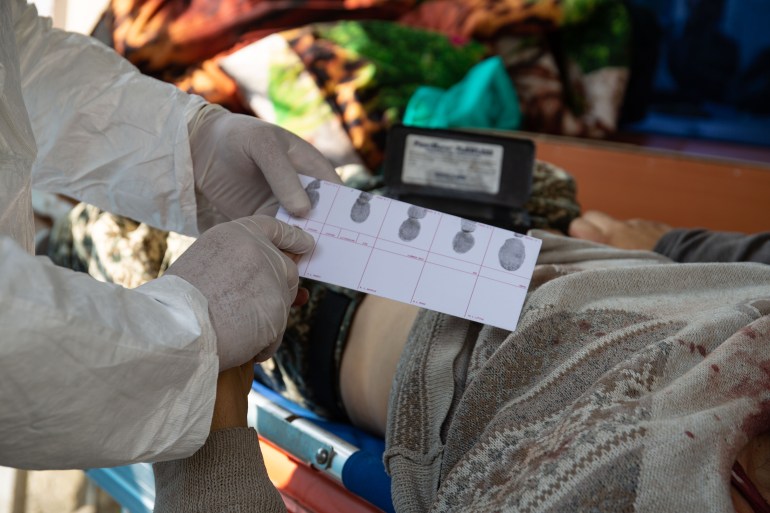
Ghullam Faroq takes the victims fingerprints while another member of the CSI team inspects the body [Lynzy Billing/Al Jazeera]
Faroq takes his fingerprints while another member of the CSI team inspects the body, scribbling down notes. A third member photographs the wounds. “One bullet with an entry and exit point, here in the trachea,” calls out Faroq.
“Now NDS [National Directorate of Security, the Afghan intelligence service] district head is talking with the family of the victim and telling them that we want to take the body to FMD. But the family is protesting. They want to take the body for the funeral now and I don’t think they will allow FMD to take it,” says Faroq.
“It’s important for the body to reach FMD so that they can determine the exact time of the shooting, the firing distance etc. If we can get the suspect to FMD also, they can also conduct tests to tell us if the victim or suspect was under the influence of any alcohol or narcotics.”
On the other side of the screen, amongst a crowd of curious onlookers, is the dead security guard’s four-year-old son with a male relative. As the team packs up and leaves the hospital, in a private gesture, Faroq hands the child his father’s boots.
A member of the CSI team photographs the victim at a local hospital in the capital [Lynzy Billing/Al Jazeera]
The team heads to the crime scene, the van moving through crowds of people in the bazaar.
“I have been working with the CSI team for seven years,” shouts one of the team over the din of the bazaar streaming in through the open windows. He reaches into a box under his seat and hands out cans of energy drinks to the driver, who also acts as the team’s photographer, Faroq and another team member in the back seat.
“He’s been here for three years,” he says in Dari, gesturing to the scrawny man in the back seat. “But he doesn’t talk. He stopped speaking two years ago. Do you want to interview him?” he adds.
“Today there are only four of us,” continues the team member, explaining that two teams are sent to investigate more serious or complex crimes.
“It’s a very dangerous and difficult job. Honestly, I think it is having a really negative impact on my mental state. I’ve personally visited around 5,000 crime scenes. Homicides are just one kind of case. We see a lot of suicide cases, and also the aftermath of suicide bombings.
“These are the photos of the suicide attack near the Ministry of Interior,” he continues, referring to the deadly January 27, 2018 blast, flipping through photos on his phone. “Here they are just photos, but I remember what it feels like to collect the flesh of someone’s body in my hands and put it in a bag.”
Among a crowd of curious onlookers is the dead security guard’s four-year-old son with a male relative [Lynzy Billing/Al Jazeera]
Violence, crime on the rise
On February 29, 2020 the United States and the Taliban signed a conditional peace deal in Doha, Qatar. The deal offers a basic bargain that requires US troops to withdraw from Afghanistan within 14 months on the condition that the Taliban ratchets back attacks on US and Afghan troops.
Despite the agreement and the beginning of the intra-Afghan peace negotiations on September 12, the country has seen a surge in violence. The Taliban has continued attacks across the country, carrying out 356 attacks in just one week, the interior ministry’s spokesman said on October 24, 2020. October was the deadliest month in Afghanistan for civilians – with at least 212 killed – since September 2019, according to data compiled by The New York Times. At least 369 pro-government forces were killed that month.
According to Human Rights Watch, a leading cause of civilian deaths and injuries were Taliban attacks using improvised explosive devices (IEDs) and in 2020 Afghanistan remained the deadliest country for civilians. The latest quarterly report from the UN Assistance Mission in Afghanistan documented 5,939 civilian casualties, including 2,117 killed and 3,822 injured, from January 1 to September 30, 2020. According to the report, the Taliban was responsible for 45 percent of civilian casualties, and Afghan national security forces for 23 percent, mostly due to ground engagements.
Moreover, Afghanistan is seeing a rise in civilian assassinations. On January 1 this year, Bismillah Adil Aimaq became the fifth journalist to be killed in two months. On January 17, two female supreme court judges were shot dead in an early morning ambush in Kabul.
‘Department of Crime Scene Investigations’ reads the text on the side of the CSI teams’ van [Lynzy Billing/Al Jazeera]
Speaking in October 2020, Faroq says the number of cases on his desk has risen in line with a rise in crime, predominantly in the capital. Hard statistics are not publicly available or do not exist from the Afghan government or from any independent organisation, yet the Center for Strategic and Regional Studies (CSRS), an independent civil society organisation, published an analysis on October 15 describing a peak in crime in a number of provinces including Kabul.
The CSRS reports that according to Kabul police officials, 146 criminal incidents took place in the city in the past 20 days and 133 suspects had been arrested in connection with thefts, murders, kidnappings, drug trafficking, and other forms of aggression.
The report explains that Afghanistan’s economy remains largely dependent on foreign aid, and as foreign aid has fallen sharply in recent years, this has led to a rise in unemployment, which is directly linked to an increase in crime. The CSRS reports drugs, economic problems, political and security problems as causes for the spike in crime the country witnessed after 2018. Issues like a lack of enforcement and widespread institutional corruption also contribute.
Faroq sees the increase in crime as eroding trust between the government and people. Citizens accuse security agencies of being involved in robberies and criminal activities and many are concerned that the perpetrators of criminal acts will be released once they are handed over to security agencies.
There is also a lack of coordination between law enforcement and security agencies in enforcing the law and penal code. Furthermore, Faroq relays that many more incidents never even reach the prosecutor’s office.
Masoud Andarabi, the interior minister, did not respond to requests for comment on the rise in crime across Afghanistan.
The crime scene
The speeding CSI van arrives at the crime scene. It is cordoned off but still swarmed by onlookers and a handful of men in dark suits. “NDS”, says Faroq nodding at the members of the Afghan intelligence service. “But actually, they are not required to be here.”
Crowds are an issue for investigations, according to Faroq. “A lot of people try to get the scene. Many times they already have.”
Six departments will work together on the case including a prosecutor from the attorney general’s office and two NDS officers.
They set about their work, placing the bullet casing in an envelope, collecting samples from a pool of blood on the floor in the courtyard, still wet, and photographing bloody footprints leading into the hospital.
A bullet casing is collected from the crime scene as evidence [Lynzy Billing/Al Jazeera]
“We record everything. Every detail can help us to have the full picture of the case before it goes to the attorney general or judge,” says Faroq, surveying his team at work.
“We need to check the list of the guards with the hospital director to determine who was on duty and at what time. Another team is searching for the first responder who transferred the victim’s body to the hospital. He could be a witness or a suspect at this point and we want to collect his fingerprints and interview him also. If we can’t find him, we will follow his phone signal and find him that way.”
The victim’s phone will go to the technical team to see what they can extract. The suspect and witnesses’ clothing will be taken into evidence.
“We should complete our work on a case in two days,” says Faroq.
The team is finished. They pack up their battered cases, now full of evidence and samples, and head to the police station. “We need to meet the suspect, take his fingerprints and it’s time for his questioning.”
The interrogation
Six men squish onto two couches in the office of the chief of police at 11 police station. The CSI team, the head of police and a prosecutor sit while two NDS officers in leather jackets and sunglasses lurk in the corner.
The suspect is brought into the room. He shuffles before the men, his head down.
He had already been questioned by police. But as head of the CSI investigation team, Faroq has his own interrogation to conduct. “The suspect admitted to killing his colleague but we know that there were others present at the same time and he could have been pressured by others or even the police, so it’s important for me to conduct my own investigation,” he explains.
He places a clipboard on his lap and begins his questioning, carefully taking notes. He asks the suspect his name, age, where he was born, where he lives, and whether he’s married. “Did you go to school?”
“Yes. Up to sixth class,” responds the despondent suspect.
As Faroq queues up his next question, the police station’s power cuts out, pitching the small room into darkness. The men rustle in their pockets, and three mobile phone lights flick on, casting distorted shadows on the walls. The questioning continues.
Faroq asks about the male relatives – his father’s name, his grandfather’s name and whether he has a brother.
“What is he doing? Nephew? What is he doing? Uncle? What is he doing?”
“He is a retired police officer.”
“Your uncle’s son? What is he doing?
“He is a de-miner in an NGO.”
“Your mother’s brother? What is his job?
“He owns a business.”
“Your father-in-law? What is his job?
“He is dead.”
“Your brother-in-law?”
“He is a teacher.”
The 30-year-old suspect is in shock. He explains how he had been trying to find work for many months, had a week’s training and only started the job as a hospital security guard a week ago. His salary is 12,000 Afghan afghani ($156) a month.
“The MOI branch provides just a week long training for their members,” says one of the NDS men from the corner of the room. He is referring to the branch of the Ministry of Interior which provides security for the private sector.
“Did they biometric you?” asks Faroq.
“No.”
Ghullam Faroq writes by cellphone light after a blackout in the police station [Lynzy Billing/Al Jazeera]
Faroq asks the suspect to take off his coat so he can be photographed.
The men proceed to photograph the suspect on their mobile phones.
“Now, sit down and tell me what happened,” says Faroq.
“We were on duty at the same time, from 5:30pm to 8:00am and we were sitting facing one another, trying to stay awake, when the gun went off,” says the suspect.
“In your training, didn’t they tell you to check the weapon’s safety lock?” mutters Faroq, shaking his head in disbelief.
“We were almost finished [with] our shift,” pipes up the suspect. “Almost ready to hand over to the new guards that morning. I only met him [the victim] that day and I remember him telling me that we were from the same area, Najrab district. This is what I keep thinking about.”
Security guards in Kabul have an incredibly tough job, Faroq later explains. They work long hours for low pay and they are on the front line of attacks. Then winter comes and the long nights become colder and staying alert becomes that much harder.
“It’s just an accident but these incidents happen too often.”
Psychological toll
The body of the victim never made it to FMD. It was intercepted en route by the family and taken for burial.
“The problem is that no one know the rules and everyone is doing what they want,” says Faroq.
“Over the past few years our work has become more difficult.”
This is largely due to the sheer size of the population, security challenges and a lack of resources and materials for the team’s investigations. “Special chemicals are needed for analysis that unfortunately is not available to the CSI and forensic teams.”
Today, high-level corruption also challenges the team. “With some cases, there are influences by governmental stockholders and security officials, powerful men, who can cause adulteration at the scene of [a] crime or with the case afterwards,” says Faroq.
Furthermore, there is a lack of cooperation between departments, and simply ensuring evidence is not tampered with, contaminated or removed can be a difficult task on its own.
In this case, the suspect’s gun went missing for hours. “It was picked up by local people and then by the police and now it has the fingerprints of many different people on it. This makes it harder to distinguish the fingerprints of the culprit, making our work very difficult.”
Another issue was the gun’s magazine. “It can hold 30 bullets, but when we received the magazine there were 27 bullets,” says Faroq. “The man was shot only once so now we are asking the district police chief how many bullets were in the gun when he received it.”
The CSI unit examines the suspects’ gun which turned up at the police station after going missing for hours after the shooting at the hospital [Lynzy Billing/Al Jazeera]
Faroq’s work largely focuses on bomb blasts but because of poverty, domestic crimes in particular have taken over the majority of the cases the CSI team are called to.
The pandemic has pushed Afghanistan’s economy into negative growth. The number of Afghans living in poverty has jumped from about half to about two-thirds according to a report by the Afghanistan Analysts Network in October. Faroq says the effect of COVID-19, unemployment, and a lack of basic government services in terms of healthcare and security are significant factors behind rising crime.
And he does not feel safe on the job, neither mentally nor physically. “There is no mental health support to address the emotional toll from the work. And because of the bad security situation in our job the physical and psychological stress and side effects feel like a severe disability like deafness and blindness.
“I am not safe and I can’t guarantee the safety of my team,” laments Faroq. “We fear our own society and people. The threat comes from Taliban, terrorist groups, local thugs, criminals and you know, the [Afghan] mafia have their way of pressuring us also.”
Identifying victims with mobile phones
Despite the enormous pressures they are under, Faroq and his team remain resourceful as do his colleagues in forensics.
An Afghan identity card, known as a Tazkira, is supposed to be issued to all citizens but Muhammad Rehman Shirzad, head of the forensic lab at the FMD, says few people actually have them, creating further problems when it comes to identifying the bodies of victims.
Shirzad says it is also because of the lack of birth certificates and ID cards that bodies are sent to their department so they can assess the victims’ age.
On January 27, 2018, a huge blast rocked the Afghan capital. A suicide bomber had driven an ambulance onto the CSI office’s doorstep and detonated, killing more than 100 people and wounding 253 others. After the blast, the dead were transported to the FMD’s criminal forensic laboratory.
“Many of the bodies were in bad condition — for some we only received body organs,” says Shirzad. “But as well as the body parts, we received bags of mobile phones, IDs and other personal items of the victims.
“Most of the mobile phones had turned off because of the huge waves produced during the bomb blast and some were half burned.”
While his team was busy with postmortem investigations, Shirzad took a damaged phone and charged it. He immediately received a phone call. “It was an older man, who I later found out was the father of the deceased. It was a really sad moment,” he says, remembering thinking how he might have to tell this person they had lost a loved one in the bomb blast.
“The father said: ‘Just tell me, did I lose him or is he alive?’ I said: ‘We receive many dead bodies, if he is not here among the dead, then I am sure he will be somewhere in the hospital.’”
The victim of the hospital shooting only had 100 Afghanis ($1.30); security guards are paid very low wages [Lynzy Billing/Al Jazeera]
Shirzad told the man they had received this phone from the evidence bags and to come to the FMD to try to identify their family member from birth marks, scars or any other markings.
“An hour later, he arrived at FMD and at a first glance he identified his son from body fragments received, by a mark on his leg, just his leg. We completed our work and handed over the body part to the family.”
Situations like these are becoming more common.
But that is because, against the odds, the CSI team and forensic department are harnessing the unique success of the Afghan telecommunications sector to identify victims and solve crimes.
They are making use of the high per-capita proliferation of mobile phones in the country. A 2019 study found that more than 90 percent of Afghans have at least one member in their household who owns a mobile phone.
“The CTD (Criminal Technique Department) and cybersecurity team can identify the phone number, most recent phone call, and they can use pictures or contacts on the phone to identify bodies,” says Faroq.
Data is taken from sim cards, SD cards and social media accounts to determine the identity of the victims from crime and bomb blasts. Through fingerprinting of the body and the phone as well as searching the phone’s videos and photographs and contacting recent contacts, the identity of the body can be verified.
Afghanistan’s telecommunications networks – both private and governmental – work together with the authorities, the CSI and cybercrime units to catch a suspect. Mobile phone carriers, like Etisalat, can provide authorities with a mobile phone’s exact location and often a history of voice recordings made by the phone as well as videos and photos, says Faroq. This data can also indicate the suspect’s exact location, along with a history of past locations.
The future of criminal justice in Afghanistan is through mobile technology and social media surveillance, he says.
A cold case
Back at the CSI headquarters, it is now 5:45pm. Dusk falls on the capital as Faroq hands over his case notes from the shift to the assistant to be filed.
“This is Afghanistan, every department, every institution is cuffed,” says Faroq. “We have limited training, equipment and resources.”
But the team remains determined to bring justice to victims of crime.
“The CSI team is emotionally and physically exhausted. I am emotionally so tired, but I stay because of my passion for this field. I stay to identify the culprits of crime and I do it for every victim.”
Elements of the day with the CSI team seemed like a dark parody, from the hijacked body to the misplaced gun. But there was no joke about the seriousness of the crimes or the possible repercussions for the suspect, who remains in police custody.
“We tried our best to find some evidence on the gun of the fingerprints of the suspect, but we did not succeed, the evidence was damaged,” says Faroq.
The investigation is ongoing, and the case has joined thousands of other unsolved cases, filed away in the dusty archives of a backroom at the Kabul CSI department.




 The CSI teams’ battered metal case of their dated but treasured forensic equipment at the crime scene [Lynzy Billing/Al Jazeera]
 Ghullam Faroq takes the victims fingerprints while another member of the CSI team inspects the body [Lynzy Billing/Al Jazeera]
 A member of the CSI team photographs the victim at a local hospital in the capital [Lynzy Billing/Al Jazeera]
 Among a crowd of curious onlookers is the dead security guard’s four-year-old son with a male relative [Lynzy Billing/Al Jazeera]
 ‘Department of Crime Scene Investigations’ reads the text on the side of the CSI teams’ van [Lynzy Billing/Al Jazeera]
 A bullet casing is collected from the crime scene as evidence [Lynzy Billing/Al Jazeera]
 Ghullam Faroq writes by cellphone light after a blackout in the police station [Lynzy Billing/Al Jazeera]
 The CSI unit examines the suspects’ gun which turned up at the police station after going missing for hours after the shooting at the hospital [Lynzy Billing/Al Jazeera]
 The victim of the hospital shooting only had 100 Afghanis ($1.30); security guards are paid very low wages [Lynzy Billing/Al Jazeera]