blogjewishscene.blogspot.com Brazil to offer 17 port contracts this year - BNamericas
News
To take advantage of positive momentum in the ports sector, Brazil is planning to offer a series of assets.
Auctions forat least 17 terminal leasing contracts are scheduled for this year, plus the concession of Espírito Santo state’s port administration (Codesa) and the Codesa-administered Vitória and Barra do Riacho ports.
“Major auctions to offer port terminal leases will happen this year and, most importantly, we will have the auction of Codesa that will attract many interested parties and large investments to the sector,” infrastructure minister Tarcísio Gomes de Freitas told a webcast.
"After the Codesaauction we will hold auctions for the concessions of the Santos, São Sebastião, Itajaí ports administrations, as well as Bahia's port authority Codeba. We are going through a new revolution in this sector that will increase the resilience that the sector already demonstrated in a year of pandemic," the minister added.
Even though analysts expect deteriorating overall economic performance due to the pandemic, the port segment will remain attractive.
"The Brazilian port sector has a consolidated model in place, offering assets to investors and even in the wake of an economic scenario that is still difficult this year due to the continuity of the pandemic. The segment will continue to attract investors with the offer of leasing contracts and also in terms of concessions," Fabrizio Pierdomenico, a port sector specialist at Agencia Porto Consultoria, told BNamericas.
PORTS PERFORMANCE
Brazilian ports handled 1.15Bt of cargo last year, up 4.2% from the previous year, according to waterways regulator Antaq.
Santos port once again moved most cargo,114Mt, followed by Paraná state’s Paranaguá port, with 52.1Mt, and Itaguaí, in Rio de Janeiro state, with 45.7Mt.
Iron ore was the most transported cargo with 356Mt, followed by oil and derivatives with 262Mt. Container transport totaled 118Mt and soybeans 104Mt.
Asian commoditydemand will likely contribute to positive performance this year.
"We do not see signs of cooling demand, neither of agricultural commodities nor of metal commodities," added Pierdomenico.
The BR do Mar bill to boost cabotage investments along the coastline was already approved by the lower house, and senate approval is expected soon.
The government also aims to encourage cargo transport via waterways to reduce dependency on highways. Trucks transport two-thirds of cargo in the country, which puts the sector in a powerful position to demand lower fuel prices and threaten strikes.
To continue reading, subscribe to BNamericas to get all the information in this article and access to related news items and reports.
Subscribe to BNamericas and gain access to thousands of project profiles, key contacts and news.
Get critical information about thousands of Infrastructure projects in Latin America: what stages they're in, capex, related companies, contacts and more.
Get critical information about thousands of Infrastructure companies in Latin America: their projects, contacts, shareholders, related news and more.
Want to read more information about Brazil to offer 17 port contracts this year?
Subscribe to BNamericas to find news reports, information on projects and contact information relating to thousands of companies that drive business in Latin America.
1 of 5
This is your first of 5 pageviews this month.
To unlock the full potential of BNamericas, subscribe now.
Few corners of the global container supply chain were left unscathed by severe congestion at terminals last year, but new data from IHS Markit, released today, shows just how significant the problem became.
According to the research group, vessel time in ports around the world shot up in the second half of last year, and it was the largest vessels that were most heavily affected by congestion.
Ships exchanging 6,000 boxes or more on a port call saw their average time at berth increase by an average of 20%, to more than 83 hours.
IHS Markit calculates in-port time from arrival at port limits to departure from berth, but excludes waiting time outside the port, which means the “overall delays for ships are likely to be higher due to extended anchoring outside ports as ships waited for berths became available”.
Some ports were hit worse than others: Los Angeles and Long Beach saw combined average in-port time for ships with workloads of more than 6,000 moves rise to more than 170 hours in the fourth quarter, up from 112 hours in the third quarter and 102 hours for similar workloads in Q4 19.
Similarly, congestion was the defining feature of operations at the UK gateway of Felixstowe last year, where the average vessel time in port rose 34%, to more than 92 hours for ships exchanging 6,000 boxes or more.
Even ports with some of the typically highest productivity rates were hit – the Chinese gateway of Qingdao saw average in-port time for ships exchanging more than 6,000 boxes increase 21% year on year, to over 50 hours in the second half of last year, while at Singapore, for vessels with similar numbers of exchanges, in-port time grew 22%, to an average of 45 hours.
“Restrictions imposed by Covid-19 saw a huge increase in port delays last year, costing time and money for cargo owners and ship and terminal operators, increasing emissions and heavily disrupting supply chains,” said Turloch Mooney, associate director at IHS Markit.
“As world trade is set to grow this year, it is important that ports operate as efficiently as possible, as trading economies seek to get clear of the negative economic impact of the pandemic,” he added.
IHS Markit Port Performance data also shows global port delays for ships doing smaller workloads were up between 7.8% and 9.5%, depending on the call size.
"port" - Google News
March 02, 2021 at 09:41PM
https://ift.tt/3q9Leab
It's crucial that ports escape congestion and delays as global trade rebuilds - theloadstar.com
"port" - Google News
https://ift.tt/2VXul6u
https://ift.tt/2WmIhpL
COLOMBO, Sri Lanka (AP) — Sri Lanka's government said Tuesday it will allow India and Japan to develop a new container terminal at the country's main port, several weeks after scrapping a deal with the two countries to develop one of the key terminals at the same port.
Sri Lanka halted the 2019 agreement for India and Japan to develop and operate the crucial East Container Terminal at Colombo Port after weeks of protests by trade unions and opposition parties. It said the terminal will be fully owned and developed instead by the state-run Ports Authority.
Japan said it regretted the Sri Lankan decision, while India urged that the 2019 agreement be implemented.
Sri Lanka announced on Tuesday that it would develop another terminal — West Container Terminal — at the same port with India and Japan.
Government spokesman Keheliya Rambukwella said the Cabinet approved the project, to be run as a public-private company with the Ports Authority and companies selected by the governments of India and Japan.
India has selected Adani ports, which was earlier chosen to invest in the East Container Terminal. Japan has not yet named its investor in the project, which will be operated on a build, operate and transfer basis for 35 years.
Inquirer Morning Newsletter
Get the news you need to start your day
Rambukwella said the government was offering foreign participation in the West terminal because it requires a large investment to be developed, while the East terminal is completed and requires little additional money.
India was particularly interested in the East terminal because it contributes about 66% of the re-exports from that terminal.
India, which considers the Indian ocean region to be its strategic backyard, has for years been worried by rival China’s growing economic and political influence over neighboring Sri Lanka.
China considers Sri Lanka to be a critical link in its massive “Belt and Road” global infrastructure building initiative and has provided billions of dollars in loans for Sri Lankan projects over the past decade. The projects include a seaport, airport, port city, highways and power stations.
China already operates the Colombo International Container Terminal as a joint venture with the Ports Authority.
Critics say the Chinese-funded projects are not financially viable and that Sri Lanka will face difficulty in repaying the loans.
In 2017, Sri Lanka leased a Chinese-built port located near busy shipping routes to a Chinese company for 99 years to end the heavy burden of repaying the Chinese loan used to build it.
The facility is part of Beijing’s plan for a line of ports stretching from Chinese waters to the Persian Gulf. China has also agreed to provide a $989 million loan to Sri Lanka to build an expressway that will connect its tea-growing central region to the Chinese-run seaport.
Japan and India are members of Quad, a group of Indo-Pacific nations that also includes the U.S. and Australia that is seeking to counter Chinese influence in the region.
"port" - Google News
March 02, 2021 at 08:27PM
https://ift.tt/2MDgsbQ
Sri Lanka approves new port development with India and Japan - The Philadelphia Inquirer
"port" - Google News
https://ift.tt/2VXul6u
https://ift.tt/2WmIhpL
Every cinematographer prizes those spontaneous, magic moments — what photographer Henri Cartier-Bresson called “the decisive moment” — when the essence of the film crystalizes before the lens both visually and thematically. For Quyen Tran, Tobias Schliessler Chris Menges and Ben Smithard, their favorite shots from the notable new films they photographed all capture that ineffable yet decisive scene when the actors’ performances deepen our understanding with new layers of meaning. And in more than one case, these shots seem to epitomize the heartbreaking pain, trauma or isolation at the heart of the story.
Quyen Tran, “Palm Springs” (Hulu)
(directed by Max Barbakow)
Released last July, months into what already felt like an interminable new reality, “Palm Springs” is still very much a movie of our times. The existential comedy, starring Andy Samberg, Cristin Milioti and J.K. Simmons, raises the single POV stakes of “Groundhog Day” by juggling three protagonists through endless time-loop resets — and nonstop jokes. “Knowing that it was an independent film with a tight budget made it that much more exciting to try to tackle this enormous metaphysical theme in less than 22 days of shooting,” says Quyen Tran. As both operator and cinematographer, Tran was always at the ready with her camera, cross-covering with a second camera when needed. “I’ve done improvised films before, but this one was just such a pleasure and a joy to see such masters at work. I wanted to be sure I did not miss a beat.”
Favorite scene: “If you have just one shot to tell a story, then it is the shot of Andy on the pizza float in this seemingly infinite body of water. The theme of being alone and finding your purpose in life is the whole movie in a nutshell. That’s why this shot is so important: It not only captures that single moment; it describes the whole film.”
“Palm Springs” director of photography Quyen Tran in a self-portrait.
(From Quyen Tran)
Genesis of the shot: “When we were scouting, I took some shots of me lying down on the diving board of this enormous pool. I thought, ‘This is a really cool idea. It looks like I’m just floating in the water. Maybe we can do this.’ We couldn’t use a drone; we were in a very windy place. We needed a Technocrane, but the producers said, ‘We don’t have any money for a crane.’ ”
Making it work: “The wide shot needed to feel boundless, to show Andy’s character floating in this vast body of water without showing the sides of the pool,” says Tran. “I talked to my key grip, Patrick H. McGinness, and he told me that our guys at [the dealer] Pro Cam were going to give us a 50-foot crane for free.” The wind did have an upside: It helped create the ripple effect in the water. “That was a huge bonus,” she says. “Otherwise, it would have looked like a mirror. We had Andy tied on monofilament [fishing line] to keep him from floating away, because I had to frame the shot end to end.”
Then she noticed something else. “This great thing happened as I was shooting,” she says. “As he drifted, his shadow was moving as well. It looked amazing, and I knew we had to frame-in the shadow. The whole time I was thinking about that song ‘Me and My Shadow,’ and it hit me how beautifully tragic this shot is. At first glance, you think he’s just enjoying himself and relaxing on a lazy day, but within the context of the plot, you see that he’s just so lonely.”
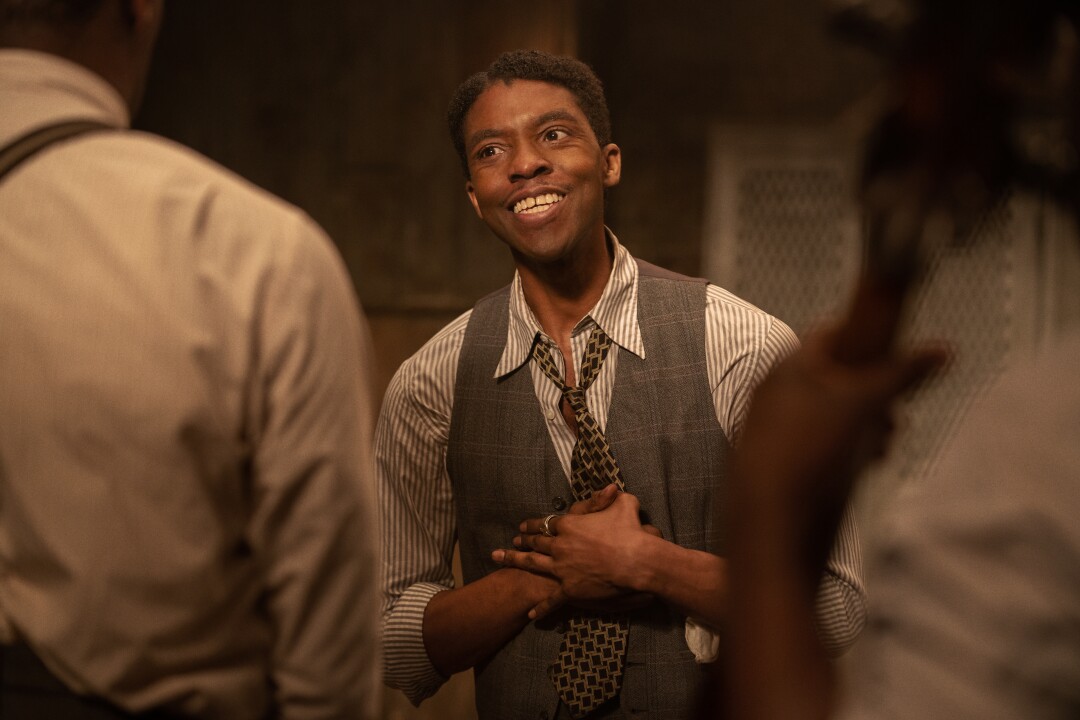
Chadwick Boseman as Levee in “Ma Rainey’s Black Bottom.”
(David Lee / Netflix)
Tobias Schliessler, “Ma Rainey’s Black Bottom” (Netflix)
(Directed by George C. Wolfe)
The drama may take place nearly 100 years ago but the message in “Ma Rainey’s Black Bottom,” starring Viola Davis and Chadwick Boseman, is as urgent as ever. Set in 1927 Chicago and based on August Wilson’s play of the same name, the film’s primary location is a cramped, featureless recording studio with few redeeming qualities. The steamy, unventilated space quickly becomes a pressure cooker of emotions, resentments, lusts and unspeakable traumas that ultimately converge in violence.
Favorite scene: “The scene that really sticks out for me is when Chadwick,” playing talented yet distracted trumpeter Levee, “recounts the rape of his mother and murder of his father to his bandmates,” Schliessler says. “That is such a moving scene, probably the most emotional one in the film and one of the most emotional I’ve ever filmed. We all felt like the camera and the lighting couldn’t be distracting to his performance in any way. George was adamant that we shoot the big monologue scenes in one continuous take so the actors could stay in the emotions. It is a six-minute take. When George said, ‘Cut,’ I realized I had been crying throughout the whole take.”
Genesis of the shot: “The basement practice room was the hardest room for me to shoot in because of its size,” Schliessler says. “It was 18-by-26-foot wide, so having four actors with their instruments made it very tight in there. We were using a very wide lens on a large-format camera. We needed to find two camera angles that could capture the whole six-minute monologue without interruption. We also wanted to use an extreme close-up on Chadwick using a very shallow depth of field, but we didn’t want to give him any specific marks [to make him feel] confined by camera or light constraints. The way George explained it to me at the beginning of prep was ‘I want you to think of it as a boxing ring, where the actors come together and have pages of dialogue, then they retreat into their corners before going out again.’”
(L-R) Dolly Grip Kyle Carden, camera operator Kirk Gardner, and cinematographer Tobias A. Schliessler on the set of Ma Rainey’s Black Bottom.”
(David Lee/NETFLIX)
Making it work: “I put two cameras on Chadwick as he’s addressing the group that track him as he retreats into his corner: one, on a profile to him behind the piano and the B camera at a 90-degree behind the band members,” he says. “Those two shots literally covered 90% of his performance in that scene. One camera had to get out of the way of the other, so it was a real ballet between those two cameras.” Both were on dolly tracks with 4-foot sliders and a single light source through the window gave the actor even more freedom to move. “I’ll never forget when he turned away from the other band members and walked right towards the A camera,” Schliessler recalls. “He landed in the ideal spot for my operator, Kirk Gardner, to slowly push in on his face, in perfect timing. Everyone was at the top of their game, especially Chadwick, who delivers the most incredible performance of his life. He was on set every day and had so many intense scenes to film. He never showed any weakness. It’s just so inspiring.”
Cinematographer Chris Menges’ favorite scene in “Waiting for the Barbarians.”
(Fabrizio Di Giulio)
Chris Menges, “Waiting for the Barbarians” (Samuel Goldwyn Films)
(Directed by Ciro Guerra)
Adapted by Nobel Prize-winning author J.M. Coetzee from his 1980 novel of the same name, “Waiting for the Barbarians” is a harrowing
story of colonialism and oppression and one man’s attempt to understand his role in perpetuating it. A nomadic indigenous people, the so-called “barbarians” that people the mountains surrounding an isolated settlement of “The Empire,” are rumored to be mounting an attack. The malevolent head of the empire’s special forces is sent in to cull the threat by ordering the capture and public torture of dozens of these tribal people. Some are killed. When the fortified settlement’s unnamed magistrate, played with distinctive command by Mark Rylance, tries as a last resort to stop it, he becomes yet another chapter in the hideous spectacle. Shooting in northwestern Africa was a dream come true for Menges. “Returning to the Sahara desert was like being in heaven for me,” Menges says. “The light was so crystal clear, the sun so bright, the sky so dark blue and the mountains such a rich, deep black.”
Favorite scene: “I loved the performance that Mark Rylance gives when he is handing back the girl to her own people in the mountains in the second part of the film,” Menges says. “When he tells her against that stunning backdrop, ‘This is what I want: I want you to return with me to the town,’ it stirs the heart. It’s just magic.”
Genesis of the shot: “In my script, I read the notes ‘The Magistrate is a complex person who wants nothing to do with the actions of the Third Bureau under Colonel Joll,” says the cinematographer. “He also knows he’s complicit in the action of the Empire. The mystery of the girl, played by Mongolian actress Gana Bayarsaikhan, lies not in her being part of the enemy ‘barbarians.’ It’s in the unbelievable pain, cruelty and suffering she experiences at the hands of her torturers, part of the Empire that the Magistrate represents.”
Cinematographer Chris Menges of “Waiting for the Barbarians.”
(Fabrizio Di Giulio )
Making it work: We were on the south side of the Atlas Mountains, so the weather in that part of the Sahara desert is very consistent. It’s always very bright and crystal clear. We obviously planned when we wanted to do it in terms of the light, but partly because the acting was so good, we got the shot very quickly without multiple takes. Like Cartier-Bresson, I just had to capture it. And that was a wonderful feeling. Mark Rylance is the most extraordinary person to work with. He’s just incredibly talented. But I also found the scenes between Gana and Mark to be completely devoid of emotional exploitation, so I think that’s another reason this worked so well. The story we told — and by “we” I mean John Coetzee along with Ciro and producer Michael Fitzgerald — is an extremely significant one to tell right now. It was Coetzee’s imagination and the very real horrors of apartheid that inspired the story and steered this ship.”
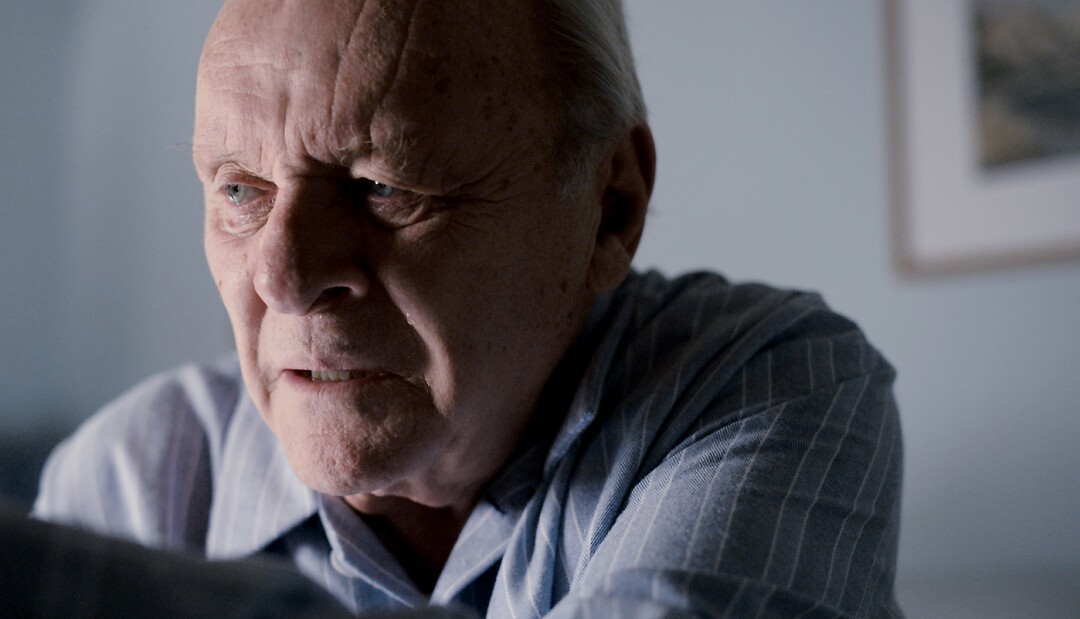
Anthony Hopkins as an elderly man experiencing dementia in “The Father.”
(Ben Smithard/Sony Pictures Classics)
Ben Smithard, “The Father” (Sony Pictures Classics)
(Directed by Florian Zeller)
It’s hard to top filming the likes of Maggie Smith, with her impeccable, scene-stealing timing, among the opulent rooms of England’s Highclere Castle. But for “Downton Abbey” cinematographer Ben Smithard, capturing Anthony Hopkins’ moving performance among the more simple, intimate spaces of “The Father,” was a career high point. “I’ve been lucky to work with him three times now, and his performance is stunning in this film,” says Smithard. First-time film director Florian Zeller ably moves a stellar cast through the confusion, fear, pathos and pain unleashed by a family member’s dementia.
Favorite scene: “I pretty much love all of this film, but my favorite scene is the last one, when he’s in his hospital room,” says Smithard. “You could look at it that he possibly doesn’t ever leave his hospital room for the entire film and you are simply inside his head. In this last scene, between him and Olivia Williams, who plays his nurse and whom he confuses with his daughter (Olivia Colman), he has a slight moment of clarity and feels completely alone. It’s so sad to look at but also amazing to watch. My job is to operate the camera, feel the emotion of the scene, try to understand the words, put the light where the important parts of the scene are, and try to position the audience where I am. Because if they can see what I see, they’ll get it.”
Genesis of the shot: “We shot with just one camera, and it was me behind it all the way through the film. The scene is four or five minutes, and it starts on him. The nurse gives him a postcard from his daughter from Paris; you see earlier in the film that she doesn’t go to Paris, but actually she does go. The entire scene is shot in two shots with a single cut, and it leads up to the end of the film and a closing shot out the window.”
Director Florian Zeller with cinematographer Ben Smithard.
(Sean Gleason / Sony Pictures)
Making it work: “A scene like this is so emotional for Tony,” says the DP. “I knew that if he was going to build himself up into this, he was only going to do it once, maybe twice. I didn’t really know where Tony was going to go, though of course I know what he’s going to say, so I know the timing of it. What I do is I just very slowly push the zoom in to a mid-shot, waist up. You don’t even notice. He says this deeply poignant line, about feeling as if he’s losing all the leaves off his tree, and he’s up against the door of the bedroom. He’s slowly moving into the corner of the room. I didn’t know he was going to go there, but I’m still slowly pushing in and getting closer to him. When he reaches the corner, he’s like a child. He’s lost all of his memory.
He holds his hand out, and Olivia takes it, and then goes over to the bed. Then there’s a cut, and he sits down on the bed with her, and we set up another position. As she puts her arm around him, I know I’ve got a really complicated and tricky move to make to end up out the window: I’ve got to move my body on the dolly without making any noise and disturbing them. And I can’t slip! I’m on the two of them, and I’ve got to twist my body and then step over the dolly as it’s moving, and I’m also pushing in a little bit. I have to get the timing spot-on, because the camera moves off them, across the bed, across the bedside table with a picture of his daughter on it, across the chair and out the window, and then slowly pushes out the window to the trees outside.”
Register with JOC.com and receive 5 free pieces of content for the first thirty days. After thirty days, you will receive 3 pieces of content and after sixty days you will receive 1 piece of content. To receive full access, Subscribe Today. You can also subscribe to our daily newsletter.
For the past three years, the Utah Legislature has made tweaks to the state’s inland port project.
This year’s bill, which passed a Senate committee Monday morning, creates a "bank" to distribute $75 million in loans for inland port infrastructure throughout the state. Utah’s Point of the Mountain and Military Installation Development Authorities could also use the money for their projects.
“Our goal with the use of this infrastructure bank is to use that to stimulate project development, project growth in our rural communities,” Hedge said. “That really is our focus.”
The bill would also get rid of a rule that prohibits the port’s board members from owning land within five miles of the project’s boundaries. That was originally implemented as a way to curb conflicts of interest.
Some people who opposed the bill criticized lawmakers for introducing it in the last week of the session — much like the first bill that created the port authority in 2018.
“The consequence of this is that once again, on a matter related to the proposed inland port and satellite ports, the taxpaying public is being shut out of the conversation,” said Deeda Seed, an organizer with the Stop the Polluting Port Coalition. The group opposes the project because of its potential environmental impacts.
Sen. Jerry Stevenson, R-Layton, sponsored the bill and said he’s been working on it throughout the session. Stevenson said it was late because of his own schedule.
“There’s no attempt to do this in a back room,” Stevenson said. “It’s out in daylight now, and I’m sure there will be plenty of opportunity to fix it in the future if we do get it wrong. If it needs to be tweaked, we have the capability of doing that.”
The bill passed the committee on a 6-1 vote. It now heads to the full Senate for consideration.
"port" - Google News
March 02, 2021 at 06:45AM
https://ift.tt/2ZZPVIQ
Utah Legislature's Latest Inland Port Bill Creates 'Bank' To Fund Infrastructure Projects - KUER 90.1
"port" - Google News
https://ift.tt/2VXul6u
https://ift.tt/2WmIhpL