Rechercher dans ce blog

Thursday, April 1, 2021

Local Scene: Conversation with the mayor, public art project unveiled - Gilroy Dispatch

Mayor hosting virtual conversation

Mayor Marie Blankley will host a virtual Conversation and Coffee on April 3 at 8:30am.

To join the meeting, visit rb.gy/x593yf with passcode 700029. The public can also dial in at 669.900.6833 with webinar ID: 82577203726 and passcode 700029.

Adopt-A-Bench public art project unveiled

Valley Water celebrated the completion of the pilot Adopt-A-Bench project with a virtual ribbon cutting ceremony on March 18. 

Two decades ago, Valley Water installed nearly 200 interpretive benches throughout Santa Clara County. Recently, the Valley Water Youth Commission worked alongside Paul J. Gonzalez, a San Jose artist and muralist, to repurpose and revitalize seven of these benches as part of a pilot program.

The revitalized benches have artwork that depict scenes of environmental stewardship, highlighting the importance of protecting plants and wildlife. The benches are along Uvas Creek at Christmas Hill Park in Gilroy, Saratoga Creek in Santa Clara, Berryessa Creek in Milpitas, Los Alamitos Creek and Penitencia Creek in San Jose, Stevens Creek in Cupertino and Permanente Creek in Los Altos.

“I think this project did a fantastic job of combining art and interesting information about the local flora and fauna surrounding each of these benches,” Youth Commissioner Elise Mullen said.

For information, visit valleywater.org/Adopt-A-Bench.

Local resident named to Dean’s List at LIM College

Emma Seery of Gilroy was named to the Dean’s List at LIM College for the Fall 2020 semester. 

To be placed on the Dean’s List, students must earn a grade point average between 3.50 and 3.79.

Founded in 1939, LIM College, located in Manhattan, educates students in the global business of fashion and its related industries.

Let's block ads! (Why?)


"Scene" - Google News
April 02, 2021 at 05:00AM
https://ift.tt/3whO9BM

Local Scene: Conversation with the mayor, public art project unveiled - Gilroy Dispatch
"Scene" - Google News
https://ift.tt/36mRPVq
Shoes Man Tutorial
Pos News Update
Meme Update
Korean Entertainment News
Japan News Update

Day 16 of Derek Chauvin trial: Supervisor detailed to jurors the immediate aftermath of George Floyd's death - Minneapolis Star Tribune

Derek Chauvin's supervisory sergeant detailed to jurors Thursday afternoon the immediate aftermath of George Floyd's death as word of the incident spread through Police Department administration.

Retired Third Precinct Sgt. David Pleoger fielded concerns through 911 dispatch on May 25 about possible excessive use of force by officers while detaining Floyd, and his initial assessment was that it sounded more like a less serious "takedown," according to dispatch audio from that night. He then headed to the scene while questioning Chauvin on what happened.

"Not really, but had to hold the guy down, he was going crazy … wouldn't go in the back of the squad," Chauvin is heard telling his sergeant over the phone on his supervisor's body-worn camera.

Pleoger then testified that Chauvin did not immediately tell him that he placed his knee on Floyd's neck. And when Chauvin made that disclosure later that night, he did not say for how long, the sergeant added.

The sergeant, who reviewed officers' body-worn camera video, was asked when use of force against Floyd should have ended. He replied: "When Mr. Floyd was no longer offering up any resistance to the officers, they could have ended their restraint."

Was that when Floyd was handcuffed and on the ground, prosecutor Steve Schleicher asked? "Yes," Pleoger replied.

Pleoger also testified that he was told by Chauvin that Floyd "became combative … after struggling with him. He suffered a medical emergency and an ambulance was called."

Asked whether Chauvin mentioned any use of force, Pleoger said he recalled, "I don't believe so."

Body-camera footage from the scene captured Pleoger instructing Chauvin and officers Tou Thao, Thomas Lane and J. Alexander Kueng to speak with witnesses.

"We can try, they're all pretty hostile," Chauvin said.

Pleoger then headed to HCMC and instructed Chauvin and Thao to do the same. Once there, he eventually learned Floyd had died and the situation was now a "critical incident."

Pleoger said he spoke with Chauvin at HCMC that night, and it was then that he learned the officer had his knee on Floyd's neck, but Chauvin did not disclose how long that contact lasted. He notified the lieutenant on duty and separated Chauvin and Thao for interviews.

Pleoger said he asked Chauvin whether other force was used.

"He said he knelt on Floyd or knelt on his neck," Pleoger testified.

"Is that the first time you became aware that force had been applied to George Floyd's neck?" Schleicher asked.

"Yes," he said.

"Did the defendant tell you how long he applied pressure to his neck?"

"No."

"And at some point, did you receive another update on Floyd's medical condition?"

"Someone approached me and let me know that he passed away."

Defense attorney Eric Nelson established while questioning Pleoger that the sergeant has made thousands of arrests in his long career and sometimes used force.

"Would you agree with the general premise that the use of force is "not necessarily attractive [and] sometimes officers have to do very violent things [and] it's a dangerous job?" Pleoger replied, "Yes."

Nelson also again hinted at the argument that the officers were concerned about the angry bystanders when he asked whether it was more important to deal with the immediate threat than a medical emergency. Pleoger said he would try to deal with both simultaneously.

"For example, if you were in a gun battle, and someone was shooting at you, and someone went into cardiac arrest, would you stop what you were doing to mitigate the threat or to immediately perform CPR?" Nelson asked.

"I'd mitigate the threat," Pleoger said.

The what to do and when kept up as the two sides wrapped up their questioning of Pleoger at the end of the day's proceedings.

The sergeant agreed with prosecutor Steve Schleicher that if a suspect is no longer resisting, then police restraint is not long needed. Pleoger's answers were the same should a suspect no longer have a pulse or stopped breathing.

And also stop restraining a suspect who is no longer resisting in order "to render medical attention?" Schleicher asked. Again, the sergeant said, "Yes."

Nelson followed and got Pleoger to agree that giving medical aid on the spot might not be wise if there was an especially agitated crowd nearby or if a suspect were in a busy street "with buses and cars going by." Both those circumstances, Nelson has suggested during the trial, were present during Floyd's arrest.

In general, the defense attorney said, officers need to assess "the totality of the circumstances and not just one single factor." The sergeant again agreed with Nelson.

Earlier Thursday, one of the paramedics who responded to the scene where Floyd lay unresponsive under Chauvin's knee testified that he immediately suspected Floyd was dead.

Hennepin EMS paramedic Derek Smith testified that he checked Floyd's pulse while three officers were on the patient, and he did not detect one. He also checked his pupils, which were dilated.

"I looked to my partner, I told him 'I think he's dead, and I want to move this out of here and begin care in the back,' " Smith said, noting the agitated crowd of bystanders. "In a living person, there should be a pulse there. I did not feel one. I suspected this patient to be dead."

However, they continued to work on Floyd in the rear of the ambulance, including directing Officer Lane to deliver chest compressions while they attempted various lifesaving attempts en route to HCMC, where Floyd was later officially pronounced dead.

Smith said Floyd never regained a pulse, but they continued attempting to save him.

"He's a human," Smith said. "I was trying to give him a second chance at life."

Under cross examination, defense attorney Nelson asked Smith why he had Lane do chest compressions when he is not an EMT. Smith said he did not know Lane's level of training, but that "any layperson can do chest compressions."

"I wanted as many people who were available at that time to help me with this cardiac arrest," Smith said.

Next to testify was Fire Capt. Jeremy Norton, who rode the firetruck from his station to Cup Foods only to find no patient there, but he encountered an "agitated to distraught" off-duty firefighter, Genevieve Hansen, and other bystanders. However, Norton said, he inquired more about her concerns as he kept searching for a patient.

While still looking, Norton soon learned over his radio that he and his rig were needed elsewhere immediately for someone injured "in a scuffle with the police, or a situation with the police." The firefighters then met up with the ambulance holding Floyd at E. 36th Street and S. Park Avenue, where he saw the man being treated by paramedics using all available medical tools.

"He was an unresponsive body on a cot," Norton said of Floyd.

"We did multiple pulse checks" and never found a pulse all the way to HCMC, he said.

With the call complete, Norton said he turned his attention back to Hansen, the off-duty firefighter.

He said that once "I understood the justification for her duress, I sent my crew back to her to make sure she was OK."

Norton said he also checked in with department administration that night and reported that Floyd "had been killed in police custody."

Nelson followed the prosecution and went over the times of the various emergency calls in connection with fire and EMS personnel responses but otherwise raised no other points for Norton to address.

Earlier in the day, George Floyd's girlfriend described through tears to jurors that her relationship of nearly three years with him leading up to his death, acknowledging that they both struggled with opioid addiction.

Courteney Ross, 45, began sobbing as she described how she met her boyfriend, whom she called "Floyd," in August 2017 while he was working security at the Salvation Army Harbor Light shelter in downtown Minneapolis.

Ross said she was at the shelter to meet her son's father.

"I started fussin' in the corner of the lobby" because the father wasn't coming to the lobby, she said. That's when the two met, she said, dabbing tears.

"You OK, sis?" she recalled him saying in his "great, deep Southern voice, raspy."
They met again soon and had their first kiss in that lobby, she said.

After describing her life with Floyd, prosecutor Matthew Frank shifted his questioning to their opioid addiction, which she said was triggered by chronic pain. Both had prescriptions and became addicted, then obtaining the drugs off the street. She said he typically used oxycodone. They obtained them through other people's prescriptions to ensure that they were safe.

"Both Floyd and I, our story is a classic story is of how we both get addicted to opioids," she testified. " ... We got addicted and tried really hard to break that addiction many times."

She said that off and on they were able to kick the addiction, by May 2020 she believed he was using again, based on changes in his behavior.

Questioning by Nelson focused on Floyd's drug use starting in March 2020 and closer to his death in May. The defense has contended that illicit drug use played a role in Floyd dying and not anything Chauvin did to him on May 25.

Ross said she and Floyd got pills in May that reminded her of "the same feeling" she had from similar pills she took in March, a stimulant that kept her up all night and left her jittery.

"And by similar experience, do you recall telling the FBI that when you had them that you felt like you were going to die?" Nelson asked.

Ross said she didn't recall saying that, but that it was in her FBI transcript.

Nelson asked whether those pills came from Morries Hall, who was with Floyd outside Cup Foods on the night he was arrested and died.

"I believe so, I'm not sure," said Ross, who did acknowledge having told the FBI that those pills left Floyd "bouncing around and unintelligible."

Under questioning by Nelson, she also recounted that in March she took Floyd to the hospital after he was "doubled over in pain" because his stomach hurt. He was hospitalized for several days.

"You later learned that was due to an overdose?" Nelson asked.

"Yes," Ross said.

"Did you learn what caused the overdose?"

"No."

"You did not know that he had taken heroin at that time?" Nelson asked.

Ross responded that she did not.

Ross was followed by Hennepin EMS paramedic Seth Bravinder, who walked jurors through their attempts to resuscitate Floyd, who was in full cardiac arrest and never regenerated a pulse.

Upon arriving to the scene, Bravinder said "there were multiple officers on top of the patient, we assumed — I assumed — there was potentially some struggle still because they were still on top of him."

Bystander footage showed Bravinder and his partner, and the officers lift Floyd onto a stretcher while Bravinder protected his head from hitting the pavement. Asked why, Bravinder said "He was, I guess, limp was the best description; he was unresponsive and not holding his head up or anything like that."

Bravinder and Smith, his partner, loaded Floyd into the ambulance and began working on him. He said full cardiac arrest is "not a good sign for successful resuscitation. Basically, just because your heart isn't doing anything at that moment, it's not pumping blood. It's not a good sign for a good outcome."

Nelson's questions addressed in part the gathering crowd at 38th and Chicago and noted that Floyd was moved quickly in the ambulance to a different location before continuing on to HCMC. The defense earlier in the trial has touched on how bystanders might have created an atmosphere that was potentially threatening to the officers at the scene.

Bravinder agreed with Nelson that Floyd needed to be moved in what is called a "load and go" to a spot a few blocks away, where Fire Department personnel joined in the resuscitation effort. From there, the trip resumed to HCMC.

Prosecutor Erin Eldridge countered and asked what other reasons are there for leaving an active police scene swiftly, and Bravinder said it's prudent to get the patient "in the ambulance with the [medical] equipment [and to be] in a good environment to concentrate."

Bravinder confirmed under questioning that medics carried ketamine to sedate agitated patients, but that it was not used on Floyd.

Paul Walsh • 612-673-4482

Let's block ads! (Why?)


"Scene" - Google News
April 02, 2021 at 04:18AM
https://ift.tt/3rJv9II

Day 16 of Derek Chauvin trial: Supervisor detailed to jurors the immediate aftermath of George Floyd's death - Minneapolis Star Tribune
"Scene" - Google News
https://ift.tt/36mRPVq
Shoes Man Tutorial
Pos News Update
Meme Update
Korean Entertainment News
Japan News Update

Cost of investigation into Port Ludlow chief hits $16k - Port Townsend Leader

blogjewishscene.blogspot.com

An outside investigation into allegations of misdeeds by Fire Chief Brad Martin has cost Port Ludlow Fire & Rescue more than $16,000.

In-house legal costs of the complaints made against the chief by the firefighters union and related issues also run into the thousands of dollars, according to invoices obtained by The Leader via a public records request.

Port Ludlow fire commissioners agreed late last year to hire an outside attorney to look into allegations against the chief made by Jefferson County Professional Firefighters Local 3811, the union that represents Port Ludlow firefighters.

Attorney Tom Burke was hired to look into concerns raised by the union after it took a vote of “no confidence” in Martin and submitted multiple letters alleging misdeeds by the chief.

The investigation was finalized in February but not made public.

At a subsequent meeting of the fire commissioners’ board, commissioners voted 3-2 against firing Martin.

Martin declined to offer comment to The Leader on the controversy. 

Fire Commissioner Chairman Gene Carmody also declined an interview request.

During the most recent commissioners’ meeting, Wicus McGuffey, president of Jefferson County Professional Firefighters, said union members were disappointed that Martin would remain chief.

“I just want to take the opportunity to express the disappointment of the local in the decision of the board to retain Chief Martin as the fire chief,” McGuffey told commissioners.

“I feel like, as a group, we had legitimate and significant concerns about his leadership of the organization and its impact on firefighter safety and service delivery,” he said.

McGuffey said commissioners have not sought additional input on the allegations from firefighters.

“I appreciate the steps that the board took to initiate an investigation. However, I feel like outside of the letters of communication that the local has submitted to the board, we’ve had no engagement from the board to further expound on our concerns, those impacts to us as a stakeholder group and what we feel our mission is with Port Ludlow Fire and Rescue,” McGuffey said.

“I understand a motion was made and accepted. However, I don’t think that dissuades the concerns of the local. And we’re hoping that there’s an opportunity to engage with the board to further discuss on a more personal level the impacts that we’re feeling as a labor group and how we see those impacts to the organization,” he added.

McGuffey noted commissioners had not scheduled a labor-management meeting since the third quarter of 2020, and the union had not been invited to participate in any executive sessions with the board or outside talks about the chief.

Carmody, the board chairman, told McGuffey he would be willing to talk.

“From my lips to your ears; we will take that under advisement,” Carmody said.

Carmody promised he would personally contact McGuffy for a labor-management meeting.

“So there you are; you got it,” Carmody told him.

The vote of no confidence in the fire chief was the first ever by Local 3811 against one of their chiefs.

The union criticized Martin for a lack of strategic planning and the loss of career firefighters who have taken jobs with other departments. 

The union said the lack of planning in the department was a primary factor in the departure of five career firefighters in the past two years.

And in a second letter of allegations that stretched for five pages, union leadership set out additional claims of “Chief Martin’s failures to lead.”

McGuffey claimed the chief had failed to properly manage the department’s staffing, and recalled an aid call to assist a 100-year-old man last August.

McGuffey said other firefighters had been dispatched to other alarms, leaving only an off-duty firefighter who was on probation to respond to the aid call. McGuffey criticized Martin for not responding to the medical emergency himself, calling it a “gross failure.”

Martin was also criticized for frequently responding to emergency incidents with his family members in his command vehicle, including minor children who were left without adult supervision at emergency scenes. 

“There have been specific cases of one of his minor children being outside of the vehicle on working fires in an area that would be considered the ‘hot zone’ and where a minor child was left unsupervised in the command vehicle that was positioned on a high speed roadway in precarious conditions of limited visibility and icy road conditions,” McGuffey wrote in a letter of complaint. “This is not only a significant liability, but discredits the professionalism of PLFR in the eyes of our mutual aid partners.”

McGuffey also noted additional allegations of what he said were examples of a lack of organizational oversight and mismanagement in the department by Martin, which included staffing issues as well as the purchase of a new command vehicle, which McGuffey said exceeded by $18,600 the $75,000 that was budgeted for the vehicle and was made without fire commissioners’ approval.

Martin has not publicly addressed the complaints, and said after the vote of no confidence that he thought the allegations were without merit.

Legal invoices for the investigation were redacted in parts to remove information the fire district’s attorney said were not subject to public disclosure. Information that was removed included the names of people who were interviewed as part of the investigation against Martin.

It is not clear that Martin was interviewed as part of the probe; documents released by the fire district show that one person refused to be interviewed but that person’s name was redacted from attorney billing records.

Burke was paid $250 an hour for his work on the investigation. Billing records through March 1 show his firm was paid $16,143 for the investigation, which includes some time by a paralegal on the case.

Port Ludlow Fire & Rescue said earlier it would not release a copy of the investigation for public review.

The report, according to the fire department, was protected by attorney-client privilege, and was prepared in anticipation of litigation.

Martin is paid a salary of $125,000 a year.

His current employment contract was approved by the board in October 2018 and expires Aug. 31.

Let's block ads! (Why?)


"port" - Google News
April 02, 2021 at 03:32AM
https://ift.tt/3ue2gWX

Cost of investigation into Port Ludlow chief hits $16k - Port Townsend Leader
"port" - Google News
https://ift.tt/2VXul6u
https://ift.tt/2WmIhpL

League offers videos for new candidates - Port Townsend Leader

blogjewishscene.blogspot.com

The League of Women Voters of Jefferson County recently posted a series of informational videos for those wishing to run and serve in public office.

The three videos are comprised of question-and-answer sessions with city and county officials and are designed to encourage potential candidates by giving them a clear idea of what to expect while campaigning and what’s to come once they’re in office.

So as to not make the videos a partisan issue, the League of Women Voters opted to only interview officials who were not up for election in the next calendar year. Interviewed were Port of Port Townsend Commissioners Bill Putney and Pam Petranek; Kristina Mayer and Nathaniel O’Hara of the Chimacum and Port Townsend school boards; and Monica MickHager and David Faber of the Port Townsend City Council.

Videos cover the topics of campaigning and the day-to-day work of elected officials, as well as the work they may be called upon to address during their time in office. The elected officials also offer advice to any aspiring candidates.

For more information, or to watch the videos, visit https://lwvwa.org/Jefferson.

Let's block ads! (Why?)


"port" - Google News
April 02, 2021 at 12:25AM
https://ift.tt/3dqHwnZ

League offers videos for new candidates - Port Townsend Leader
"port" - Google News
https://ift.tt/2VXul6u
https://ift.tt/2WmIhpL

US port authorities hopeful West Coast port congestion will ease - World Grain

blogjewishscene.blogspot.com

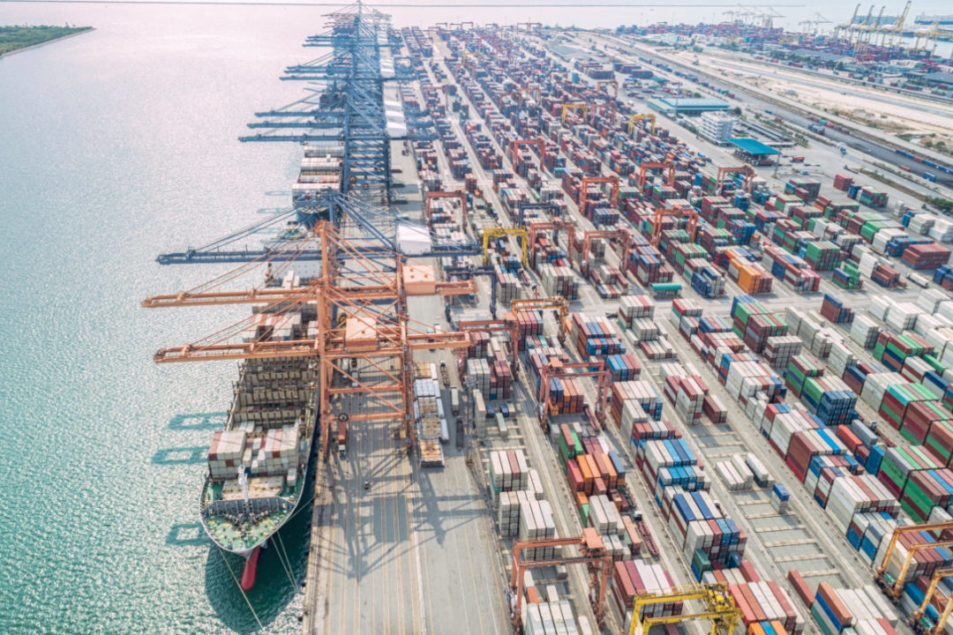
KANSAS CITY, MISSOURI, US — Port authorities were hopeful congestion that has plagued container loading and unloading facilities along the West Coast will diminish with the approach of summer. But there likely will be little time to fully recover more normal port operations before August, when import volumes, already at record levels, will begin to expand seasonally ahead of the winter holidays.

In the meantime, imports of containers loaded with consumer goods, including food and food ingredients grown or manufactured in Asian and Pacific nations, were delayed in reaching American importers for transport to markets across the United States, and exporters of American agricultural products complained that ocean carriers were slow to load or even refused to load US agricultural exports in order to expedite the return of empty containers to Asia to take advantage of the far more lucrative west-to-east trade.      

The explosion in e-commerce purchases by American consumers in the last several months of the pandemic resulted in container volumes that overwhelmed workforces on the docks, in warehouses and on truck routes in between that have struggled with illnesses and absences because of the COVID-19 pandemic. It was expected these workforce problems will abate as more workers are vaccinated.

Some US ports have never been busier. The Port of Los Angeles, the largest container port in North America, was experiencing record volume. The port processed 799,315 containers, 20-foot equivalent units (TEUs), in February, a 47% jump compared with February 2020.  It was the seventh consecutive month of year-over-year increases in volume and the strongest February in the port’s 114-year history.

“One year ago, global trade slowed to a crawl as the COVID-19 pandemic first hit China and then spread worldwide,” Gene Seroka, executive director, Port of Los Angeles, said in a March 16 press briefing. “Today, we are in the seventh month of an unparalleled import surge, driven by unprecedented demands by American consumers.”

Seroka noted in February 2021 loaded container imports at the Port of Los Angeles reached 412,884 TEUs, up 53% from 270,025 TEUs in February 2020.  But loaded container exports totaled 101,208 TEUs, down 25% from 134,469 TEUs in February 2020.

At the same time, the dispatch of empty containers, heavily in demand in Asia, from the Port of Los Angeles surged 104% compared with February 2020, reaching 285,223 TEUs.

For importers, frustration and delays stem from the sheer number of container ships that must be unloaded and the time a container must wait on a dock tarmac or in a port warehouse before it is picked up for delivery to inland warehouses and points beyond.

Seroka in a March 30 interview with CNBC said, “The time it takes for the importer to pick up their cargo at the port is now more than four days, but it’s off its high of five days sitting under dwell.”

He reported some progress in other metrics as well.

“Truck times — the amount of time that it takes a trucker to move in and out of the port to drop off and pick up containers — has decreased to 77 minutes from 88 back in December,” Seroka said. “So, we’re starting to see some of the trending in the right direction.”

To accelerate improvement, Seroka emphasized the importance of getting the entire port workforce vaccinated.

“There are more than 100,000 folks who come to work here at the port complex every day,” he explained. “We’ve made significant strides (in vaccinating) with our dock workers and longshore members, but we still have a lot of work ahead of us with respect to truck drivers, warehouse workers and others.”

Seroka also said it was important for importers to pick up their cargoes as quickly as they can.

“We can then increase fluidity much more quickly,” he said. “Our tarmacs are about 90% full, and in our industry, 80% is considered full capacity.”

For agricultural product exporters, the greatest frustration in recent months has been the difficulty in securing containers, which increasingly have been shipped back across the Pacific empty.

In a recent interview with DC Velocity, Peter Friedmann, executive director, Agricultural Transportation Coalition, explained that ocean carriers consider the revenue they stand to receive on cargo shipped from Asia to the United States when deciding whether to have containers returned empty. Asian exporters of goods to the United States pay $6,000, $8,000, $10,000, and in some cases up to $14,00 in freight rates for a container going to the United States, Friedmann said.

 “US agriculture exporters have to compete with producers from all over the world,” Friedmann continued. “We cannot afford to pay those kinds of freight rates. The value of the cargo in those export containers (agricultural cargoes destined for Asia) is not that high. Therefore, the export revenue that the ocean carriers get for carrying the cargo westbound to Asia is more like $400, $800, or maybe $1,400 to $2,000 on the high end. So, ocean carriers are making an economic decision to forgo carrying cargo outbound across the Pacific and instead are sending the containers back empty.”

US agricultural organizations and even members of Congress were pressing the Biden administration to ensure US agricultural shippers are treated fairly by ocean carriers.

In a Feb. 24 letter to President Joe Biden and copied to Secretary of Agriculture Tom Vilsack; Secretary of Transportation Peter Buttigieg;  Michael Khouri, chairman of the Federal Maritime Commission (FMC), and Cecilia Rouse, chairwoman of the Council of Economic Advisers, the Agriculture Transportation Coalition and 70 other food and agriculture organizations, said, “According to their own public records, the ocean carriers are enjoying their most profitable period in decades by controlling capacity and charging unprecedented freight rates, imposing draconian fees on our exporters and importers, and frequently refusing to carry US agricultural products.”

The groups explained, “These refusals and charges by the ocean carriers dramatically increase costs to our exporters, marking foreign sales inefficient and uneconomical, rendering farmers and processors, for the first time, unreliable suppliers to the global supply chain.”

The groups asserted, “The Shipping Act provides the FMC with the authority to prohibit unreasonable, unjust practices and ‘to promote the growth and development of US exports through competitive and efficient ocean transportation.’ Given the urgency of this situation in commerce, we ask that these tools and any others available to our government be immediately applied to stem the current ocean carrier practices that are so damaging our agriculture exports.”

Roger Isom, president and chief executive officer, Western Agricultural Processors Association, who signed the letter addressed to the Biden administration, recently told Ag Net West, “There’s been movement from the Federal Maritime Commission. They’re definitely taking a deeper dive into investigating what the shipping companies are doing, but it’s very bureaucratic. They’re telling us it’s going to take weeks before any answers come back. We don’t have weeks. This thing has been going on for months.”

Let's block ads! (Why?)


"port" - Google News
April 01, 2021 at 08:35PM
https://ift.tt/3wmi7EW

US port authorities hopeful West Coast port congestion will ease - World Grain
"port" - Google News
https://ift.tt/2VXul6u
https://ift.tt/2WmIhpL

West Coast ports believe congestion will slow during summer - Meat & Poultry

blogjewishscene.blogspot.com

WASHINGTON — Port authorities were hopeful congestion that has plagued container loading and unloading facilities along the West Coast will diminish with the approach of summer. But there likely will be little time to fully recover more normal port operations before August, when import volumes, already at record levels, will begin to expand seasonally ahead of the winter holidays.

In the meantime, imports of containers loaded with consumer goods, including food and food ingredients grown or manufactured in Asian and Pacific nations, were delayed in reaching American importers for transport to markets across the United States, and exporters of American agricultural products complained that ocean carriers were slow to load or even refused to load US agricultural exports in order to expedite the return of empty containers to Asia to take advantage of the far more lucrative west-to-east trade.      

The explosion in e-commerce purchases by American consumers in the last several months of the pandemic resulted in container volumes that overwhelmed workforces on the docks, in warehouses and on truck routes in between that have struggled with illnesses and absences because of the COVID-19 pandemic. It is expected these workforce problems will abate as more workers are vaccinated.

Some US ports have never been busier. The Port of Los Angeles, the largest container port in North America, was experiencing record volume. The port processed 799,315 containers, 20-foot equivalent units (TEUs), in February, a 47% jump compared with February 2020.  It was the seventh consecutive month of year-over-year increases in volume and the strongest February in the port’s 114-year history.

“One year ago, global trade slowed to a crawl as the COVID-19 pandemic first hit China and then spread worldwide,” Gene Seroka, executive director, Port of Los Angeles, said in a March 16 press briefing. “Today, we are in the seventh month of an unparalleled import surge, driven by unprecedented demands by American consumers.”

Seroka noted in February 2021 loaded container imports at the Port of Los Angeles reached 412,884 TEUs, up 53% from 270,025 TEUs in February 2020.  But loaded container exports totaled 101,208 TEUs, down 25% from 134,469 TEUs in February 2020.

At the same time, the dispatch of empty containers, heavily in demand in Asia, from the Port of Los Angeles surged 104% compared with February 2020, reaching 285,223 TEUs.

For importers, frustration and delays stem from the sheer number of container ships that must be unloaded and the time a container must wait on a dock tarmac or in a port warehouse before it is picked up for delivery to inland warehouses and points beyond.

Seroka in a March 30 interview with CNBC said, “The time it takes for the importer to pick up their cargo at the port is now more than four days, but it’s off its high of five days sitting under dwell.”

He reported some progress in other metrics as well.

“Truck times — the amount of time that it takes a trucker to move in and out of the port to drop off and pick up containers — has decreased to 77 minutes from 88 back in December,” Seroka said. “So, we’re starting to see some of the trending in the right direction.”

To accelerate improvement, Seroka emphasized the importance of getting the entire port workforce vaccinated.

“There are more than 100,000 folks who come to work here at the port complex every day,” he explained. “We’ve made significant strides (in vaccinating) with our dock workers and longshore members, but we still have a lot of work ahead of us with respect to truck drivers, warehouse workers and others.”

Seroka also said it was important for importers to pick up their cargoes as quickly as they can.

“We can then increase fluidity much more quickly,” he said. “Our tarmacs are about 90% full, and in our industry, 80% is considered full capacity.” 

For agricultural product exporters, the greatest frustration in recent months has been the difficulty in securing containers, which increasingly have been shipped back across the Pacific empty.

In a recent interview with DC Velocity, Peter Friedmann, executive director, Agricultural Transportation Coalition, explained that ocean carriers consider the revenue they stand to receive on cargo shipped from Asia to the United States when deciding whether to have containers returned empty. Asian exporters of goods to the United States pay $6,000, $8,000, $10,000, and in some cases up to $14,000 in freight rates for a container going to the United States, Friedmann said.

 “US agriculture exporters have to compete with producers from all over the world,” Friedmann continued. “We cannot afford to pay those kinds of freight rates. The value of the cargo in those export containers (agricultural cargoes destined for Asia) is not that high. Therefore, the export revenue that the ocean carriers get for carrying the cargo westbound to Asia is more like $400, $800, or maybe $1,400 to $2,000 on the high end. So, ocean carriers are making an economic decision to forgo carrying cargo outbound across the Pacific and instead are sending the containers back empty.”

US agricultural organizations and even members of Congress were pressing the Biden administration to ensure US agricultural shippers are treated fairly by ocean carriers.

In a Feb. 24 letter to President Joe Biden and copied to Secretary of Agriculture Tom Vilsack; Secretary of Transportation Peter Buttigieg;  Michael Khouri, chairman of the Federal Maritime Commission (FMC), and Cecilia Rouse, chairwoman of the Council of Economic Advisers, the Agriculture Transportation Coalition and 70 other food and agriculture organizations, said, “According to their own public records, the ocean carriers are enjoying their most profitable period in decades by controlling capacity and charging unprecedented freight rates, imposing draconian fees on our exporters and importers, and frequently refusing to carry US agricultural products.”

The groups explained, “These refusals and charges by the ocean carriers dramatically increase costs to our exporters, marking foreign sales inefficient and uneconomical, rendering farmers and processors, for the first time, unreliable suppliers to the global supply chain.”

The groups asserted, “The Shipping Act provides the FMC with the authority to prohibit unreasonable, unjust practices and ‘to promote the growth and development of US exports through competitive and efficient ocean transportation.’ Given the urgency of this situation in commerce, we ask that these tools and any others available to our government be immediately applied to stem the current ocean carrier practices that are so damaging our agriculture exports.”

Roger Isom, president and chief executive officer, Western Agricultural Processors Association, who signed the letter addressed to the Biden administration, recently told Ag Net West, “There’s been movement from the Federal Maritime Commission. They’re definitely taking a deeper dive into investigating what the shipping companies are doing, but it’s very bureaucratic. They’re telling us it’s going to take weeks before any answers come back. We don’t have weeks. This thing has been going on for months.”

Let's block ads! (Why?)


"port" - Google News
April 01, 2021 at 08:25PM
https://ift.tt/3wkesHl

West Coast ports believe congestion will slow during summer - Meat & Poultry
"port" - Google News
https://ift.tt/2VXul6u
https://ift.tt/2WmIhpL

DOT's Maritime Administration issues NOFO for Port Infrastructure Development Program - Logistics Management

blogjewishscene.blogspot.com

Earlier this week, a Notice of Funding Opportunity (NOFO) was issued by the United States Department of Transportation’s Maritime Administration, which encourages states and port authorities to apply for $230 million in discretionary grant funding for port and intermodal infrastructure-related projects through the Port Infrastructure Development Program (PIDP).

DOT officials explained that the PIDP supports the efficient movement of commerce upon which the economy relies upon, with grants awarded on a competitive basis to support projects that strengthen and modernize port infrastructure and support the nation’s long-term economic vitality.

DOT said the review process will also consider how proposed projects address climate change and environmental justice impacts and advance racial equity, reduce barriers to opportunity, and meet challenges faced by rural areas, all key priorities of the Biden-Harris Administration.  

“Our nation’s ports are a key part of our critical infrastructure. They create jobs and make our economy more resilient and sustainable,” said U.S. Secretary of Transportation Pete Buttigieg, at a White House event focused on the development of offshore wind and energy programs. “This funding will build upon local investments in infrastructure to deliver long-term economic benefits to American workers and communities, while also addressing climate and equity.”

The Consolidated Appropriations Act 2021, made $230 million available for the Port Infrastructure Development Program, with $205 million reserved for grants to coastal seaports and Great Lakes ports, according to DOT. And it added that the minimum award size is $1 million, with a Federal cost-share not to exceed 80%, although the Federal cost share can be higher for certain categories of projects.

Port of Long Beach Executive Director Mario Cordero recently told LM that it is imperative that U.S. ports continue to seek funding for the PIDP.

“The good news is that Congress has put some money towards it,” he said, in a November interview. “We will see where it goes, but there still needs to be negotiations between the Senate and the House to reach a common ground.” 

Let's block ads! (Why?)


"port" - Google News
April 01, 2021 at 01:53PM
https://ift.tt/3dEZrrt

DOT's Maritime Administration issues NOFO for Port Infrastructure Development Program - Logistics Management
"port" - Google News
https://ift.tt/2VXul6u
https://ift.tt/2WmIhpL

Search

Featured Post

JAX firefighters find Jaguars star Travis Hunter at the scene of a call last week - Action News Jax

[unable to retrieve full-text content] JAX firefighters find Jaguars star Travis Hunter at the scene of a call last week    Action News Jax ...

Postingan Populer