Rechercher dans ce blog

Thursday, December 23, 2021

Sudan's Red Sea port struggles to recover from blockade and turmoil - Reuters

blogjewishscene.blogspot.com

A man stands opposite the modern port at the harbour in Port Sudan at Red Sea State February 24, 2014. REUTERS/Mohamed Nureldin Abdallah

Register now for FREE unlimited access to Reuters.com

  • Tribal group blocked port in dispute with government
  • Several major shipping firms paused bookings
  • Some see Port Sudan losing out to Egyptian rival
  • Foreign investment in trade gateway may wither

KHARTOUM/LONDON, Dec 23 (Reuters) - A blockade of Sudan's main Red Sea port by a local tribal group and threats of more disruptions have hurt efforts to lift the country out of economic crisis and could push trade flows to another regional route, officials and shipping executives say.

Several shipping firms were forced to pause bookings via Port Sudan, the African nation's main international trade gateway that generates vital revenue for the cash-strapped state that is trying to recover from three years of political turmoil.

The port, the main route for 90% of Sudan's international trade and the terminal for a regional oil pipeline, could lose business to overland trade via Ain Sokhna, a Red Sea port in neighbouring Egypt to the north, Sudan's former trade minister Ali Jiddo and other industry sources told Reuters.

Register now for FREE unlimited access to Reuters.com

Another former minister said foreign investor interest in upgrading the port - which Sudan has long sought to turn into a hub to serve neighbouring landlocked nations - could wither.

"Anything can happen so people will stay away from Port Sudan for a while," a managing director for a local logistics company told Reuters, saying the blockade and other disruptions showed the government was not in full control.

The Beja Council, a group representing some eastern Sudanese tribes that have long complained of neglect by the central government, blocked the port for more than six weeks until Nov. 1 and has threatened further action. Meanwhile, Sudan has been convulsed by national protests and an Oct. 25 military coup.

The group demanded a new cabinet and renegotiation of a sweeping 2020 deal that aimed to end conflicts across Sudan.

The group's actions reversed efforts to improve efficiency at the port. A U.N. report this month said the blockade had left 950 containers stuck at the port, while a port official said the facility had lost 45 million euros ($51 million) in revenue.

Meanwhile, the capital and other areas of Sudan have faced shortages of fuel, wheat and other food imports.

Sudan's military initially did little to intervene to end the blockade by the Beja Council, saying it was a legitimate protest against poor conditions in Sudan's east - although demonstrators on the streets of Khartoum have often face teargas and sometimes live rounds. The military denies opening fire.

PAYING THE PRICE

Opponents of Sudan's generals say the failure to act more swiftly - the blockade only came to an end after the Oct. 25 coup - may have served the military's aims by creating a sense of crisis.

The military, which denies any collusion, said last Thursday it was offering a concession related to the Beja Council's demands, preventing a second blockade of the port.

Whoever is to blame for the port disruptions, businesses say they are paying the price.

"The private sector is the one who pays for these political conflicts," said a medicine importer, who said delays pushed up fees and sometimes meant products arrived after their expiry.

A Sudanese shipping agent, who like several others contacted by Reuters asked not to be identified because of political sensitivities, said delays had meant the export window had been missed for key export earners such as sesame seeds, peanuts, cotton and gum arabic.

Two major shipping lines resumed new bookings on Tuesday to import and export container shipments via Port Sudan but prices were 50% higher than before the blockade, the agent said.

The managing director of the logistics firm said freight costs for Chinese firms that had not halted activity had doubled.

Faced with disruptions in Port Sudan and higher costs, officials at Egypt's Red Sea port of Ain Sokhna said they had seen a rise in Sudan-related trade, without giving figures. Several executives said businesses were considering a more permanent shift to cope with the uncertainty of shipping via Port Sudan.

Plans for Sudan's economic recovery had included developing Port Sudan as a regional logistics hub for landlocked neighhours. Sudan's former infrastructure minister Hashim Ibnouf said the port had in the past attracted interest from investors in the United Arab Emirates, Egypt and France.

Philippines-headquartered International Container Terminal Services (ICTSI) (ICT.PS) signed a 20-year concession in January 2019 to manage a portion of Port Sudan. But the deal with the port authority was cancelled later that year after President Omar Bashir, who had ruled for three decades, was toppled.

ICTSI head of corporate Christian Gonzalez said his company "would be willing to come back to the table" once it received some 200 million euros owed as the remainder of its upfront fee.

A port official said the port had received a new investment offer and said he thought trade flows through Port Sudan would return to normal in 2022.

($1 = 0.8841 euros)

Register now for FREE unlimited access to Reuters.com

Reporting by Nafisa Eltahir and Khalid Abdelaziz in Khartoum, Jonathan Saul in London; Additional reporting by Yusri Mohamed in Ismailia and Aidan Lewis in Cairo; Writing by Nafisa Eltahir; Editing by Aidan Lewis and Edmund Blair

Our Standards: The Thomson Reuters Trust Principles.

Adblock test (Why?)


"port" - Google News
December 23, 2021 at 07:17PM
https://ift.tt/32wQjTO

Sudan's Red Sea port struggles to recover from blockade and turmoil - Reuters
"port" - Google News
https://ift.tt/2VXul6u
https://ift.tt/2WmIhpL

Wednesday, December 22, 2021

Extending ports' operating hours won't be enough to fix supply chain disruptions | TheHill - The Hill

blogjewishscene.blogspot.com

The colossal shipping jam at Southern California’s ports is delivering one thing in abundance: surprise anxiety for American families, many worried whether Santa will pull through in time — and without breaking the bank.

But for experts in supply-chain management, what’s happening is no surprise. Instead, it’s the unmasking of a long-hidden problem, thanks to disruptions wrought by the pandemic.

Addressing the fundamental causes will require much more than extending hours at the ports, a development heralded last month by the White House. To keep these shipping slowdowns from recurring, worsening and menacing economic growth, the U.S. needs comprehensive strategies to update overall port infrastructure, encourage automation and strengthen communication.

First, the nation must reckon with the port system’s severe capacity issues. The country’s two largest ports — the ports of Los Angeles and Long Beach, which handle 40 percent of imports and 30 percent of exports — rank only as the ninth-largest port operation in the world when counted as a combined entity. This is a glaring mismatch with the United States’s standing as the largest economy, the largest importer and the second-largest exporter.

Notably, seven of the 10 biggest ports are in China. The No. 1-ranked Port of Shanghai handles about three times the volume that moves through Los Angeles and Long Beach.

U.S. ports aren’t especially economical, either. In the World Bank’s new Container Port Performance Index, no U.S. port cracks the top 50 for efficiency. The Los Angeles and Long Beach ports land at 328 and 333, respectively, in the ranking of 351 container ports worldwide. Even the Port of Lome in Togo, one of the poorest countries, does better.

To understand how those rankings translate into time lost, consider this: It takes an average of 46 seconds to move a container on large vessel calls at the ports of Rotterdam, Antwerp and Hamburg. At the Port of Singapore and the Chinese ports of Yantian, Ningbo and Shanghai, the average is just 27 seconds. But at Los Angeles and Long Beach? A full 76 seconds. None of these figures includes the time to send cargo through customs or to collect it for shipping inland.

This isn’t to condemn the entire U.S. supply system. For years, domestic supply chains have negotiated our port system with amazing efficiency. Logistics costs have been around 8 percent of GDP. The number in China is around 14 percent; in Japan, 5 percent; and in Germany, 7 percent. In the U.S., a combination of thoughtful planning, supply-chain coordination, new technologies and routing and scheduling optimization make possible the standout performance.

Thanks to hardworking and highly efficient supply-chain managers, American holiday shopping carts always have been packed, even with the current bottleneck at port operations. This year again, retailers prepared and planned ahead, as early as the summer. Chartered vessels have been hired; ports on the East and Gulf coasts are added to shipping routes; and, of course, air transportation volume has increased. To counter rising prices, retailers such as Walmart have compromised with suppliers to manage costs. So far, consumers have had a favorable holiday shopping season.

However, there is a limit to how much our private sector can cope with outdated infrastructure in handling increased demand and unprecedented disruptions. We cannot delay the expansion and construction of our ports anymore. Specifically, they need railway connections, greater channel width, bigger cranes and higher bridges, both to accommodate large vessels and to encourage competition with one another.

The infrastructure shortfalls reach from coast to coast. In Seattle, the port’s crane is low and can’t off-load large vessels. Shipping channels in the New Jersey-New York area are narrow and limited by overhead bridges. Some ports lack railway connections. Ports such as Miami’s have benefited from smooth port-to-rail links, which should be expanded everywhere.

While all U.S. ports need better capacity, West Coast ports should be a priority because they’re the fastest conduit from East Asia. Cargo from Asian ports takes about three weeks in over-water time to arrive there, a full week or two faster than the travel time to the East Coast. And some giant ships just cannot pass through the Panama Canal to reach the East Coast.

Automation needs attention as well, but bigger budgets alone won’t do the trick. Collective-bargaining agreements slow automation in order to guarantee jobs. Conflicts between the ports and unions must be worked out, and politicians must work harder to reestablish trust and build partnerships with organized labor.

Finally, the ports’ intersections with the rest of the supply chain need better coordination. For example, the volume of inbound and outbound containers should be balanced constantly; railways and trucking companies should share loads efficiently to maximize the flow rate; and communications between shippers and carriers should be enhanced. In particular, shippers need better technology to track cargo containers. Stronger investment in artificial intelligence, the internet of things and blockchain technologies is key to this progress.

Who should pay up? Given the huge scope of the need, government at the federal and local levels should lead and coordinate large-scale investments. It should encourage experimentation, too — perhaps a brand-new port built without union constraints on automation. The U.S. could take a cue from the new Shanghai port, constructed on a manmade island replete with new technology and extreme efficiency.

A profound problem needs profound solutions. When we nail them down, we’ll safeguard not just holiday shopping but also our country’s economic vitality, keeping our ports from turning into a permanent battleground.

Yu Amy Xia is an associate professor of business analytics at the Raymond A. Mason School of Business and a faculty affiliate of William & Mary's Global Research Institute. Her research interests include contract design, risk management and new technology in supply-chain management.

Adblock test (Why?)


"port" - Google News
December 23, 2021 at 04:00AM
https://ift.tt/3qgLoi4

Extending ports' operating hours won't be enough to fix supply chain disruptions | TheHill - The Hill
"port" - Google News
https://ift.tt/2VXul6u
https://ift.tt/2WmIhpL

Georgia port uses pop-up concept to alleviate supply chain issues - CBS News

blogjewishscene.blogspot.com

The Port of Savannah in Georgia — one of the nation's busiest — is using a new pop-up container yard concept that could be applied nationwide to unclog shipping ports where goods have been stacking up for months.

Back in October, cargo ships spent 12 days waiting to unload in the Port of Savannah — three times as long as in 2019. To help, the port established what amounts to four in-land pop-up ports, one hundreds of miles away near the North Carolina border. Now, the number of cargo containers waiting is closer to seven.

"We think these things can be replicated across the nation," said Griff Lynch, the executive director of the Georgia Ports Authority. "...I see some of them becoming permanent yards where it's actually going to help our business."

The pop-ups, which were set up in idle rail yards, are now bringing cargo closer to its final destination, while freeing up space at the dock.

The port has been working around the clock — 24 hours a day — loading and unloading giant ships. And it's having an impact. In October, there were 31 vessels waiting offshore to be unloaded. That number has been cut to just six.

"It's that kind of problem solving that I think is going to help us deal with these short term issues, even while we're making big investments for the long run," Transportation Secretary Pete Buttigieg said.

Buttigieg said the Biden administration is now looking to see if similar pop-up sites make sense nationwide. But supply chain delays mean some goods did not make it before the holidays.

When asked if they had solved the problem, Buttigieg said: "We welcome ideas, but look at what we've been able to do cutting some of these container-dwell times in half. If you go to the store you're going to see a lot of options there."

Kinks in the supply chain are still limiting furniture designer Ruel Joyner's options. Inventory at his store, 24e Style, and in his warehouse are about half its normal size. One of his sofas is made in Dallas, Texas, but one of its parts comes from China and is back-ordered.

"We normally get this done in 24 to 30 days," Joyner said. "Right now we're probably looking at a six month lead time."

When asked if the supply chain was costing him money, Joyner said, "absolutely," displaying the costly consequence of a supply chain struggling to get back on track.

Adblock test (Why?)


"port" - Google News
December 22, 2021 at 07:55PM
https://ift.tt/32sFbHf

Georgia port uses pop-up concept to alleviate supply chain issues - CBS News
"port" - Google News
https://ift.tt/2VXul6u
https://ift.tt/2WmIhpL

Georgia port uses pop-up concept to alleviate supply chain strain - Sand Hills Express

blogjewishscene.blogspot.com

▶ Watch Video: Georgia uses pop-up ports to ease backlog

The Port of Savannah in Georgia — one of the nation’s busiest — is using a new pop-up container yard concept that could be applied nationwide to unclog shipping ports where goods have been stacking up for months.

Back in October, cargo ships spent 12 days waiting to unload in the Port of Savannah — three times as long as in 2019. To help, the port established what amounts to four in-land pop-up ports, one hundreds of miles away near the North Carolina border. Now, the number of cargo containers waiting is closer to seven.

“We think these things can be replicated across the nation,” said Griff Lynch, the executive director of the Georgia Ports Authority. “…I see some of them becoming permanent yards where it’s actually going to help our business.”

The pop-ups, which were set up in idle rail yards, are now bringing cargo closer to its final destination, while freeing up space at the dock.

The port has been working around the clock — 24 hours a day — loading and unloading giant ships. And it’s having an impact. In October, there were 31 vessels waiting offshore to be unloaded. That number has been cut to just six.

“It’s that kind of problem solving that I think is going to help us deal with these short term issues, even while we’re making big investments for the long run,” Transportation Secretary Pete Buttigieg said.

Buttigieg said the Biden administration is now looking to see if similar pop-up sites make sense nationwide. But supply chain delays mean some goods did not make it before the holidays.

When asked if they had solved the problem, Buttigieg said: “We welcome ideas, but look at what we’ve been able to do cutting some of these container-dwell times in half. If you go to the store you’re going to see a lot of options there.”

Kinks in the supply chain are still limiting furniture designer Ruel Joyner’s options. Inventory at his store, 24e Style, and in his warehouse are about half its normal size. One of his sofas is made in Dallas, Texas, but one of its parts comes from China and is back-ordered.

“We normally get this done in 24 to 30 days,” Joyner said. “Right now we’re probably looking at a six month lead time.”

When asked if the supply chain was costing him money, Joyner said, “absolutely,” displaying the costly consequence of a supply chain struggling to get back on track.

Adblock test (Why?)


"port" - Google News
December 22, 2021 at 07:41AM
https://ift.tt/3FldXBb

Georgia port uses pop-up concept to alleviate supply chain strain - Sand Hills Express
"port" - Google News
https://ift.tt/2VXul6u
https://ift.tt/2WmIhpL

Georgia port to get more than $14M in federal aid for expansion - Henry Herald

blogjewishscene.blogspot.com

[unable to retrieve full-text content]

Georgia port to get more than $14M in federal aid for expansion  Henry Herald

"port" - Google News
December 22, 2021 at 03:17AM
https://ift.tt/3mlgDav

Georgia port to get more than $14M in federal aid for expansion - Henry Herald
"port" - Google News
https://ift.tt/2VXul6u
https://ift.tt/2WmIhpL
Tuesday, December 21, 2021

Port of Rotterdam Considers Shore Power Expansion - Ship & Bunker

blogjewishscene.blogspot.com
Port of Rotterdam Considers Shore Power Expansion

Rotterdam is seeking to expand the range of ships that can use shore power services at its terminals. File Image / Pixabay

The authorities at Rotterdam are considering expanding the shore power service available at the Dutch port.

Studies  have commenced at the terminals of Hutchinson Ports ECT Rotterdam, APMT2, Vopak and Cruiseport Rotterdam looking into the possibility of rolling out shore power provision, the Port of Rotterdam said in a statement on its website on Tuesday. The EU is partly subsidising the research.

"The studies are in conformity with the policy of the Port Authority to work with businesses and the municipality on the energy transition of the port, in which shore-based power plays a key role," Allard Castelein, CEO of the Port of Rotterdam, said in the statement.

"The studies are important because shore-based power for sea-going shipping is a complex matter.

"This is partly due to the huge electricity consumption and the fact that many sea-going vessels do not have the proper connections for using shore-based power.

"Shipping companies want to have certainty that their vessels can make use of shore-based power, also in other ports, before they invest in the adaptations this requires."

Adblock test (Why?)


"port" - Google News
December 21, 2021 at 10:46PM
https://ift.tt/3ehxcQd

Port of Rotterdam Considers Shore Power Expansion - Ship & Bunker
"port" - Google News
https://ift.tt/2VXul6u
https://ift.tt/2WmIhpL

Supply Chain Latest: Philippine Tycoon Steers Ports Through Covid - Bloomberg

blogjewishscene.blogspot.com

Almost two years after the coronavirus triggered dire forecasts for global trade, one of the world’s largest port operators is looking to expand despite a challenging environment that its billionaire owner calls a “war against an invisible enemy.”

“There have been a lot of difficulties with the pandemic, but in spite of all those, we’re having probably our best year,” Enrique Razon, president and longtime chairman of Manila-based International Container Terminal Services Inc., said in an interview. “Whatever opportunities come up in Africa, we’ll seriously look at it, the Middle East and other markets. We’re definitely in expansion mode in markets that fit our strategy and profile.”

Razon’s company, ranked by Lloyd’s List as the eighth-biggest container port operator, runs 34 terminals in 20 countries including Australia, Mexico and Poland. Shares of the Philippines-listed company have jumped more than 50% this year, on pace for their biggest annual advance in more than a decade.

Revenue from port operations totaled $1.37 billion in the first nine months of the year, a 24% increase from the same period a year earlier, as container volume rose 11% to 8.3 million 20-foot equivalent units.

While ports in the U.S. and Europe are gaining attention for the record volumes they’re handling this year, the business has been tougher to navigate in developing markets, like ICTSI’s terminals in Iraq and Madagascar.

Rich vs Poor

Shipping lines have shifted container capacity away from such economies to make more money on busier routes to the developed world — moves that some observers worry will widen the gap between the world’s rich and poor.

Razon said performance has indeed been patchy depending on the location, but the company’s overall average growth should remain solid heading into 2022.

“In our port portfolio, we’re looking at probably just beyond 5-6% — that sort of growth,” he said. “In some places we’re going to shrink 15%, some ports will grow 25%, some will be flat. But the overall average, we’re not expecting anything beyond single digits.”

The pandemic has both accelerated online shopping and underscored the importance of the services needed to move products globally.

Read More: How the Pandemic Saved the World’s Retailers

“You can’t deliver any product over the phone — you still have to move it, warehouses are needed, ports are needed, ships are needed,” Razon said. “I don’t see anything that’s changing that in the foreseeable future.”

Razon said it might take two or three more years to work though the pandemic and the shipping disruptions it’s caused. In the meantime, there’s a risk that governments might overcorrect trying to slow inflation and tip their economies into recessions. “That would certainly solve the trade backlog,” he said. “The virus seems to outsmart mankind at every turn.”

Brendan Murray in London

Charted Territory

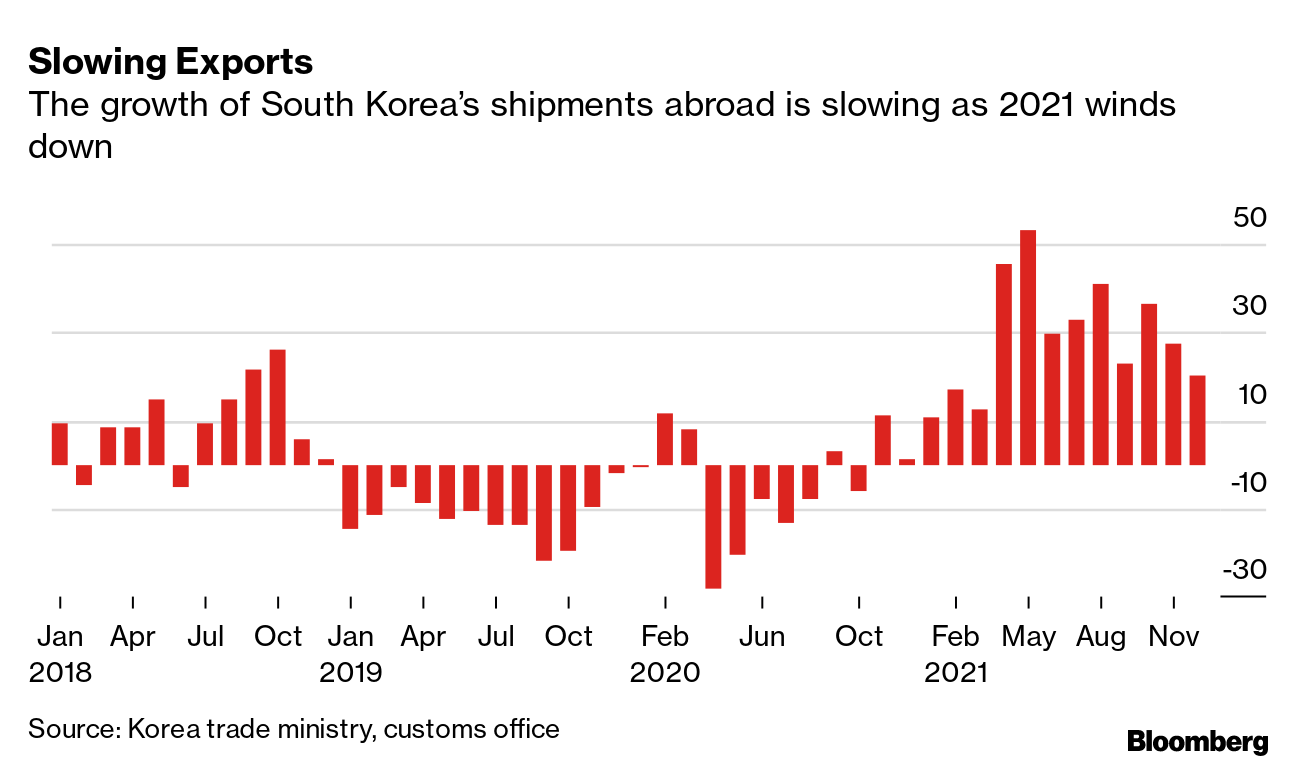
Slowing Exports

The growth of South Korea’s shipments abroad is slowing as 2021 winds down

Source: Korea trade ministry, customs office

South Korea’s export gains look set to slow this month, as supply bottlenecks disrupt shipping during a key holiday season and a spike in global Covid cases puts a damper on reopening plans overseas. Exports rose 20% in the first 20 days of December from a year earlier, according to data from the customs office released Tuesday. 

Today’s Must Reads

  • Harbor town | Across the street from America’s busiest port in Los Angeles sits the blue-collar neighborhood of Wilmington, where residents say the supply-chain chaos is disrupting daily life — and comes with fewer economic benefits to the community. 
  • Olive branch | President Joe Biden closed another chapter on his predecessor’s trade disputes with the European Union by declining to appeal an adverse World Trade Organization ruling over American tariffs on Spanish olives. Separately, the WTO said the volume of global merchandise trade fell by 0.8% in the third quarter, ending a 12-month run of solid expansion.
  • Failing grades | More than a third of Australia’s largest listed companies have poor modern slavery disclosures, indicating they don’t understand the risks in their supply chains, according to a new report. 
  • Shoe repair | Nike’s business in China plummeted last quarter, but growth in the U.S. help buoy its overall results. The world’s largest athletic brand was dealing with production delays mainly from a Covid-19 outbreak in Vietnam that shuttered factories.
  • Russia dispute | The WTO agreed to review a EU dispute complaint that alleged Russia illegally discriminated against 290 billion euros ($328 billion) worth of European goods.
  • French connection | MSC, the world’s No. 2 container shipping line, offered to buy the African transport and logistics business of Bollore SA for 5.7 billion euros including debt.
  • Small fry | McDonald’s in Japan will only offer french fries in small sizes starting Friday after flooding at a Vancouver port and the coronavirus pandemic have cut off supplies of one of its key offerings.

On the Bloomberg Terminal

  • Holiday break | The North American spot-trucking market tightened significantly last week, a move Bloomberg Intelligence attributed to drivers parking rigs before Christmas and increased precautions over the recent surge in Covid-19 cases. 
  • CEO search | The next catalyst for shares of Canadian National will be the announcement of a new CEO following the surprise retirement of J.J. Ruest, according to Bloomberg Intelligence.
  • Use the AHOY function to track global commodities trade flows.
  • Click HERE for automated stories about supply chains.
  • See BNEF for BloombergNEF’s analysis of clean energy, advanced transport, digital industry, innovative materials, and commodities.
  • Click VRUS on the terminal for news and data on the coronavirus and here for maps and charts.

Like Supply Lines?

Don’t keep it to yourself. Colleagues and friends can sign up here. We also publish the New Economy Daily, a briefing on the latest in global economics.

For even more: Follow @economics on Twitter and subscribe to Bloomberg.com for unlimited access to trusted, data-driven journalism and gain expert analysis from exclusive subscriber-only newsletters.

How are we doing? We want to hear what you think about this newsletter. Let our trade tsar know.

— With assistance by Ian C Sayson, and Albertina Torsoli

    Adblock test (Why?)


    "port" - Google News
    December 21, 2021 at 07:00PM
    https://ift.tt/30PMyZ8

    Supply Chain Latest: Philippine Tycoon Steers Ports Through Covid - Bloomberg
    "port" - Google News
    https://ift.tt/2VXul6u
    https://ift.tt/2WmIhpL

    Search

    Featured Post

    ‘Spider-Man: Brand New Day’ Post-Credits Scene Reportedly Leaks, and the Doomsday Connection Just Got Real - IMDb

    [unable to retrieve full-text content] ‘Spider-Man: Brand New Day’ Post-Credits Scene Reportedly Leaks, and the Doomsday Connection Just Got...

    Postingan Populer