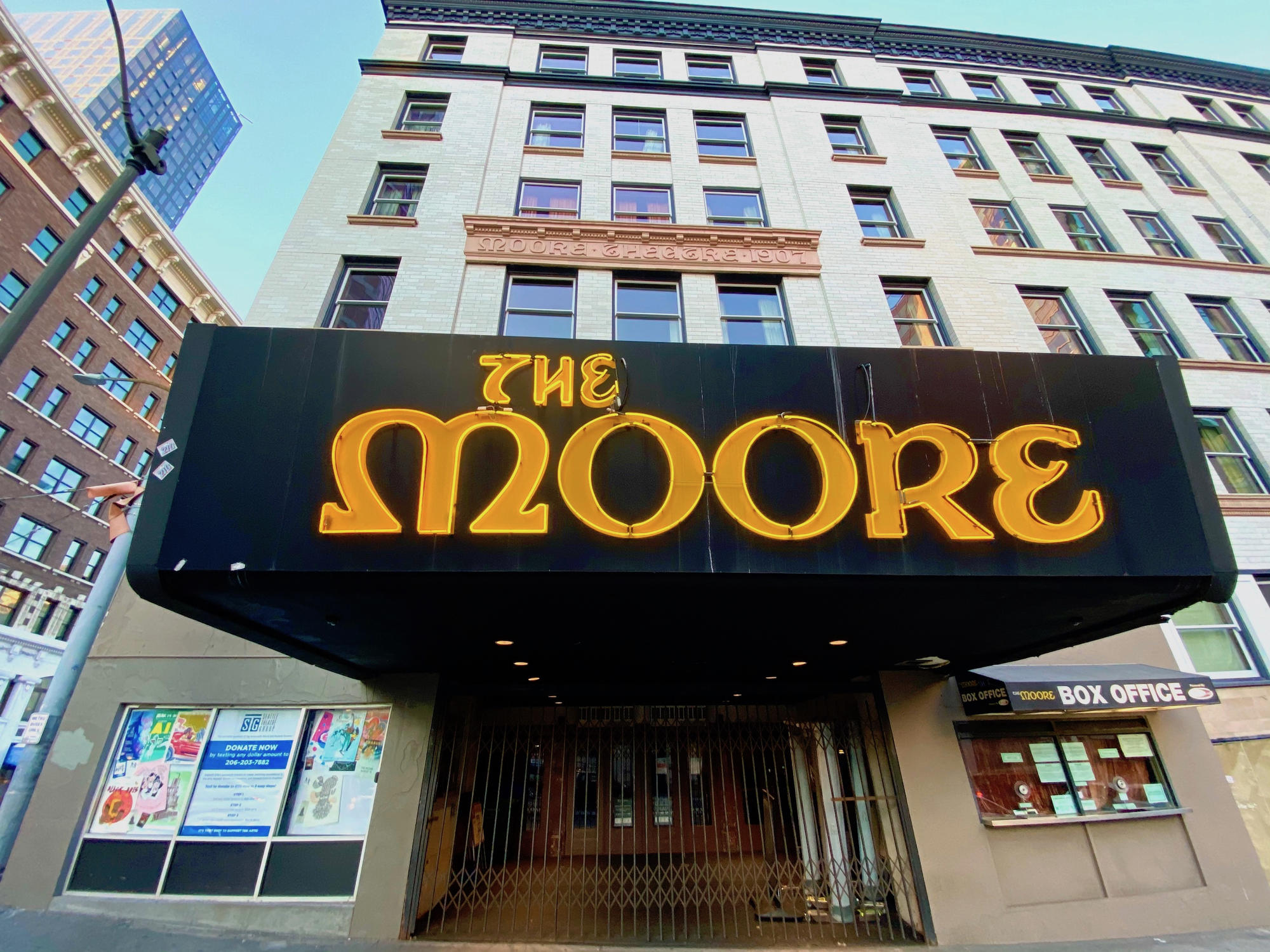
With hundreds of thousands dead nationally, it hardly seems right to whine that the music industry has been decimated, but it has much larger repercussions than just missing out on seeing a favorite band. King County is in Phase 2 of the state’s “Safe Start” reopening guidance, but nightclubs and concert venues like the Moore won’t reopen until Phase 4. This leaves live music, along with theaters and large sporting events, among the last industries set to reopen. Most in the industry think the best-case scenario for opening is spring or summer 2021.
Arts- and culture-related jobs accounted for 8.4% of our state’s gross domestic product in 2017, according to the Americans for the Arts Action Fund. In Washington, there were as many people employed in the arts (pre-pandemic) as employed by Boeing. According to the Recording Industry of America Association, the state’s music industry provided 38,000 of those jobs last year, and contributed $2.42 billion to the state economy.
Because live performance accounts for 75% of musician income, and 100% of venue income, this source of revenue has basically halted entirely. Many aspects of the economy have slowed down, but few industries have plummeted to zero — and stayed there — in the way live music has. A large proportion of those 38,000 music jobs are based in Seattle, which means this is not an insignificant hit to the city.
Multiple efforts are underway to raise awareness and funds. Nationally, the $10 billion Save Our Stages Act, which aimed to award grants to independent music venues, had bipartisan support. But that bill, even with Republican co-authorship, stalled as part of the larger bailout spending package debate.
The past spring, Seattle saw dozens of GoFundMe efforts for local clubs, mostly supporting employees at closed venues. One fundraiser for the staff at the Tractor Tavern raised $40,000. Many club owners took the initial loans from the federal Paycheck Protection Program to pay employees, but that money, along with unemployment bonuses, has long run out.
The day before I gave blood at the Moore, I joined in a Zoom call with club owners and musicians who are trying to raise funds for Washington clubs with the recently launched Keep Music Live WA campaign.
On that call was Steven Severin, co-owner of Neumos, who says that, without support, 90% of independent music venues may close by the end of the year. “Six Seattle clubs have closed so far, and every week I hear more stories,” he says. “When these venues go, they won’t come back. They will turn into condos, or Panera Breads.”
Keep Music Live WA seeks to raise $10 million to support venues that hold fewer than 1,000 guests. If those clubs go bankrupt, the local industry worries that the big concert companies with deep pockets (such as LiveNation) will be able to monopolize in post-pandemic times by buying the best of the remaining independent venues in town.
Seattle legend Sir Mix-A-Lot, one of several musicians on the Zoom call, has contributed to the cause. “This career has been given to me,” he says. “I’ve [played] venues where the venue owner didn’t make the climb up with me.” Mix saw his career rise as he gained fame and record sales, but he says the clubs he started in — though they meant everything to his success — didn’t get a financial boost for nurturing talent.
Music venues also bring customers to surrounding restaurants and establishments. “The tentacles reach really far,” says Karli Ingersoll, who runs the Lucky Lounge in Spokane.
When the pandemic first struck, there was hope it would mean a temporary pause, and that clubs could reopen, or adapt, but case numbers haven’t warranted that. Seattle’s Jazz Alley invested thousands this spring to retrofit its stage with Plexiglas barriers, and announced a series of shows in late June. But the state put the kibosh on that workaround, due to the county’s caseload and restrictions on large gatherings.
There have been some attempts at pay-per-view livestream concerts, but so far these have created only tiny amounts of revenue compared with physical concerts. Pollstar, the concert industry trade sheet, now tracks livestream view numbers, but doesn’t bother with revenue. I haven’t heard anyone, even the most tech-forward people I know, suggest that livestreams will soon replace live shows.
For musicians, playing a Zoom concert, even one that generates revenue from a digital tip jar, has challenges. “Performing virtually is just not the same,” says Tekla Waterfield. She and her husband, Jeff Fielder, have put on several successful streams, but it’s not something any musician can do every day of the week, or would want to. “Performing is all about the adrenaline that comes with the synergy between the audience and the band,” Waterfield says. “It’s community building.”
Those in the industry increasingly discuss the idea that Seattle might have few or no clubs at the end of the pandemic, but for many musicians this is simply too dark to imagine. “We try not to think about the future very much because it just hurts,” Waterfield says.
On the Keep Music Live Washington webpage, Sir Mix-A-Lot talks about how the memory of live performance stays with him long after a show. “I don’t think a lot about the gold records on the wall,” he says. “I think about the memories in the small rooms.”
The Moore is bigger than a small club, but it’s still a place rife with memories for me. I wanted to give blood to feel like I was doing something positive, but I’ll admit that the idea of being back in that space was a big part of the appeal. I hadn’t given blood in years. I’m squeamish about needles, which is partly why I closed my eyes and listened to Patti Smith. I don’t eat red meat, and run anemic, so I was certain I would be rejected. But I passed.
The donation took 15 minutes and was painless — and because all Bloodworks donations are tested for antibody markers (a free benefit to donating blood), a couple days later I learned I was negative for COVID-19. Along with staying home and always wearing a mask, giving blood felt to me like a small victory in a world with so many losses. I was almost disappointed when it was over, because with other donors slated after me, it meant I had to exit the Moore Theatre.
No one knows when live music is coming back to Seattle. The Patti Smith show from March was initially just postponed, but has since been canceled. My only shot to get in the Paramount soon might be when it hosts another pop-up blood drive in November.
When that Patti Smith concert was postponed, her name was taken down from the Paramount marquee. What went up in its place was a message that felt like a credo for music in Seattle right now, maybe a credo for many aspects of life in this unprecedented time.
“This is just intermission,” it read. “We’ll see you soon.”
"Scene" - Google News
October 08, 2020 at 07:01PM
https://ift.tt/2Fcfe3H
My heart (and arm) bleeds for the Seattle music scene - Crosscut
"Scene" - Google News
https://ift.tt/36mRPVq
Shoes Man Tutorial
Pos News Update
Meme Update
Korean Entertainment News
Japan News Update


No comments:
Post a Comment