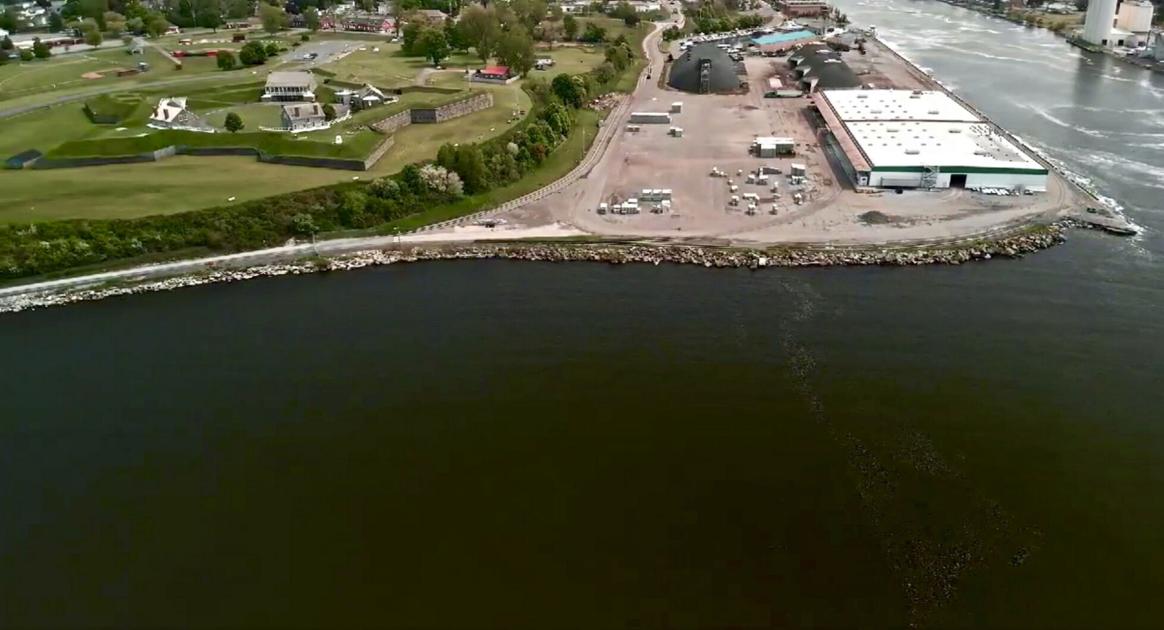
OSWEGO – When former mayor John Sullivan looks north as a future Oswego River flows through the harbor and into the Great Lake Ontario, he sees a wide-open vista, a well-developed and vibrant public waterfront from the western sculpted Breitbeck Park, the neatly-cared-for Wright’s Landing, the meditative International Pier, perhaps a restaurant, perhaps a performance center, to the classic H. Lee White Maritime Museum. To his east is the Port, quietly humming, and just beyond it, the Fort Ontario and Safe Haven National Park, whose grounds welcome a steady flow of visitors from the world over. Some come here by ferry from Kingston, Ontario. Some will visit the National Marine Sanctuary. All stay at a new hotel just east of the Fort and perhaps venture out again later into a beautiful sunset onto the water for a night of gambling.
When Bill Scriber looks over that same future river, he first sees a teeming Port of Oswego that he directed to its preeminence on the lake, massive ships coming and going, longshoreman hustling ‘round the clock, trains and trucks loading and unloading in a never-ending dance of aluminum and grain, potash and salt, silos filling, an economy growing, a bustling from east side to west side, a modern reminder of Oswego’s exalted shipping past when mills lined the river and Oswego was wealthy. He sees the marina across the river and the peaceful Breitbeck Park to its west. He sees the Maritime Museum and is proud of what the Port has done for it and what it has done for the city. And he is mindful of the Fort, the Port’s nearest neighbor, now a national park with Safe Haven on its grounds. It is all meaningful. It is all an intertwined history. And the Port and the Fort are its center.
Kevin Hill, president of Safe Haven, and Dan Laird, president of the Friends of Fort Ontario, see a future national park, a longed-for goal and financial anchor assuring their growth and stability, honoring their places in history as symbols of American military power, human kindness and protection.
All have their own future vision of this same river and lake, and all but Scriber worry that their vision may be blocked out by his. For presently, the Port of Oswego Authority, is looking to increase its capacity by building a new, and considerably larger, grain silo and 180-foot grain elevator that many are concerned may negatively impact the view from the Fort and the view and the feel of the entire waterfront, river and lake, to the extent it may even endanger national park status.
“There’s no reason for it,” Sullivan said of the Port’s east side granary plans in a recent interview. “We have had the Port, as an agency of the state, back since the early ‘50s. And more often than not, they and the city have not seen eye to eye in terms of development. I think that may be the case again today.” Looking back on the Port’s history along the river’s east side, Sullivan said, “First they built the two silos, then they built this huge, barrel-shaped dome to store potash. That great big, cigar-shaped storage facility never, never was fully utilized. It never lived up to its projected use or revenue projections. So, it was kind of a big white elephant.
“Potash? Is that the be all and end all of prime waterfront property? Storage of potash? There are a lot of higher and better ways we could use the waterfront than storage and potash. Well now, apparently, we’ve gone from potash to a proposed granary. Frankly, I question the statistics they’re relying on in the study. Where’s the grain going to come from? They’re saying mostly central and northern New York farmers. Really? I’m from Missouri. Show me.
“I don’t know why the mindset gets locked in on grain and other commodities,” Sullivan continued, “but it seems to. The point is, instead of saying, ‘Let’s build a 185-foot-high grain silo,’ a great big derrick, which will uglify, further uglify, the waterfront ambiance, just, to me, is shooting ourselves in the foot. We’ve made great strides in developing the waterfront, and so why take one step forward and two steps backward and put up the big ugly? To what extent is the community going to benefit from that?
“Yesterday, we had a conversation with the executive director (Bill Scriber),” Sullivan said, “in which he emphasized that the Port is a business. I firmly disagree. The Port is a public authority. It is not a for-profit entity. So, what should the priorities of a Port Authority be? Its emphasis on grain shipments on the east side is, I believe, a throwback to earlier days and a manifestation of the mindset, ‘If we build it, they will come.’ We’ve had experience with building things and nobody coming. I would regret the board’s repeating those mistakes of the past. I ask you,” he said recently to the Port’s board, “to take into consideration more things than you have.”
Sullivan emphasized these are his personal views. “I’m not trying to speak as the chairman of the Mayor’s Commission on the Waterfront,” he said. “I want to make it clear. I’m not speaking for the Commission.”
As executive director, Bill Scriber does speak for the Port of Oswego Authority.
“We’ve handled grain and exported grain since 2014,” he said in a recent interview. “The ship portion has become relatively more important because New York state only has one port on Lake Ontario, and most of the grain is grown within the central New York area, particularly the highest-quality soybeans. This new project includes both rail and water, which makes it more economical for farmers to make their short haul to the Port and then trans-load to a ship or rail. We’ve spent approximately $6.5 million over four years in upgrading our rail, increasing our rails. So, this isn’t just water, this is rail and water. It’s an intermodal grain system. It’s not just a silo. It’s a system.”
Scriber said federal regulations mandate the Port upgrade if it is to stay in the grain-shipping business.
“In order to export grain,” he said, “you need USDA (U.S. Dept. of Agriculture) certified scales. You need a system that takes samples, and you have to have their certified lab on site. So, a lot of this investment is so that we can meet federal regulations for grain export.”
Scriber noted a number of benefits resulting from building the planned grain system.
“We’re looking at bringing in more jobs, more commodity, and we’re trying to give farmers an alternative to export,” he said, “because now the only way you can get grain anywhere is you either truck it, which is expensive, or you rail it, and there’s only three rail sites that have any capacity. And with a new system being built, we would be able to dwarf that. We would be able to handle 20 to 30 cars a day, when most places can handle barely a dozen.”
The new silo, Scriber said, will replace one building that will be knocked down.
“We’re integrating the silo into the barrel building, which has a million-bushel capacity. So, we’re not building another silo. We’re building one silo, with a conveyor system that can draw from the barrel building and then transport to a ship. But anything we do that goes to a ship has to be USDA certified and has to go through the new scale and diverter system.”
Scriber believes the visual impact of the new silo and grain elevator will be minimal.
The width of the elevator is still in the design stages. At most, said Scriber, it will be 21 feet wide. He is urging it be turned sideways so that only a 15-foot wide elevator would face the Fort, and possibly, he said, the whole width could still be further reduced by the engineering designers. Vertically, it will rise to an elevation of 180 feet, according to the Port’s architectural drawings.
“That isn’t really a huge visual impairment when you have LaFarge (concrete storage silos), Sprague (petroleum storage silos), and Lehigh (cement facility), all on the west side of the Oswego River, right at the same line of sight,” Scriber said.
And although the drawings of the elevator’s visual impact show the elevator as black, Scriber said it will be a light blue, somewhat see-through, lattice-work construction.
“I think the argument against us isn’t being used against everything else,” he said.
As far as this plan’s financial prospects go, Scriber is extremely confident. He is quite sure the new silo “will be leased and operating when we’re done. We have a market that’s been proven,” he said. “I actually have people vying to come into the Port to operate and use it (the new grain system).”
Scriber said the Port has done everything it could, including making numerous changes, to mitigate any negative effect its plan might have on the Fort.
“We studied, we discussed, and we came up with a plan that was the least intrusive and at the only place we could put it,” he said.
“We proposed it the farthest south we could. That was the only place of the depth of the channel that we could bring in large freighters for grain. This is the minimum we could build. We could have built bigger, but we went to the lowest footprint and actually least offensive tower we could.”
But, he said, “We are a commercial port. We do not receive state funding for operations. I have between 11 and 15 full-time employees here at the Port, and I have an obligation to keep people employed and to create a better avenue for farmers to export grain. A commercial port has to have commercial business. And part of our mix is grain.”
Scriber is proud of and emphasizes the Port’s long history.
“This is called the Port City for a reason. It’s not called the Hotel City or the Marina City. It’s called the Port City. And a port operates as a commercial entity, and you have to balance the commercial entity against other interests.
“I think people don’t have the entire picture,” Scriber said. “They see a part of the picture that I think a few people in the community are pushing on social media. But it’s not as bad as everyone thinks it is. I’d love to build that tower somewhere else, but where do I build it?”
The Port is very close to ready to go on this project and is not waiting on any more permits, according to Scriber. “We’re complete,” he said.
Construction will begin in spring 2021 and be finished in July or Aug., with a company occupying the new silo, Scriber said.
“I have one point of view because I work at the Port,” Scriber concluded. “I love the Port. My passion is this Port. I’d like to see it grow. I’d like to see it be successful, because if we grow and we are successful, it’s not just for the Port, it’s for the economy. It’s for people and jobs. And that’s our mission.”
"port" - Google News
November 13, 2020 at 12:15PM
https://ift.tt/3lqQmVO
Port of Oswego takes heat over its planned granary expansion - NNY360
"port" - Google News
https://ift.tt/2VXul6u
https://ift.tt/2WmIhpL

No comments:
Post a Comment