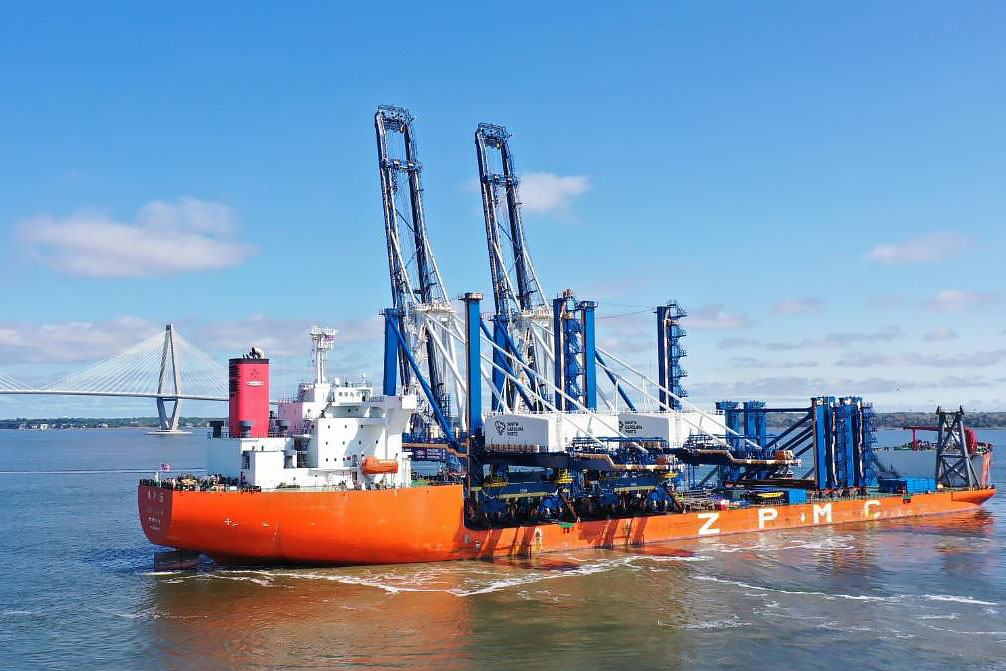
The Zhen Hua 36 arrived in Charleston carrying two SC Ports’ ship-to-shore cranes for the Hugh K. Leatherman Terminal, due to open in March 2021. Photo credit: SCPA/Walter Lagarenne.
(This story has been updated to include a statement from South Carolina Attorney General Alan Wilson)
Arguing that the master East and Gulf coast longshore labor agreement is interfering with its plans to divert services to the first new US marine terminal since 2009, South Carolina Ports Authority (SCPA) on Wednesday filed an unfair labor practice charge alleging an illegal secondary boycott in violation of the National Labor Relations Act.
The action represents a rare flare-up in what for years has been a tranquil environment at East and Gulf coast ports for longshore labor relations in contrast to the West Coast, which has seen a series of disruptive longshore labor actions since the mid-1990s that contributed to a shift in market share to the East and Gulf coasts.
Two carrier alliances — the Ocean and THE alliances — told the South Carolina Port Authority they were unwilling to agree to the port’s request to relocate four services, three serving Asia and one serving Europe, to the new $1.7 billion Hugh K. Leatherman Terminal set to open on 300 acres of a former Navy base in March, from the port’s existing Wando Welch terminal.
In refusing the port’s request to relocate, the carriers cited a clause in the master collective bargaining agreement between the International Longshoremen's Association (ILA) and the United States Maritime Alliance (USMX), the umbrella employer group that negotiates the coastwise master contract with the ILA covering ports on the US East and Gulf coasts.
That clause, originally inserted into the master agreement in 2013 and incorporated the master contract agreed to in 2018, requires that at newly opened terminals, longshore work which traditionally had been handled by nonunion employees at the state-run ports of Charleston, Savannah, and Wilmington — including operating the ship to shore cranes and yard equipment — be handled by ILA labor. The Leatherman terminal is the first test of that clause since it was incorporated into the master contract.
“This is two parties [the ILA and USMX] trying to dictate how a third party runs its business and we think that’s illegal,” said James Newsome, executive director of South Carolina Ports Authority.
Among other legal arguments, South Carolina said the provision does not apply because it was added to the master contract after the Leatherman terminal received necessary permits and construction had commenced. The port said the 2013 contract applies to ports “contemplating or intending to develop” a new container handling facility, whereas the Leatherman terminal by that point had progressed well beyond the contemplation stage.
“After the [Leatherman terminal] was permitted and construction had commenced, the ILA in 2013 belatedly added a two-part provision to its master contract with the USMX that the ILA now is claiming applies to the HLT to pressure ocean carrier customers or others to boycott the HLT in an attempt to take away the state waterfront jobs, which the SCPA believes constitutes an illegal secondary boycott of the HLT,” South Carolina Ports said in a statement.
“It’s not a new terminal as far as we’re concerned under the master contract, so that alone would disqualify the application of this clause to the Leatherman terminal,” Newsome said in an interview with JOC.com.
ILA pressures on the hyrbid model
At the port of Charleston, as well as at Savannah and Wilmington, the state port authority uses a so-called “hybrid” work model where the port authority employs a state employee workforce of crane and lift machine operators as well as heavy lift maintenance staff. Those dockworkers work alongside three crafts of the ILA — deep sea, clerks, and checkers — a system the port said has contributed to a doubling of container volume at Charleston since 2009 and is “the competitive standard for the South Atlantic port market” which is “multi-generational in nature and forms a proud heritage to be respected and appreciated.”
The ILA for its part has long sought to bring the state employee jobs into the union workforce similar to how they are at ports on the West Coast and at other major container ports within the jurisdiction of the ILA, including Houston. The union’s local leadership in Charleston, including longtime president Kenny Riley, author of a recent book on longshore labor, is supportive of the effort.
“The ILA has long aspired to perform all of the waterfront work undertaken in South Atlantic ports. This includes work historically and currently performed by the state employees of the SCPA,” South Carolina said in its statement.
Newsome said the port authority opted not to incorporate automation into the design of the Leatherman terminal and recently offered a compromise to the ILA and USMX whereby it would agree to establish four “house gangs” of ILA labor who would in effect be full-time labor paid whether or not work is to be done, addressing a longtime concern that the ILA workers, as opposed to the state workers, are a temporary workforce who only get called when work requires it.
Newsome also said the port authority is precluded by state law from entering into any collective bargaining with a union.
South Carolina Attorney General Alan Wilson, who filed the charge on behalf of the port, issued a statement emphasizing how the union action conflicts with South Carolina being a right-to-work state, the principle that allows workers the freedom to choose whether or not to join a union.
“The union is expected to follow the rule of law like everyone else,” Wilson said in the statement, issued Wednesday. “South Carolina has long been a staunch right-to-work state and the union cannot undermine our laws guaranteeing the right to work. Those laws do not permit the union to take over jobs from state employees.”
Potential implications for Savannah
The issue may come up again in Savannah, which in 2019 announced plans to expand its facilities to a 200-acre site on Hutchinson Island across the Savannah River from its existing 1,200-acre Garden City terminal, adding 2.5 to 3 million TEU of capacity. It is not clear whether that would be considered an expansion of the existing Garden City terminal or a new terminal as defined in the ILA-USMX agreement.
Longshore labor disruption has been rare on the US East Coast, and there was no immediate indication that the action by South Carolina Ports would change that. Recent instances of disruption are few and far between, including a one-day wildcat strike on Jan. 29, 2016 at the Port of New York and New Jersey and a walkout at Baltimore in Nov. 2018 that prompted the Steamship Trade Association of Baltimore to file suit in US District Court claiming members of ILA Local 333 violated the no-strike clause in the coastwide master contract when they walked off the job.
"port" - Google News
January 07, 2021 at 04:49AM
https://ift.tt/3hSXdGm
East Coast ports: South Carolina says ILA blocking liner services from new container terminal - JOC.com
"port" - Google News
https://ift.tt/2VXul6u
https://ift.tt/2WmIhpL

No comments:
Post a Comment