Congestion at the U.S. West Coast’s busiest ports is disrupting cargo coming from all of the world — not just shipments coming directly from Asia.
The situation has deteriorated to the point where Hapag-Lloyd, the world’s fifth-largest container line, has halted all bookings coming from Latin America, a region that accounted for almost a quarter of its volume in 2020.
Shipments face delays of 10 to 13 days at the Los Angeles and Long Beach ports, a spokesman for the Hamburg, Germany-based company said.
Such operational constraints “are heavily affecting our services connecting some of our Latin America import cargoes,” the carrier’s statement said. “As result, we are facing challenging trans-shipment operations and congestion in Far East and in our main hubs in Latin America including Manzanillo, Mexico.”
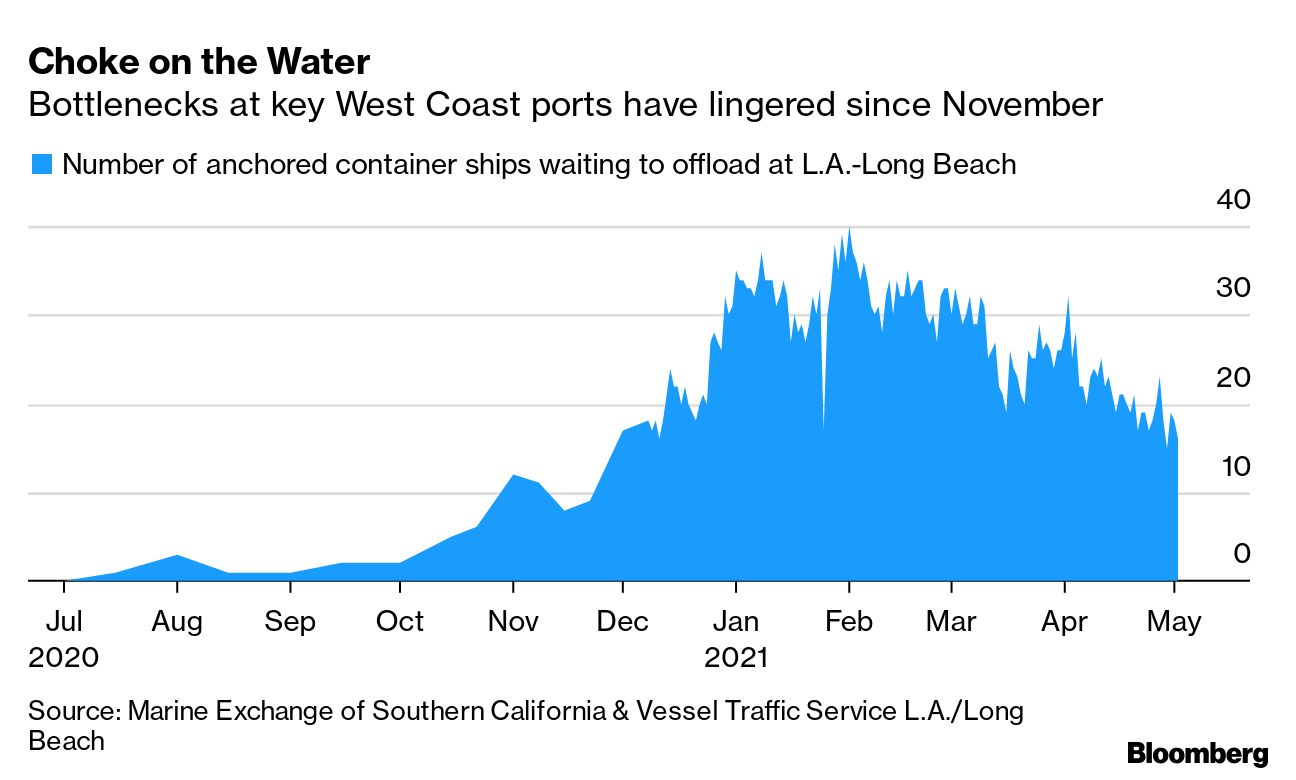
Choke on the Water
Bottlenecks at key West Coast ports have lingered since November
Source: Marine Exchange of Southern California & Vessel Traffic Service L.A./Long Beach
The stoppage in new bookings, which took immediate effect when Hapag-Lloyd announced it on April 23, affects cargo from countries including Nicaragua, El Salvador and Costa Rica, it said.
A faster-than-expected rebound in demand for goods is causing supply-chain disruptions such as container shortages and severe delays at some of the world’s busiest ports.
Still, there are signs the inbound traffic is lightening up. The number of anchored container ships waiting to offload at L.A.-Long Beach totaled 16 as of Sunday, down from 18 a week earlier and less than half the length of the queue in February.
Elevated rates may extend into the second half of the year given “very strong bookings," Hapag-Lloyd CEO Rolf Habben Jansen said last month. “I don’t see any signs around the corner that demand is falling off a cliff.”
—Maria Eloisa Capurro in New York
Charted Territory
One Direction
Commodities from food to metal are soaring
Source: Bloomberg
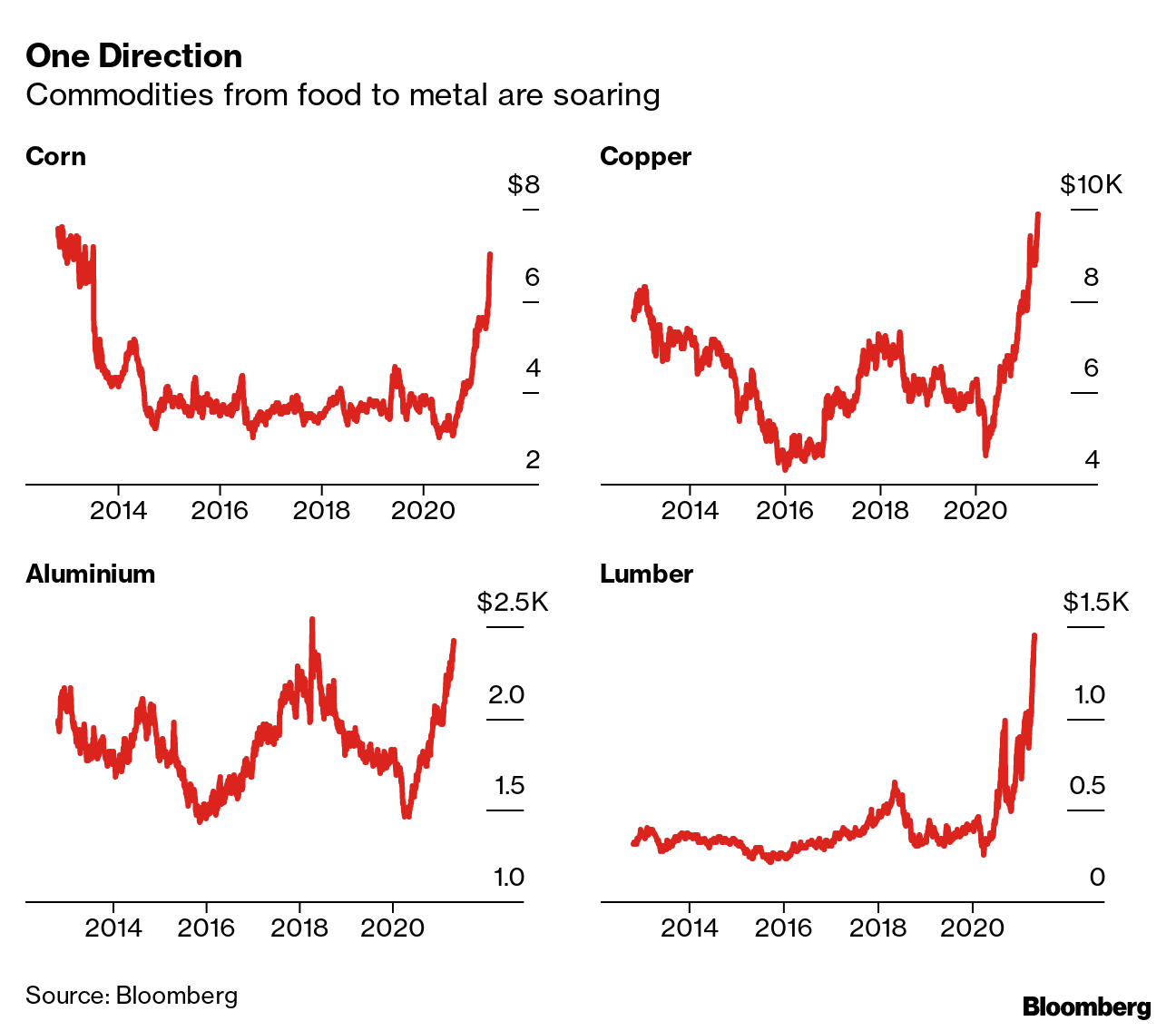
The prices of raw materials used to make almost everything are skyrocketing, and the upward trajectory looks set to continue as the world economy roars back to life.
Today’s Must Reads
- Mixed picture | Asia’s manufacturing activity remained robust through April even as a gauge of factory output in China, the region’s top economy and industrial powerhouse, showed signs of cooling. In the euro area, manufacturers are battling unprecedented delays in securing raw materials and parts, leading to a record build-up of uncompleted orders and rising prices.
- Hostage to China | Europe needs to assess its “strategic dependencies” after being caught by surprise by radical changes to supply chains during the initial phase of the pandemic last year, according to a draft EU document laying out the bloc’s future industrial roadmap. Meanwhile, Australia is reviewing whether to force a Chinese company to sell a lease to a strategically important port used by U.S. Marines, a move that could further stoke tensions with Beijing.
- IP problem | Joe Biden’s administration urged China to do more to respect the intellectual property of American companies, signaling the U.S. will maintain pressure applied under Trump to crack down on commercial crimes ranging from IP theft to counterfeiting and digital piracy.
- Stuck at sea | Singapore said it will prohibit ship crew changes for personnel with recent travel history to Bangladesh, Nepal, Pakistan and Sri Lanka.
- Trade bellwether | South Korea’s exports last month rose the most in 10 years, boosted by an increase in the number of working days from a year earlier and reflecting a recovery from the effects of the pandemic.
- Dock unblocked | Longshoremen at Canada’s Port of Montreal are back at work after lawmakers passed legislation to end a strike that added to shipping delays.
On the Bloomberg Terminal
- Lost appeal | Mexican exporter Deacero lost its appeal of the U.S. duty rate on certain entries of its steel wire rod, after the Federal Circuit the Commerce Department properly concluded the company failed to cooperate with its review. Bloomberg Law reports.
- Making calculations | Texas Instruments' decision to boost inventory in 2020, as well as better customer visibility and increased capacity, will likely help it navigate current component shortages in the chip supply-chain better than peers, Bloomberg Intelligence writes.
- Use the AHOY function to track global commodities trade flows.
- Click HERE for automated stories about supply chains.
- See BNEF for BloombergNEF’s analysis of clean energy, advanced transport, digital industry, innovative materials, and commodities.
- Click VRUS on the terminal for news and data on the coronavirus and here for maps and charts.
Like Supply Lines?
Don’t keep it to yourself. Colleagues and friends can sign up here. We also publish Balance of Power, a daily briefing on the latest in global politics.
For even more: Follow @economics on Twitter and subscribe to Bloomberg.com for unlimited access to trusted, data-driven journalism and gain expert analysis from exclusive subscriber-only newsletters.
How are we doing? We want to hear what you think about this newsletter. Let our trade tsar know.
"port" - Google News
May 03, 2021 at 06:00PM
https://ift.tt/3tecx4y
Supply Chains Latest: Latin American Cargo Hits US Port Snarls - Bloomberg
"port" - Google News
https://ift.tt/2VXul6u
https://ift.tt/2WmIhpL

No comments:
Post a Comment