Almost every facet of the vital world of logistics has been thrown into a tailspin in the past 18 months, with industry observers expecting little improvement until at least next year.
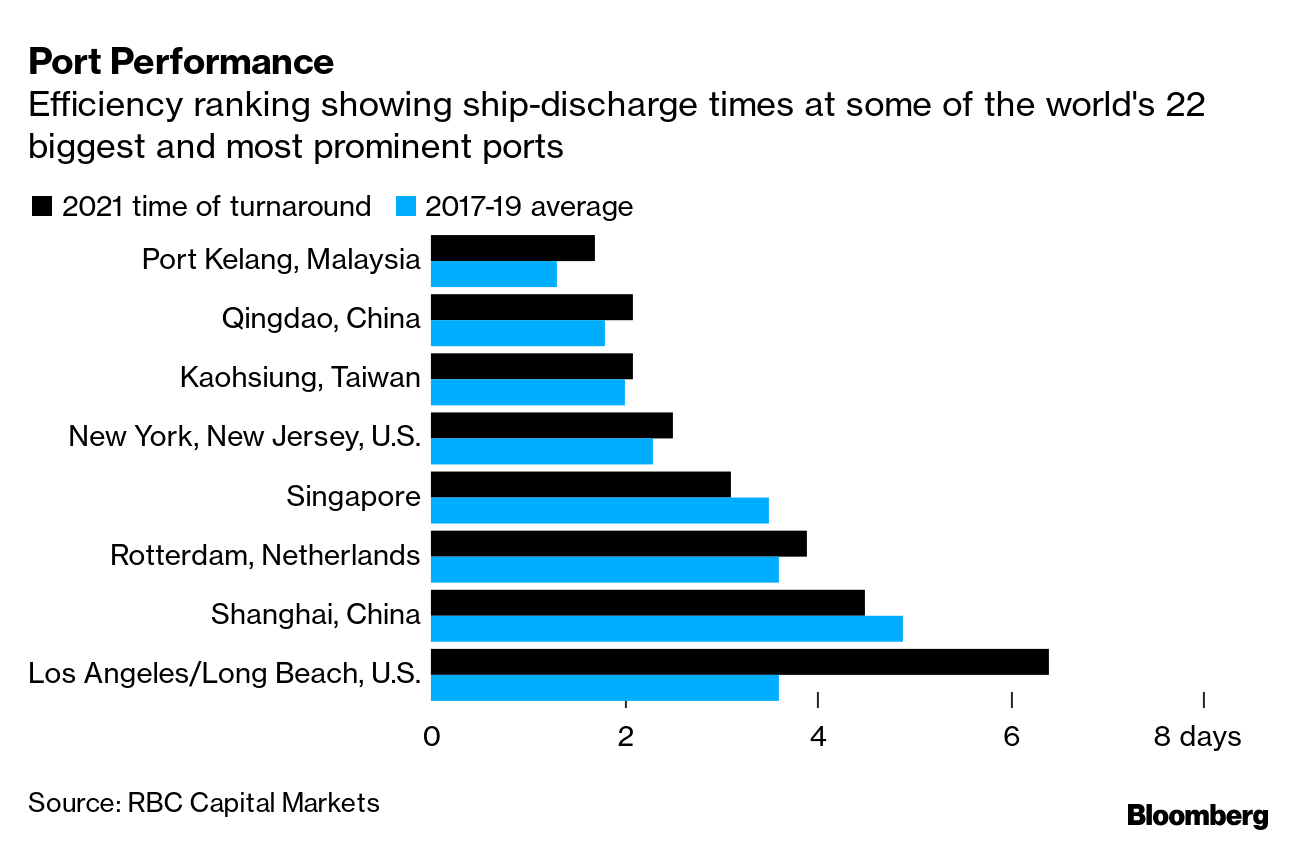
With supply chains not looking like they’re about to normalize soon, analysts at RBC Capital Markets have come up with a custom metric — known as the time of turnaround — to gauge whether global ports are increasing or decreasing container discharge times and clearing congestion.
Using near real-time geospatial intelligence including ship tracking and cell-phone location data, RBC is able to assess the pace and direction of the trends at 22 of the world’s largest and most prominent ports.
“A lot of investors — hedge funds, pension funds, mutual funds all over the world and corporations as well — they’re aware of the supply chain issues but it’s hard to quantify,” said Michael Tran, RBC’s managing director for digital intelligence strategy. “This has really caught fire with so many investors on a global basis.”
According to RBC, 77% of the ports were experiencing abnormally long times of turnaround.
The latest reading of a Bloomberg port tracker is showing similar pileups, with the number of vessels waiting to enter one of the world’s busiest ports at the highest since August.
A surge in demand for goods, logistically jumbled global container and ship positioning, shortages of longshore workers and poor port operations have all led to extended wait times at global ports, RBC’s data showed.
And while the number of ships in circulation has been relatively constant over recent years, rising about 3% annually, the exceptional demand for products has seen more containers packed onto each ship. Couple this with the longshore worker and trucker shortages, and the result is longer discharge times.
Port Performance
Efficiency ranking showing ship-discharge times at some of the world's 22 biggest and most prominent ports
Source: RBC Capital Markets
Still, the difference in performance at the world’s most prominent maritime hubs has varied greatly.
The most efficient operation is Port Kelang in Malaysia, which has handled an average of 131 ships weekly and taken 1.7 days to service each vessel compared with 1.3 days in 2017 to 2019.
Port Congestion Index Shows U.S. Import Rush Clogging Trade Hubs
The worst performance is at Los Angeles and Long Beach, where the average turnaround time almost doubled this year to 6.4 days from 3.6 in 2017 to 2019.
L.A.-Long Beach services an average of 42 ships weekly this year compared with 39 in the period from 2017 to 2019. China’s Shanghai is by far the biggest operation, handling an average of 350 ships weekly (from a 320 average in 2017 to 2019) and taking 4.5 days to service a vessel.
“What we're trying to do is increase the signal-to-noise ratio,” Tran said. “While qualitative measures can be put in place, unless our time-of-turnaround metric starts moving lower and decelerates, the plans are not working.”
—Jill Shah in New York
Charted Territory
Sisyphean Task
China's imports from the U.S. nowhere near the agreed target
Source: Bloomberg calculations based on Chinese customs data
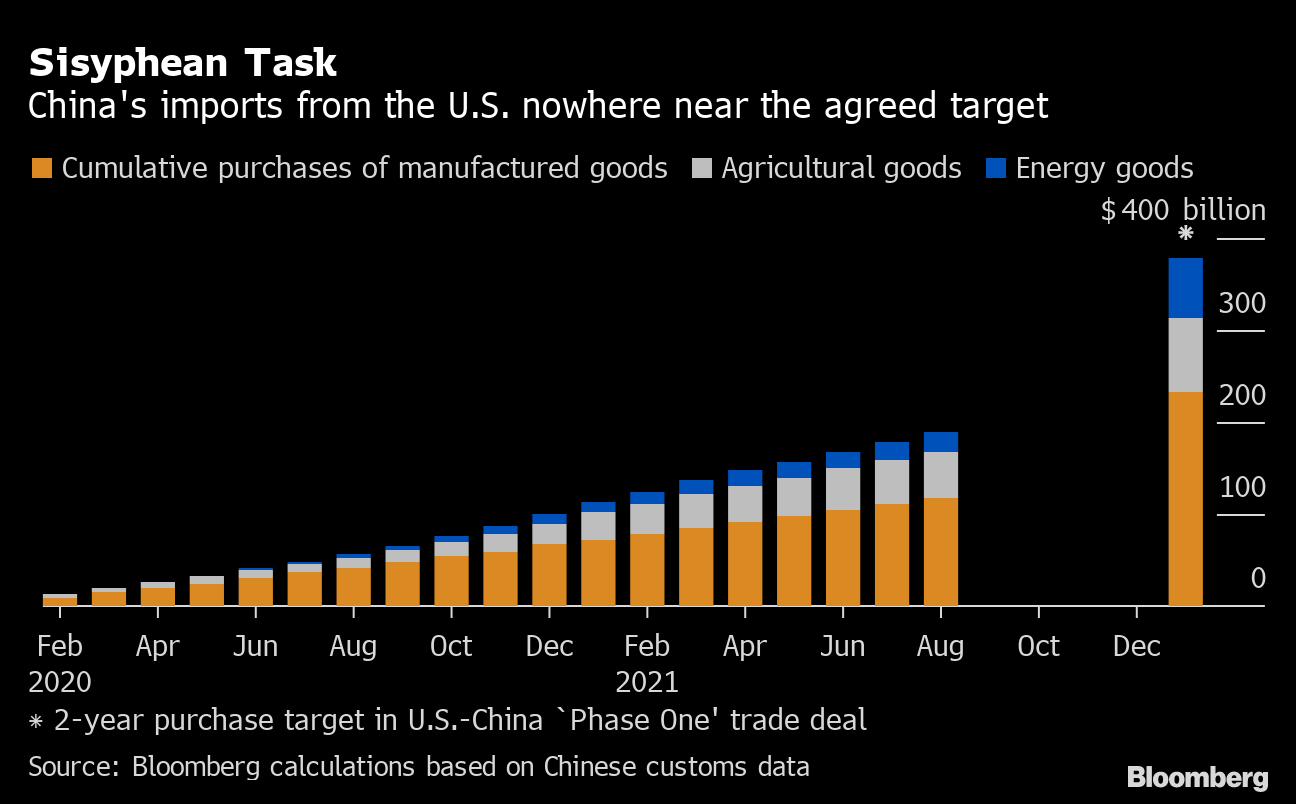
The U.S. and China are still far apart on economic and trade questions, with recent statements from both sides showing just how big that gap remains. China’s ambassador to Washington said over the weekend that Beijing wants the U.S. to stop restrictions and sanctions against its companies, outlining some of the Asian nation’s demands for future talks. That was in response to U.S. Trade Representative Katherine Tai’s comments before her call with Vice Premier Liu He, in which the U.S. raised concerns about China’s state-led support for businesses.
Today’s Must Reads
- Vietnam’s reopening | Units of Intel and Samsung Electronics are targeting to resume full operations of their Ho Chi Minh City plants by the end of November, a move that could provide relief to global supply chains.
- Mind the gap | The global trade finance gap rose 15% to $1.7 trillion in 2020 as Covid-19 sent shock waves through trade and supply chains, according to a survey conducted by the Asian Development Bank.
- Falling optimism | German investor confidence declined for a fifth month in October, adding to evidence that global supply bottlenecks and a surge in inflation are weighing on the recovery in Europe’s largest economy.
- African trade | DP World and CDC Group have formed a partnership to develop ports in Africa and committed to spending $1.72 billion on infrastructure over the next few years.
- Rift resurfaces | The U.K. and the European Union are preparing for a fresh clash over Brexit this week, with both sides set to unveil major policy proposals related to Northern Ireland. Meanwhile, France said it received the backing of Germany and nine other European Union members in its dispute with the U.K. over fishing rights, and highlighted the possibility of countermeasures.
- Bigger, better | It turns out that 2021 was a pretty good year to be an American farmer. After struggling through extreme weather, a trade war and tepid demand in recent years, things started to turn around this season as Chinese buying roared back.
- Price surges | A surge in energy and metal prices is offering investors a fresh reminder of how the commodities market can fuel inflation and imperil the post-pandemic economic recovery.
On the Bloomberg Terminal
- European outlook | Activity in the euro area is rebounding rapidly as progress on vaccinations is supporting recovery in consumer services, but the risks remain firmly to the downside amid supply snarls, according to Bloomberg Economics.
- Ripple effect | Gasoline shortages due to the global energy crunch could make beer and other carbonated drinks more costly and less fizzy, Bloomberg Intelligence writes. Tight oil-product supplies, fueled by too-few drivers and too-costly crude may stoke cost inflation for beverage producers.
- Use the AHOY function to track global commodities trade flows.
- Click HERE for automated stories about supply chains.
- See BNEF for BloombergNEF’s analysis of clean energy, advanced transport, digital industry, innovative materials, and commodities.
- Click VRUS on the terminal for news and data on the coronavirus and here for maps and charts.
Like Supply Lines?
Don’t keep it to yourself. Colleagues and friends can sign up here. We also publish the New Economy Daily, a briefing on the latest in global economics.
For even more: Follow @economics on Twitter and subscribe to Bloomberg.com for unlimited access to trusted, data-driven journalism and gain expert analysis from exclusive subscriber-only newsletters.
How are we doing? We want to hear what you think about this newsletter. Let our trade tsar know.
— With assistance by Kevin Varley
"port" - Google News
October 12, 2021 at 06:00PM
https://ift.tt/3oTz8ot
Supply Chain Latest: Port Trackers Highlight Global Logjams - Bloomberg
"port" - Google News
https://ift.tt/2VXul6u
https://ift.tt/2WmIhpL

No comments:
Post a Comment