Economic policy making is not easy and supply chains are complicated. But when President Joe Biden last week said he was contemplating calling in the National Guard to help clear the backlog of containers at California’s ports, he was latching on to a simple solution for at least one thing that ails the American economy today.
Supply chains run on logistics. Armies need to be good at logistics. Having well-oiled supply lines is an essential component of any general’s military strategy. You need to keep your soldiers fed and clothed and armed in any war. You must have trucks to move your battalions.
Read More: Long Beach Eases Container Rules Amid ‘National Emergency’
So if one of the biggest challenges now facing economic policy makers is how to control consumer prices rising more stubbornly than expected thanks to the clash between unleashed pent-up consumer demand and supply-chain choke points, then isn’t one good prescription sending in the army to help clear those bottlenecks?
There are longer term issues that America needs to ponder. Maybe just-in-time manufacturing should be revisited. Maybe it’s time for a broader industrial policy push to build national capacity in certain components. Maybe the U.S. needs a strategic stockpile of computer chips. It certainly seems like investing more in port infrastructure is worthwhile. And that it’s time to pay truckers a living wage and examine the absurd conditions they operate under.
Read More: U.K. Puts Army Drivers on Standby Amid Fuel Crisis
But in the short term it’s hard to identify a more basic solution to America’s supply chain crisis — and the inflation it is feeding — than bringing in military trucks and the GIs to drive them. It may do more to tame inflation without curtailing growth in a fragile recovery than pulling traditional economic policy levers and raising interest rates, for one.
The debates over what the best courses are for fiscal, monetary, and industrial policy will continue long after the current episode is done. For now, though, raise the bugle. Call in the troops. In this emergency it seems like simple and sound economic policy.
—Shawn Donnan in Washington
Charted Territory
Recovery Slows
China's on-quarter growth momentum weakens to 0.2%
Source: National Bureau of Statistics
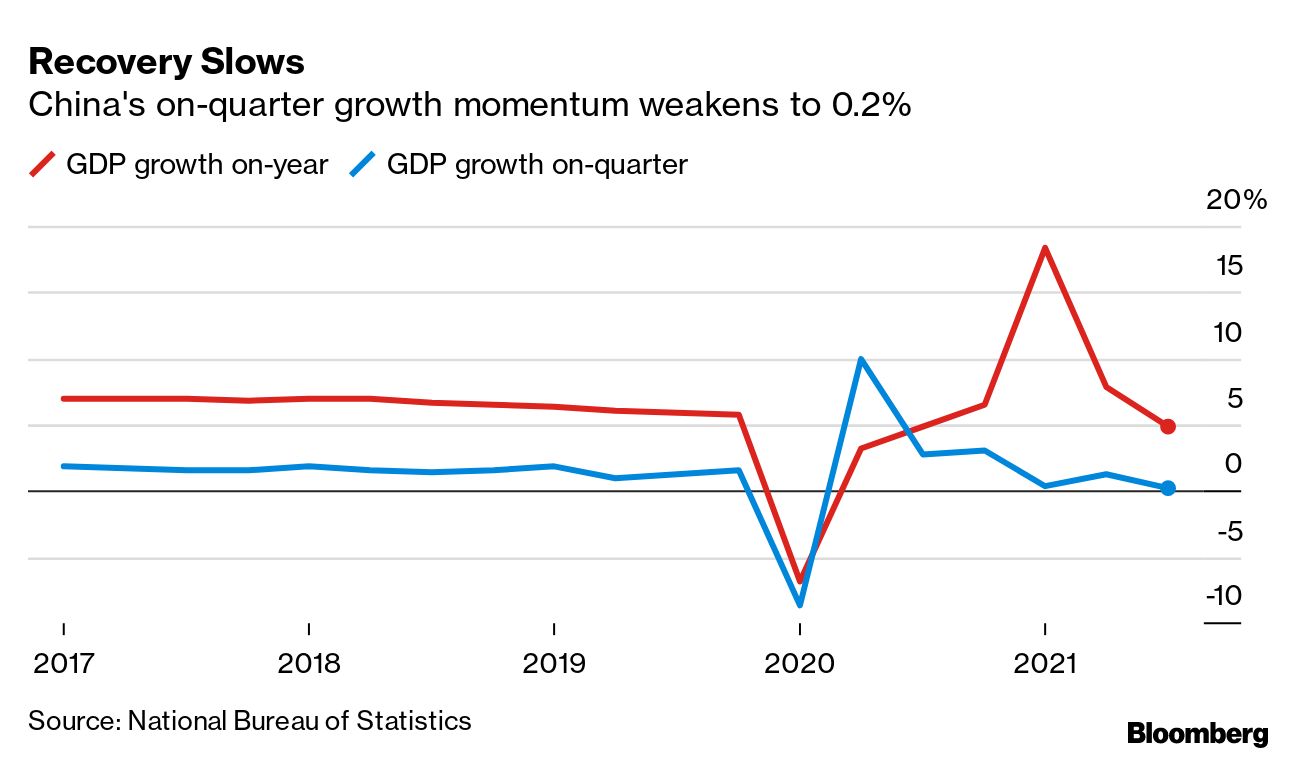
China’s economy continues to cool as the nation’s housing slump intensifies, while supply-chain bottlenecks are keeping a tight grip on the recoveries in the U.S. and Europe. The resulting inflation is pressuring global central bankers, including those at the Bank of England, to tighten monetary policy. Click here to see some of the Bloomberg charts that illustrate he latest developments in the global economy.
Today’s Must Reads
- Under control | Treasury Secretary Janet Yellen said she expects price increases to remain high through the first half of 2022, but rejected criticism that the U.S. risks losing control of inflation.
- Pocketbook pinch | Consumers around the world are about to get socked with even higher prices on everyday items, companies from food giant Unilever to lubricant maker WD-40 warned as they grapple with supply difficulties.
- Rescued ship | A fire aboard a container vessel near British Columbia has been brought under control, Canada’s coast guard said after evacuating most of the crew and establishing a safety perimeter in the area amid concern about floating debris and air quality.
- Kind of blue | A Dutch paint maker is running out of ingredients to make some shades of blue, the latest fallout from the global supply-chain disruptions that are spreading across manufacturers.
- Out of gas | Fuji Oozx is one of hundreds of automotive-parts suppliers in Japan whose very existence is being threatened by the world’s shift toward electric vehicles. For almost 70 years, the company has been making intake valves, an essential component of any gasoline-powered car.
- Wipeout | The owner of Vans sneakers and the Supreme streetwear brand reported earnings that fell short of Wall Street’s expectations, citing port congestion and ongoing coronavirus outbreaks that have constrained suppliers. Separately, Continental lowered sales and profit guidance after the semiconductor shortage and other supply-chain snarls intensified.
On the Bloomberg Terminal
- Food frustrations | General Mills, Campbell Soup, Mondelez, Keurig Dr Pepper and Kraft Heinz are among the food and beverage companies that will continue to be affected by labor shortages constraining supply chains.
- Radio check | In this week’s episode of Bloomberg Intelligence radio, logistics analyst Lee Klaskow notes that trucker sentiment is driving bullish rate expectations.
- Use the AHOY function to track global commodities trade flows.
- Click HERE for automated stories about supply chains.
- See BNEF for BloombergNEF’s analysis of clean energy, advanced transport, digital industry, innovative materials, and commodities.
- Click VRUS on the terminal for news and data on the coronavirus and here for maps and charts.
Like Supply Lines?
Don’t keep it to yourself. Colleagues and friends can sign up here. We also publish the New Economy Daily, a briefing on the latest in global economics.
For even more: Follow @economics on Twitter and subscribe to Bloomberg.com for unlimited access to trusted, data-driven journalism and gain expert analysis from exclusive subscriber-only newsletters.
How are we doing? We want to hear what you think about this newsletter. Let our trade tsar know.
"port" - Google News
October 25, 2021 at 06:00PM
https://ift.tt/3Eddxfg
Supply Chain Latest: Using the Military to Ease Port Congestion - Bloomberg
"port" - Google News
https://ift.tt/2VXul6u
https://ift.tt/2WmIhpL

No comments:
Post a Comment