Gauging whether the logjams at the U.S.’s busiest gateway for trade are improving or not depends who you ask.
Port of Los Angeles Executive Director Gene Seroka on Friday said the number of aging containers sitting on the docks awaiting collection had dropped 60% since the port announced it plans to charge ocean carriers penalties on Oct. 25.
Speak to the Harbor Trucking Association CEO Matt Schrap, and the picture looks different — empty boxes are now clogging up space elsewhere, including on chassis that are hooked onto trucks.
Read More: Port Snarls Show Mixed Results Getting Unclogged
“For us, it’s gotten a little more strained, to be honest,” Schrap said. “Right now, we’re literally storing thousands of empty containers, thousands of chassis that we can’t use to move these imports.”
There are more than 115,000 empty containers in the Los Angeles port waiting to return to their point of origin and that’s “on top of another over 10,000 containers that are out in the wild, so to speak, across the Southwest United States, in our truck yards on the streets, grounded, sitting on chassis all over the place,” he said.
The issue is restrictions on empty-container returns, Schrap said. Trucks need a chassis to collect import-laden containers, but unless they bring an empty container to free up the chassis, they’re unable to move the import, he said. Los Angeles is also not operating fully around the clock, further undermining efforts.
Read More: Every Step of the Global Supply Chain Is Going Wrong
The chokepoint is one of
many bottlenecks in the complex global supply-chain web that have contributed to delays, shortages of some goods and faster inflation worldwide. In the U.S., Americans’ concern over rising prices contributed to a fresh low in President Joe Biden’s approval rating, with the leader making a debut appearance on a late-night TV show Friday to tamp down the fears.Still, Biden and port envoy John Porcari’s efforts to address the blockages by getting ocean carriers, terminal operators, truckers, and government officials around the table are “unprecedented,” Schrap said, adding that they’re doing “a great job.”
— Ana Monteiro in Washington
Charted Territory
A Logistical Nightmare
Transport, warehouse and inventory costs rose close to records in the U.S.
Source: Logistics Managers' Index
*The LMI is a diffusion index where 50 is the dividing line between expansion and contraction.
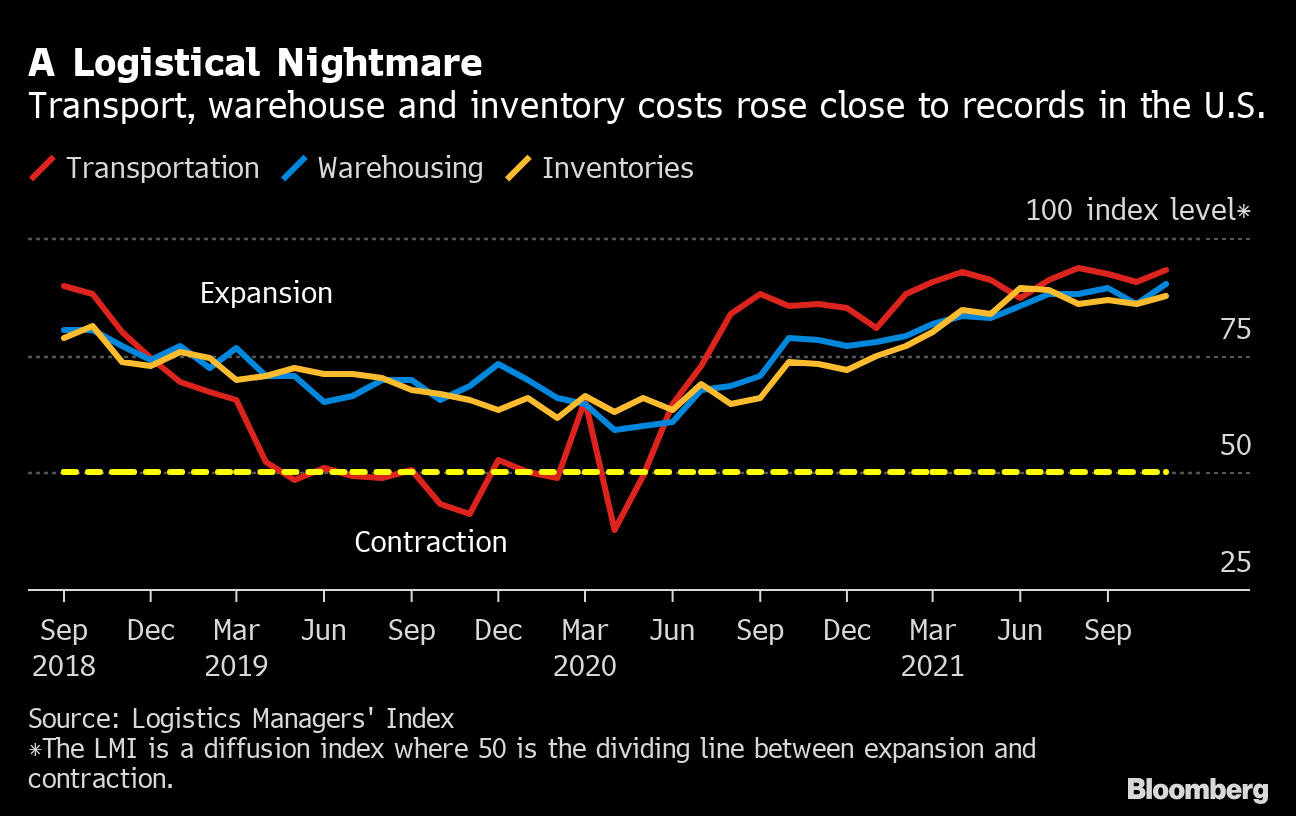
The monthly U.S. Logistics Managers’ Index released last week showed continued strains in supply chains. The gauge climbed for a second month in November, reflecting warehouse costs that jumped to a record, as well as rising inventory and transportation expenses and survey respondents don’t anticipate any significant relief over the next 12 months.
Today’s Must Reads
- Biggest 2022 risks | Economists have struggled to see ahead in the pandemic. They’re upbeat about next year, but could easily get blindsided again.
- Price point | President Joe Biden said that despite experiencing the most rapid inflation in almost 40 years in November, U.S. price increases have peaked and will decelerate more rapidly than Americans expect.
- Fishing licenses | The U.K. has issued additional fishing licenses for European Union boats, in a step that may signal some progress toward resolving the post-Brexit dispute in which the two sides are engulfed.
- Next risk | Chinese seafarers weary of the pandemic are returning home to celebrate the Spring Festival early next year, adding to a shortage of truckers and port workers in the country that’s compounding snarls in global supply chains.
- Rescue robots | Santa Claus is getting a bunch of help from robots this Christmas, as one of the world’s biggest supply-chain firms rushed to add automation to its U.S. operations ahead of the holidays.
- Battery frenzy | Demand for Murata Manufacturing’s lithium-ion batteries is so strong the Japanese firm can’t make enough of them for its own use. But inflated freight costs mean the business is likely to record a loss this year, yet another victim of the ongoing supply-chain chaos.
- U.S.-Asia trade | The Biden administration aims to sign what could prove a “very powerful” economic framework agreement with Asian nations — focusing on areas including coordination on supply chains, export controls and standards for artificial intelligence — next year, Commerce Secretary Gina Raimondo said.
On the Bloomberg Terminal
- Contract breach | Anchorage, Alaska, showed that the U.S. Maritime Administration breached a contract to upgrade facilities at the Port of Anchorage that ended with “project failure,” the U.S. Court of Federal Claims ruled, Bloomberg Law reports.
- Pain passing | Asia’s supply-chain pain may have passed its worst and it looks set to ease further entering 2022, partly due to cheaper fuel, Bloomberg Economics says. Yet bottlenecks may remain due to port congestion and the omicron variant.
- Use the AHOY function to track global commodities trade flows.
- Click HERE for automated stories about supply chains.
- See BNEF for BloombergNEF’s analysis of clean energy, advanced transport, digital industry, innovative materials, and commodities.
- Click VRUS on the terminal for news and data on the coronavirus and here for maps and charts.
Like Supply Lines?
Don’t keep it to yourself. Colleagues and friends can sign up here. We also publish the New Economy Daily, a briefing on the latest in global economics.
For even more: Follow @economics on Twitter and subscribe to Bloomberg.com for unlimited access to trusted, data-driven journalism and gain expert analysis from exclusive subscriber-only newsletters.
How are we doing? We want to hear what you think about this newsletter. Let our trade tsar know.
"port" - Google News
December 13, 2021 at 07:00PM
https://ift.tt/3ypAgmG
Supply Chain Latest: US Truckers Say West Coast Port Logjams Worsen - Bloomberg
"port" - Google News
https://ift.tt/2VXul6u
https://ift.tt/2WmIhpL

No comments:
Post a Comment