The floodwaters are receding and roads and rail lines are being repaired. But it’s still likely to take weeks for Canada’s biggest port to work through its backlog of cargo and vessels after historic rainfall left British Columbia soaked and isolated.
Storms dropped enormous volumes of rain on the province in November, forcing evacuations, drowning hundreds of thousands of livestock, and temporarily cutting off Vancouver from the rest of the country by road and rail.
Ever since, the two major freight railways — Canadian National and Canadian Pacific — that carry about two-thirds of the cargo that’s transported by land to the Port of Vancouver have fixed the lines and are working to keep them open.
They’re running again, albeit slowly. The deluge also caused the Trans Mountain Pipeline, the sole oil conduit running from Alberta to the B.C. coast,
to shut for three weeks. The government imposed emergency fuel rationing on Nov. 19, though that should be lifted soon.Data from the Vancouver port’s mobile app show that half of the 88 vessels at port are awaiting berths on Monday afternoon, with many anchored on the other side of the Strait of Georgia, along the Vancouver Island coast. The port has 28 deep-sea anchorages.
Robin Silvester, the port’s chief executive officer, told BNN Bloomberg Television that the bottleneck has caused ripple effects across Canada, primarily because of the woes on the railway, which he called the “lifeblood of the system.” Typically, C$700 million ($548 million) worth of cargo goes through the port each day, he said.
The Port of Vancouver operates 29 terminals that load and unload goods ranging from vehicles to grain to petroleum. To ease supply-chain problems that have been exacerbated by the extreme weather, a 40-acre site is being prepared to temporarily handle and store empty containers.
— Marcy Nicholson in Winnipeg
Save the Date

Join Bloomberg Intelligence’s freight transportation 2022 outlook briefing with BI senior analyst Lee Klaskow, Christian Wetherbee of Citi Research and Amit Mehrotra of Deutsche Bank, on Dec. 9 at 11 a.m. New York time. Register here.
Charted Territory
STMicro’s Global Network of Facilities
Malaysia is a key player in the world’s semiconductor pipeline
Sources: STMicroelectronics, Bloomberg
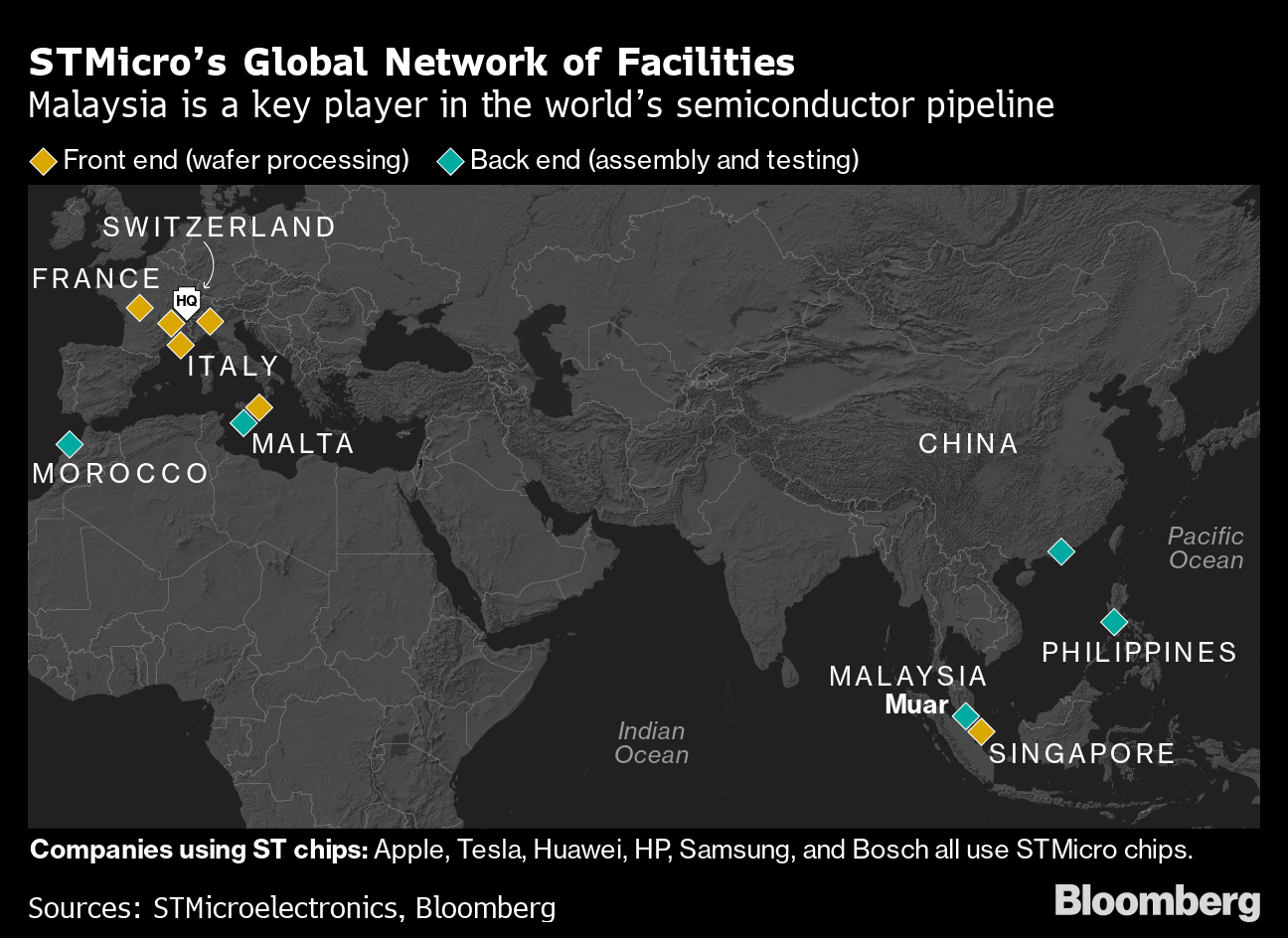
The world’s relentless demand for microchips has taken a human toll in places like Malaysia, where authorities — like those in many other countries — were concerned about keeping their economy on track during the pandemic. So they granted chipmakers exemptions while much of the country locked down. While companies and governments push to keep supply chains running, ordinary people are the ones putting their lives at risk. Read the Bloomberg Big Take story here.
Today’s Must Reads
- Solid demand | China’s exports and imports grew faster than expected in November, with both hitting records as external demand surged heading into the year-end holidays and domestic production rebounded on an easing power crunch.
- New plant | Toyota will break ground on its first battery factory in the U.S. at a mega-site in North Carolina, joining an industrywide push as automakers accelerate efforts to electrify their fleets.
- Inflame tensions | The European Union warned U.S. congressional leaders and the Biden administration that the aggressive use of electric-vehicle credits in the pending Build Back Better Act could run afoul of international trade rules and create “friction” in the transatlantic relationship. Meanwhile, the EU has yet to unveil its new proposal for an anti-coercion trade tool to safeguard the bloc’s geopolitical interests, but it’s already facing skepticism.
- State by state | The U.K. is moving forward on trade engagement with individual American states, and stands ready to resume talks with Washington on a broader federal deal, Secretary of State for International Trade Anne-Marie Trevelyan said.
- Germany’s slump | Olaf Scholz is about to become chancellor of an unhealthier German economy than the one he looked set to inherit when his party won elections in late September, after data underscored the deterioration in Europe’s biggest economy.
- Sanctions option | The U.S. and European allies are weighing sanctions targeting Russia’s biggest banks and the country’s ability to convert rubles for dollars and other foreign currencies should President Vladimir Putin invade Ukraine, according to people familiar with the matter.
- Grocery battles | Almost four years after Amazon opened its first cashier-less stores, the e-commerce behemoth is a long way from conquering Main Street. But a strategy is gradually emerging that could make Jeff Bezos & Co. a deluge of profit from the concept without opening another store. That’s because selling groceries isn’t a great business these days. Selling software, however, often is.
On the Bloomberg Terminal
- Very tight | In the euro area, a Bloomberg Economics gauge shows supply conditions are still getting worse. Given the long lag between price increases early in the production process and final consumer goods prices, there's no sign that relief is nearing.
- Plunging orders | North American heavy-truck orders plunged 82% in November to 9,500 units, according to FTR, suggesting the supply chain has yet to show signs of improvement and is likely to remain a near-term production risk, Bloomberg Intelligence reports.
- Use the AHOY function to track global commodities trade flows.
- Click HERE for automated stories about supply chains.
- See BNEF for BloombergNEF’s analysis of clean energy, advanced transport, digital industry, innovative materials, and commodities.
- Click VRUS on the terminal for news and data on the coronavirus and here for maps and charts.
Like Supply Lines?
Don’t keep it to yourself. Colleagues and friends can sign up here. We also publish the New Economy Daily, a briefing on the latest in global economics.
For even more: Follow @economics on Twitter and subscribe to Bloomberg.com for unlimited access to trusted, data-driven journalism and gain expert analysis from exclusive subscriber-only newsletters.
How are we doing? We want to hear what you think about this newsletter. Let our trade tsar know.
— With assistance by Robert Tuttle
"port" - Google News
December 07, 2021 at 07:00PM
https://ift.tt/31FKmDC
Supply Chain Latest: Vancouver Port Emerges From Flood Crisis, Slowly - Bloomberg
"port" - Google News
https://ift.tt/2VXul6u
https://ift.tt/2WmIhpL

No comments:
Post a Comment